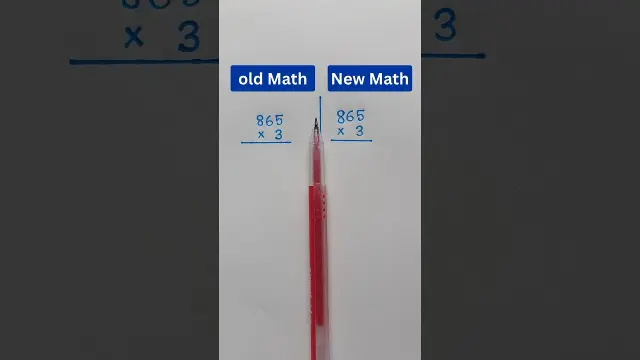
 Old Versus New Math: Comparing US Multiplication Methods
#Math Teaching
2 ideas
Old Versus New Math: Comparing US Multiplication Methods
 Five Practical Tips for Using Guided Notes in Middle School Math
Get new #Math Teaching ideas by email
Every Thursday: the week's best ideas, with the newest from #Math Teaching.
Related tags
A Beginner's Guide to Teaching Math with Confidence
Teaching math is the craft of helping someone move from following a rule to understanding why the rule works. It sounds simple and rarely is. Math is one of the few subjects where a learner can produce correct answers for years while quietly missing the ideas underneath, and part of the teacher's job is to notice that gap and close it early.
What math teaching covers
The work spans far more than explaining procedures. A math teacher chooses what to work on and in what order, designs problems that make a concept visible, watches how students reason, gives feedback that moves thinking forward, and builds a classroom where being wrong is a normal step rather than a failure. Underneath all of it sits the goal of fluency: a learner who can compute accurately, explain their reasoning, and use the idea in an unfamiliar situation.
The main approaches
Read more
Most teaching sits somewhere between two poles. Explicit instruction presents a concept clearly, models it, and gives students guided practice before they work alone. Inquiry-based approaches start with a problem or a question and let students build the idea themselves, with the teacher steering rather than telling. Neither wins everywhere: new material and struggling learners often benefit from clear, structured explanation, while rich tasks and discussion deepen understanding once the basics are in place. Concrete, pictorial, abstract sequencing — objects, then drawings, then symbols — helps many learners make the leap to abstraction.
Where beginners should start
- Know the concept, not just the algorithm. If you can explain why a shortcut works, you can answer the question a student will actually ask.
- Prepare the examples and non-examples in advance. Contrast is what makes a definition stick.
- Plan the questions you will ask, especially the ones that probe reasoning rather than answers.
- Expect misconceptions. Wrong answers usually follow a consistent logic, and finding that logic is more useful than marking the answer incorrect.
- Keep routines predictable so the thinking itself is what feels new.
Practical tips
Ask students to explain their reasoning aloud or in writing; the explanation reveals understanding in a way that a correct answer does not. Wait after asking a question — a few seconds of silence gives more people time to think. Use mistakes publicly and without blame, treating them as information rather than embarrassment. Build in retrieval practice, revisiting earlier material in short bursts, because mathematics accumulates and old skills quietly fade. Connect ideas to real contexts where you honestly can, but do not force a story onto everything; abstract reasoning is a skill worth practising on its own terms.
Be patient with yourself as well. Teaching math well is learned mostly through teaching, reflecting, and adjusting, and every group of learners will teach you something the last one did not.
#Math Teaching: frequently asked questions
How do I start teaching math if I've never taught it before?
Begin with one small topic you can explain from the ground up, not just perform, and prepare your examples alongside a few non-examples so the boundary of the idea is visible. Plan the questions you'll ask before the lesson, especially the ones that ask a learner to explain their reasoning rather than just give an answer. Keep your routines predictable so the new thinking is the only unfamiliar part.
What do I actually need to prepare before a math lesson?
You need a clear sense of the concept behind the procedure, a set of examples and deliberately contrasting non-examples, and a short list of questions that probe how someone is thinking. It also helps to anticipate the likely misconceptions so you can recognize the logic behind a wrong answer instead of simply marking it incorrect. Nothing elaborate is required beyond that.
Should I explain the method first or let students discover it?
Neither approach wins everywhere, so the honest answer is that it depends on the learner and the topic. Clear, structured explanation with guided practice tends to serve new material and students who are struggling, while open problems and discussion deepen understanding once the basics are solid. Many teachers move along a path from physical objects to drawings to symbols, which gives learners something concrete to hold onto before abstraction.
How do I help someone who gets the right answer but doesn't understand it?
Ask them to explain their reasoning aloud or in writing, because the explanation exposes the gap that a correct answer hides. Then work backward from the shortcut or rule they're using and show why it holds, since understanding the reason is what lets them apply the idea somewhere unfamiliar. Short, regular revisits of earlier material matter too, because skills fade quietly.
What are the most common mistakes when teaching math?
Treating a wrong answer as the end of the conversation instead of the start of one is the biggest, since most errors follow a consistent internal logic worth uncovering. Another is rushing past the wait time after a question, which quietly limits how many people actually think. Forcing a real-world story onto every concept is a lesser but real one, because abstract reasoning is worth practising on its own terms.
How do I make a math lesson stick?
Build in retrieval practice by bringing earlier material back in short bursts rather than assuming it's retained. Make mistakes public and blameless so being wrong becomes ordinary information rather than embarrassment, and ask for reasoning out loud so understanding is visible. Teaching well is mostly learned through teaching, reflecting, and adjusting, so expect each group of learners to teach you something new.
Videos come from YouTube and posts from Instagram; titles and summaries are our own. All rights belong to their creators.