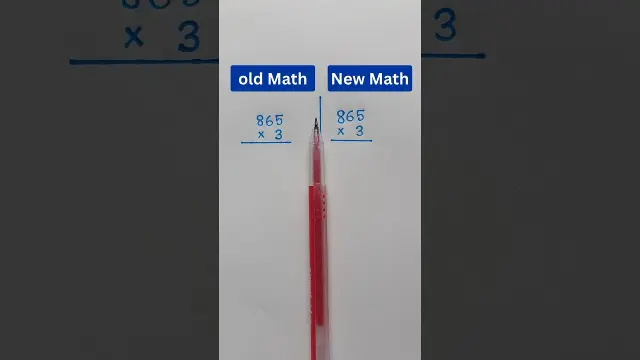
 Old Versus New Math: Comparing US Multiplication Methods
#New Math
1 ideas
Old Versus New Math: Comparing US Multiplication Methods
Get new #New Math ideas by email
Every Thursday: the week's best ideas, with the newest from #New Math.
Related tags
New Math: How Numbers Are Taught Today
"New math" is one of those phrases that gets used in two different ways, and it helps to know which one you are looking at. Historically, it refers to a curriculum reform that spread through schools in the late 1950s and 1960s, when lessons were rebuilt around sets, number bases and the underlying logic of mathematics rather than drilling alone. Today, most people use the term more loosely, to describe the methods their children bring home from school: strategies for place value, breaking numbers apart, and explaining the reasoning behind an answer.
Two meanings, one idea
The older reform faded, but the instinct behind it never quite left. Most modern primary curricula share a goal with it: to help you see why a procedure works, not only to produce the right digits. That is why a child may come home multiplying in a way that looks nothing like the method you were taught.
How the methods differ
Read more
The traditional approach tends to teach one reliable procedure and then practise it until it is automatic. You line numbers up, carry and borrow, and repeat the steps. It is compact and efficient once learned.
Modern teaching usually introduces several strategies first, then works towards an efficient one. Typical examples include:
- Splitting numbers by place value, so a multiplication becomes a sum of easier products.
- Drawing arrays or grids to show what multiplying actually represents.
- Number bonds and fact families, which build fluency with small numbers before larger ones.
- "Making ten" and other regrouping tricks for mental addition and subtraction.
- Estimation before calculating, so you can tell whether an answer is plausible.
Why it looks so different
The written work is often longer, because the reasoning is written down rather than hidden. When a child decomposes a number into tens and ones, the paper fills with intermediate steps that an adult never needed to show. That can look like a step backwards, but it is usually scaffolding — something to be removed once the understanding is secure.
What beginners should know
If you are helping someone learn, or learning yourself, a few principles hold up well:
- Understanding and fluency are not rivals. Ideas first, then speed, is the usual order.
- Let the learner explain their method out loud. The explanation is where misconceptions surface.
- Keep one familiar method in reserve so nobody is stuck when the reasoning gets hard.
- Nobody has to abandon the way they were taught. If an old method is accurate and the child can use it confidently, it is still a good method.
- Watch for signs a child is guessing at rules. A quick "why does that work?" sorts this out faster than more practice.
The friction between old and new math is mostly a translation problem. Once you can read the newer written steps, the arithmetic underneath is the same one you already know.
Videos come from YouTube and posts from Instagram; titles and summaries are our own. All rights belong to their creators.