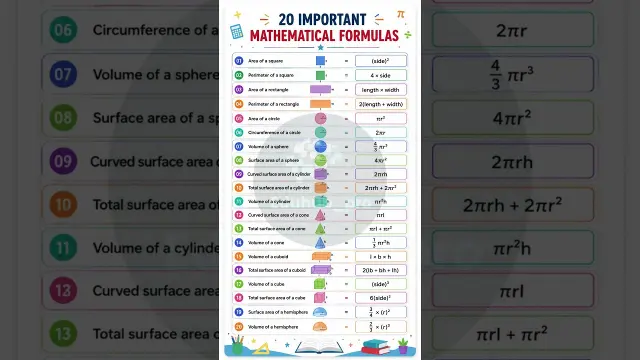
 Twenty Important Mathematical Formulas for Quick Revision
#Mensuration
2 ideas
Twenty Important Mathematical Formulas for Quick Revision
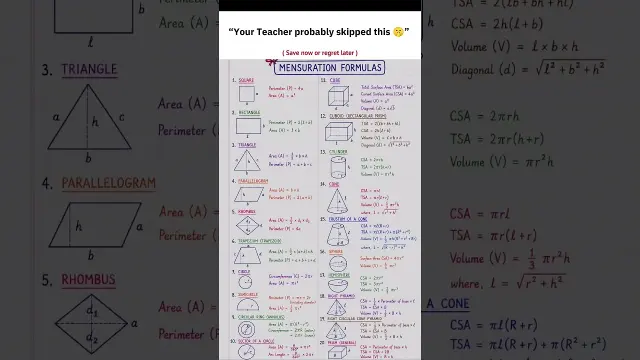 Essential Mensuration Formulas for Class 10 Students
Get new #Mensuration ideas by email
Every Thursday: the week's best ideas, with the newest from #Mensuration.
Related tags
Mensuration: A Complete Guide to Measuring Shapes
Mensuration is the branch of geometry that deals with measuring figures: how long their boundaries are, how much flat surface they cover, and how much space they enclose. The word comes from the Latin mensura, meaning measure, and the subject is as old as building and farming themselves, since anyone who fences a field, tiles a floor or fills a tank is doing mensuration.
Plane figures and solid figures
Mensuration splits naturally into two families. Plane, or two-dimensional, figures such as rectangles, triangles, circles and polygons have a perimeter and an area. Solid, or three-dimensional, figures such as cubes, cuboids, cylinders, cones, spheres, prisms and pyramids have a surface area and a volume. Everything else in the subject is a variation on these two ideas.
The measures you will meet
Read more
- Perimeter: the total length of the boundary of a plane figure.
- Area: the amount of surface a plane figure covers.
- Surface area: the total area of all the faces of a solid, which may be curved, flat or both.
- Volume: the space a solid occupies.
- Capacity: how much a hollow container holds, usually given in litres or millilitres.
Getting to know the common shapes
A rectangle's area is length times breadth, and a square is the special case where the two are equal. A triangle is half of a parallelogram that shares its base and height, which is why its area is half base times height, whatever its shape. A circle brings in the constant pi, the fixed ratio between a circle's circumference and its diameter, giving a circumference of two pi r and an area of pi r squared. A cuboid multiplies length, breadth and height for its volume; a cylinder is its circular cousin. A cone is a third of the cylinder that shares its base and height, and a sphere's volume and surface area are both expressed in terms of pi and the radius. You do not need to memorise these blindly: once you see where each formula comes from, they stay with you.
Skills that matter more than formulas
- Units. Measure consistently before you calculate, and remember that converting a length changes an area by the square of the factor and a volume by its cube.
- Diagrams. Sketch the figure, write the given values on it, and mark what you are asked to find.
- Decomposition. Most real problems involve composite shapes, which you break into rectangles, triangles and circles, or into familiar solids.
- Pythagoras. It unlocks the slant height of a cone, the diagonal of a cuboid and the height of many triangles.
Practical tips for beginners
Keep a single sheet of formulas and add to it as you learn. Round only at the very end, and state the units of your answer. Check that the result is sensible: a room's floor area should not come out larger than the house. Practise reverse problems, such as finding a radius from a given area or a height from a given volume, because they test understanding rather than recall. Finally, apply the ideas to everyday tasks such as estimating paint, flooring or packaging; measurement is much easier to remember when it has a purpose.
#Mensuration: frequently asked questions
What exactly does mensuration cover?
Mensuration is the part of geometry concerned with measuring figures: the length of their boundaries, the flat surface they cover, and the space they enclose. It splits into plane figures, which have perimeter and area, and solid figures, which have surface area and volume, with capacity describing what a hollow container holds. Anything you measure around the house, from a floor to be tiled to a box to be packed, falls under it.
How should a complete beginner start learning mensuration?
Begin with the simplest plane shapes and get comfortable with perimeter and area before moving on to solids, since the three-dimensional formulas build on the two-dimensional ones. Sketch each figure as you go, label the given values on the drawing, and keep a single running sheet of formulas that you add to as you learn. Applying the ideas to small everyday jobs, like working out how much paint or flooring a space needs, makes the measurements stick far better than reading alone.
Do I really need to memorise every formula?
Memorising blindly is the hard way round; it is far more durable to understand where each formula comes from. Once you see, for instance, that a triangle is half of a parallelogram sharing its base and height, or that a cone is a fraction of the cylinder with the same base and height, the results stay with you and you can rebuild them if you forget. A formula sheet is still worth keeping, but treat it as a reminder rather than the source of your understanding.
What is the difference between area, surface area and volume?
Area is how much flat surface a two-dimensional figure covers, while surface area is the combined area of all the faces of a solid, whether those faces are flat, curved or a mixture. Volume is the space the solid actually occupies, and capacity is simply how much a hollow shape can hold. Keeping these three separate in your mind prevents a lot of wrong answers, especially when a question asks about a container rather than the material it is made from.
What mistakes do people most often make in mensuration problems?
The commonest is mixing units, so lengths are converted carelessly before calculating even though a change in length alters an area by the square of the factor and a volume by its cube. Rounding too early, leaving the answer without units, and forgetting to check whether the result is plausible all cost marks for no good reason. Drawing no diagram is another frequent slip, since marking the known values and the unknown on a sketch usually reveals the route to the answer.
How do I tackle awkward shapes that are not in any formula list?
Most real problems involve composite shapes, which you break down into familiar pieces such as rectangles, triangles, circles or standard solids, then add or subtract the parts. Pythagoras is the other reliable tool, unlocking slant heights, diagonals and the heights of many triangles that would otherwise look impossible. Practising reverse problems, like recovering a radius from a given area or a height from a given volume, builds the flexibility these questions demand far better than repeating routine substitutions.
Videos come from YouTube and posts from Instagram; titles and summaries are our own. All rights belong to their creators.