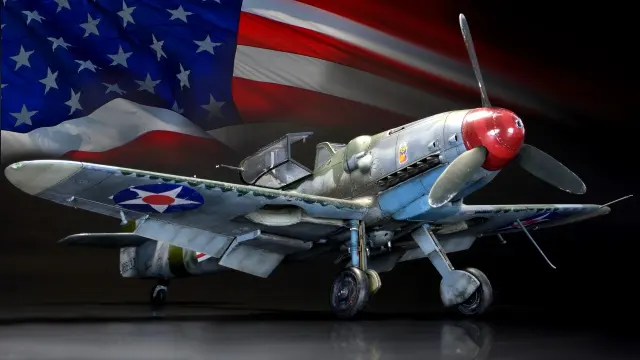
 Building and Detailing a 1/48 Scale Eduard Messerschmitt BF-109G6
#Military Aviation
1 ideas
Building and Detailing a 1/48 Scale Eduard Messerschmitt BF-109G6
Get new #Military Aviation ideas by email
Every Thursday: the week's best ideas, with the newest from #Military Aviation.
Related tags
Military Aviation: Aircraft, Roles and History
What military aviation is
Military aviation is the use of aircraft for defence, combat, transport, surveillance, training, and support. It covers a wide range of flying machines, from fighters and bombers to transport planes, helicopters, and reconnaissance aircraft. While civilian aviation focuses on travel and commerce, military aviation is built around speed, reach, protection, and mission flexibility.
It grew from the earliest military uses of balloons and aircraft in the early 20th century, when nations quickly saw the value of seeing farther, moving faster, and striking from the air. Since then, aircraft have become an essential part of modern armed forces, changing how wars are fought and how countries patrol their airspace, support ground troops, and respond to emergencies.
Main types of military aircraft
Read more
Military aviation includes several broad kinds of aircraft, each with a different purpose:
- Fighters are designed mainly to control the air, intercept other aircraft, and protect friendly forces.
- Bombers carry weapons to strike targets on the ground or at sea.
- Attack aircraft focus on supporting ground operations and engaging surface targets.
- Transport aircraft move troops, equipment, and supplies over long distances.
- Reconnaissance and surveillance aircraft gather information and observe activity from the air.
- Helicopters are widely used for troop transport, medical evacuation, search and rescue, and close support.
- Training aircraft help pilots learn basic and advanced flying skills before moving on to operational machines.
Some aircraft combine more than one role, especially in modern air forces, where flexibility is often important.
Common features and design goals
Military aircraft are usually designed with specific priorities in mind. Speed, manoeuvrability, range, payload, protection, and reliability all matter, but not equally for every type. A fighter may be built for agility and rapid response, while a transport aircraft may emphasise cargo space and endurance. Armour, stealth, sensor systems, and weapons integration can also shape the design.
For a beginner, it helps to think of military aviation as a balance between mission and machine. The shape of the aircraft often reflects its job: sleek and compact for air combat, broad and sturdy for transport, or built with large sensor areas for observation.
How to understand it as a topic
If you are new to military aviation, start by learning the basic roles first. Once you can recognise the difference between fighters, bombers, transport aircraft, and helicopters, it becomes much easier to understand aircraft families, national air forces, and historical developments.
A few simple tips can help:
- Look at the aircraft’s shape and ask what mission it suggests.
- Notice whether the aircraft is meant for speed, range, cargo, or observation.
- Learn the basic terms used for roles and categories before worrying about technical detail.
- Remember that many aircraft are adapted for specific tasks, so one type may have several variants.
Why it matters
Military aviation has influenced strategy, technology, and national defence for over a century. It also plays a role in disaster relief, evacuation, border patrol, and maritime security. Understanding it means understanding not just aircraft, but the changing relationship between airpower, geography, and modern life.
#Military Aviation: frequently asked questions
How do I get started learning about military aviation?
Begin with the roles rather than the technology: learn to tell fighters, bombers, attack aircraft, transports, reconnaissance planes, and helicopters apart, since each one exists to do a different job. Once those categories feel familiar, aircraft families, air forces, and historical developments start to make sense. From there you can follow whichever thread interests you most, whether that is air combat, transport and logistics, or rescue work.
Which kind of military aircraft should I choose to model or study first?
Pick a type whose mission you find genuinely interesting, because that interest carries you through the fiddly parts of a build. A compact fighter is a manageable first subject with a simple, readable shape, while a large transport or a helicopter brings more parts and more complex assembly. It also helps to look at the aircraft's outline and ask what job it suggests, since the design usually tells you what it was built to do.
What do I need to build a military aircraft scale model?
A kit, a sharp knife, fine sandpaper, glue suited to the material, and a place with good light and ventilation cover most of the basics. Paint and brushes or an airbrush come next, along with a way to hold small parts steady while they set. Decals for markings are usually included in the kit, and a simple stand or shelf space keeps the finished model safe.
How do I look after a finished military aircraft model?
Keep it out of direct sunlight and away from damp, since both fade paint and can loosen decals over time. Dust it gently with a soft brush rather than a cloth, which can catch on antennas, pitot tubes, and other fine details. Handle the model by its base or fuselage rather than by protruding parts, and store spare parts and decal sheets flat in case a repair is needed later.
What mistakes do beginners make with military aviation subjects?
The most common one is chasing technical detail before the basics are clear, which makes the whole subject feel harder than it is. Another is assuming every aircraft fits neatly into one role, when many are adapted for several tasks and appear in different variants. Rushing assembly or applying heavy paint coats too quickly is the usual modelling mistake, and both are easier to avoid by working in slow, small stages.
Is military aviation a good theme for a family project or display?
Yes, it works well as a shared activity because the subject appeals across ages and invites conversation about history, engineering, and how aircraft are used in rescue and relief work as well as defence. A family build session can be split by skill, with one person handling assembly and another doing paint or decals. Finished models also make an informative display that shows how shape follows mission.
Videos come from YouTube and posts from Instagram; titles and summaries are our own. All rights belong to their creators.