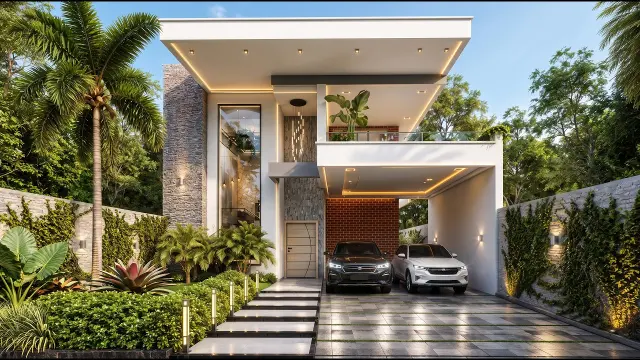
 Modern Minimalist Two-Story House Plans With Pool
#Minimalist Architecture
1 ideas
Modern Minimalist Two-Story House Plans With Pool
Get new #Minimalist Architecture ideas by email
Every Thursday: the week's best ideas, with the newest from #Minimalist Architecture.
Related tags
Minimalist Architecture Guide
What minimalist architecture means
Minimalist architecture is a design approach that focuses on simplicity, clarity, and purpose. It uses only the elements that are needed, leaving out decoration that does not serve a function. Instead of relying on ornament, it creates interest through proportion, light, materials, and the careful use of space.
The idea has roots in modern architecture and in older traditions that value restraint, balance, and harmony. It is often associated with clean lines, open layouts, and a calm visual feel, but it is not limited to one style. A minimalist building can look warm, bright, severe, refined, or highly natural depending on its materials and setting.
Common features
Read more
Minimalist architecture usually shares a few recognizable qualities:
- simple geometric forms
- open or uncluttered floor plans
- limited material palettes
- smooth surfaces and clear lines
- an emphasis on natural light
- careful attention to proportion and scale
- built-in storage or hidden functions to reduce visual clutter
The result is often a space that feels calm and organized. Because there is less visual noise, details such as the placement of a window, the texture of wood, or the shadow cast by a wall become much more noticeable.
Materials and atmosphere
Minimalist design does not have to feel cold. Many minimalist buildings use warm natural materials such as wood, stone, concrete, glass, plaster, or metal. What matters is not luxury or cost, but how the materials are used. A limited palette helps the eye rest and gives the architecture a strong sense of coherence.
Light is especially important. Large windows, carefully positioned openings, and soft reflected light can make simple spaces feel spacious and alive. Good minimalist architecture pays close attention to how a room changes throughout the day.
Styles and approaches
Minimalism can appear in different ways. Some designs are very strict, with sharp edges and near-total restraint. Others are softer and more organic, using gentle curves, natural textures, or warm neutral colors. You may also see minimalist ideas in small homes, apartments, offices, galleries, and public buildings.
A useful distinction is between decorative simplicity and functional simplicity. In true minimalist architecture, the simplicity is not just visual. It comes from thoughtful planning, where every element has a reason to be there.
What to know if you are planning or studying it
If you are new to minimalist architecture, start by thinking about use before appearance. Ask how each space should work, how people move through it, and what can be reduced without losing comfort. Good minimalism is not about emptiness for its own sake. It is about removing the unnecessary so the essential stands out.
Practical tips include:
- choose a limited number of materials and repeat them consistently
- plan storage early so daily items do not disrupt the clean look
- let daylight shape the space whenever possible
- pay attention to texture, because simple surfaces need subtle variation
- avoid overfurnishing, since the architecture needs room to breathe
Minimalist architecture is at its best when it feels calm, useful, and timeless. It asks for discipline, but it rewards you with spaces that are easier to understand, easier to live in, and often more lasting in style.
Videos come from YouTube and posts from Instagram; titles and summaries are our own. All rights belong to their creators.