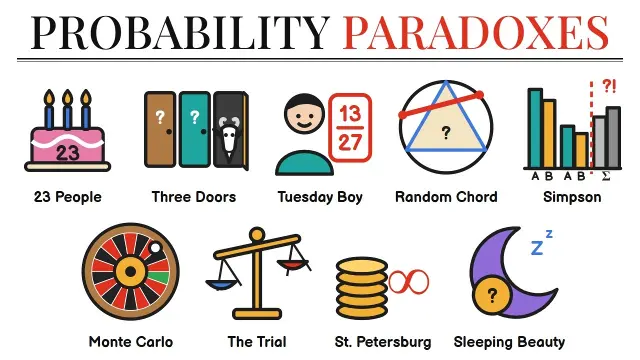
 Nine Probability Paradoxes That Fool Our Intuition, Explained
#Monty Hall Problem
3 ideas
Nine Probability Paradoxes That Fool Our Intuition, Explained
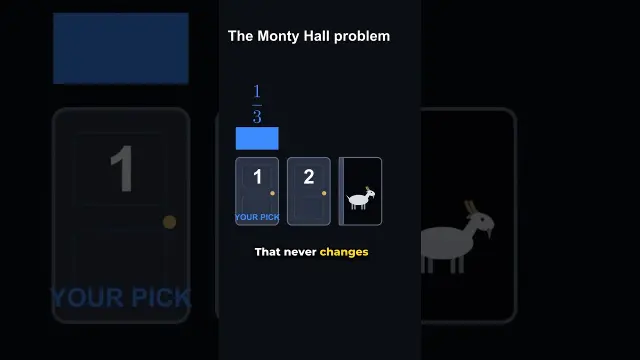 Monty Hall Problem Explained: Why Switching Doors Wins Two Times in Three
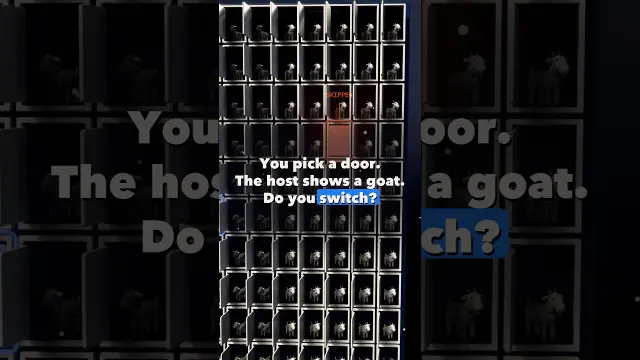 The Monty Hall Problem Explained with Three Doors
Get new #Monty Hall Problem ideas by email
Every Thursday: the week's best ideas, with the newest from #Monty Hall Problem.
Related tags
The Monty Hall Problem: Why Switching Wins
Imagine you are a contestant on a television game show. Three closed doors stand in front of you. Behind one is the prize; behind the other two, nothing. You pick a door. The host, who knows where the prize is, opens one of the two doors you did not choose and shows you an empty room. Then he offers you a choice: stay with your original door, or switch to the remaining one. Most people feel the odds are now fifty-fifty. They are not. Switching wins two times out of three.
Where the puzzle comes from
The scenario is named after the host of an American game show, but it was circulating as a puzzle among mathematicians before it reached a general audience through a magazine column. Readers wrote in by the thousand to insist the answer was wrong, including people with doctorates in mathematics. That reaction is what made it famous: the puzzle is less about probability than about how confidently our intuition can mislead us.
Why switching works
Read more
The key is that your first pick is right only one time in three, and wrong two times in three. Nothing the host does changes that. When he opens an empty door, he is not adding information about your door; he is using his knowledge to eliminate a losing option from the pair you rejected. So in the two-thirds of cases where your first guess was wrong, the prize has to be behind the single door he left closed. Switching wins exactly whenever you were initially wrong.
The objections people raise
The usual complaints are worth taking seriously, because each points to a hidden assumption.
- The host must know where the prize is. If he opens a door at random and happens to reveal an empty one, the advantage disappears.
- The host must always open a door and always offer the swap. If he offers it only when you have already picked correctly, staying is better.
- The host must never open your door, and never open the prize door.
Once those rules hold, the puzzle is settled. Change any of them and you are solving a different problem, which is why disagreements about it often turn out to be disagreements about the rules.
Variants to think with
Try the same puzzle with one hundred doors. You pick one; the host opens ninety-eight empty ones and leaves a single alternative closed. Staying looks absurd there, and that intuition is the correct one — the structure is identical to the three-door version, just easier to feel.
What beginners should take from it
Work out the probability of your first choice, then ask what the new information actually tells you and what it leaves untouched. Draw the three possible arrangements on paper if the argument still feels slippery. And notice the honest lesson underneath: when a result surprises you and the mathematics is solid, the confusion is usually in the assumptions you brought, not in the sum.
#Monty Hall Problem: frequently asked questions
How should I approach the Monty Hall problem if I’m new to it?
Start by focusing on your first choice and what the host does after it. The key idea is that the host is not choosing randomly; he is removing a losing option while leaving your original choice unchanged. That is why the puzzle feels surprising at first but becomes clearer when you track the rules step by step.
What has to be true for the switching strategy to work?
The host must know where the prize is and must always open a losing door without ever revealing the prize or your chosen door. He also has to always offer you the chance to switch. If those conditions change, you are no longer solving the same puzzle.
Should I stay with my first door or switch to the other one?
If the standard rules are in place, switching is the smarter choice. Your first pick was made before any extra information was revealed, so it keeps its original weakness. The unopened door left by the host carries the advantage created by removing a losing option.
What is the most common mistake people make with this puzzle?
The biggest mistake is assuming the last two doors are equally likely just because one losing door has been opened. That ignores the fact that the host’s action is guided by knowledge, not chance. Another common error is forgetting that the puzzle changes if the host does not always behave the same way.
How can I explain the Monty Hall problem in a simple way?
Think of your first pick as a guess made before the host gives any help. When the host opens an empty door, he is not making your original door better; he is showing you which of the other possibilities can be discarded. That is why switching makes more sense than it first appears.
Videos come from YouTube and posts from Instagram; titles and summaries are our own. All rights belong to their creators.