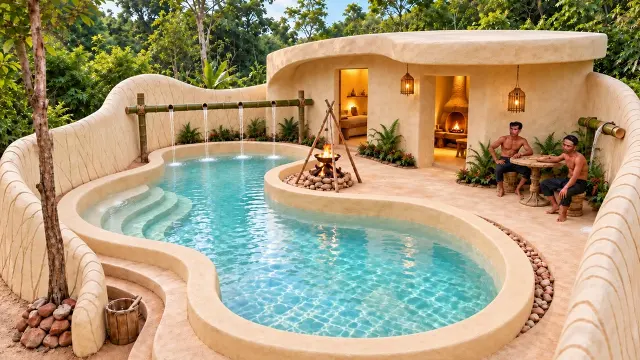
 Building a Luxury Jungle Villa with Private Pools
#Natural Building
1 ideas
Building a Luxury Jungle Villa with Private Pools
Get new #Natural Building ideas by email
Every Thursday: the week's best ideas, with the newest from #Natural Building.
Related tags
Natural Building: A Beginner's Guide to Earth, Straw and Timber
Natural building is an approach to construction that puts materials first: earth, straw, stone, timber, bamboo, lime and clay, chosen because they are abundant, minimally processed and gentle on the land. It is less a single style than a way of thinking. Rather than starting with a finished design and ordering whatever the drawings require, natural builders tend to begin with what the site and the local landscape already offer, then shape the building around it.
The tradition is older than any of its names. People have built with mud, stone and thatch for thousands of years, and every region developed its own vocabulary in response to its climate. What is called natural building today is a loose gathering of those traditions, revived and adapted by people who wanted homes that were healthier to live in and lighter on the planet than conventional construction.
The main approaches
- Earth building: rammed earth, cob and adobe all use subsoil mixed with water, sometimes with straw or sand. Walls are thick, heavy and slow to change temperature, which suits hot days and cool nights.
- Straw bale: bales stacked as walls and rendered on both faces. Highly insulating and surprisingly quick to raise, but it must stay dry.
- Timber framing and cordwood: structural wood, infill, and roundwood log ends set in mortar.
- Stone: dry-stone or mortared walls, often using stone cleared from the site itself.
- Light earth and wattle-and-daub: timber frames packed or plastered with clay-rich soil, useful where weight matters.
- Natural finishes: clay and lime plasters, earth floors, and breathable paints made from casein, chalk or clay.
Read more
What beginners should know
Water is the central concern. Earth walls need generous eaves and a raised base so rain never sits against them; straw needs protection from damp above all else. Get those details right and these materials last for generations. Get them wrong and nothing else will save the wall.
Breathability matters too. Natural walls manage moisture by absorbing and releasing it, and they work best when the whole assembly — plaster, paint, insulation — allows that exchange. Sealing a clay wall behind cement render or plastic paint defeats the purpose.
Think about structure early. Many natural materials are excellent in compression but weak in tension, so roofs, lintels and openings need proper engineering. Building codes vary widely, and many areas now have formal pathways for earth and straw construction; check what applies where you are building before you fall in love with a method.
Expect labour to replace some of the cost of materials. Natural building is often affordable precisely because it is hands-on, which makes it well suited to owner-builders, workshops and community builds — and worth practising on a garden wall before committing to a house.
Finally, let the climate decide. Thick earth suits places with wide day-to-night swings; highly insulated straw suits cold winters; light, ventilated structures suit humid tropics. The best natural building is the one that answers its place.
#Natural Building: frequently asked questions
How do I start with natural building if I've never done it before?
Begin with the site and the climate rather than with a plan: look at what earth, stone, straw or timber your area already provides and what the weather demands. Practice on something small and low-stakes, such as a garden wall or a shed, so you learn how the material behaves before committing to a whole house. Talking to local builders and building authorities early will also save you trouble later.
What do I need before I begin a natural building project?
The essentials are a realistic understanding of the material, a plan for keeping it dry, and structural advice for roofs, lintels and openings. Many natural materials carry weight well but handle tension poorly, so those elements need proper engineering rather than guesswork. Since much of the work replaces purchased materials with your own time and labour, you should also be honest about how much hands-on effort you can give.
Which natural building method should I choose?
Let the climate narrow it down for you. Thick earth walls are slow to change temperature and suit places with hot days and cool nights, highly insulating straw suits cold winters, and light ventilated structures work better in humid tropical settings. Availability of local material and the skills of the people around you should settle the rest.
How do I care for a natural building over time?
Keeping it dry is the whole job, and most problems trace back to water reaching the wall. Generous eaves, a raised base and good drainage protect earth and straw far more effectively than any coating applied afterwards. Re-check plasters, renders and gutters periodically, because a small repair done early costs far less than a saturated wall.
Why does breathability matter so much in these buildings?
Natural walls handle moisture by taking it in and letting it back out, and they only work when every layer of the assembly allows that exchange. Covering clay with cement render or plastic paint traps damp inside, which is exactly what you were trying to avoid. Stick to lime and clay plasters and breathable paints so the wall can keep regulating itself.
What are the most common mistakes beginners make?
The classic error is designing the building first and only then asking what the site and the local materials can offer. The second is underestimating water: skimpy eaves, a low base or poor drainage will undo an otherwise well-made wall. The third is sealing a breathable wall behind a waterproof finish, which quietly turns a healthy wall into a damp one.
Videos come from YouTube and posts from Instagram; titles and summaries are our own. All rights belong to their creators.