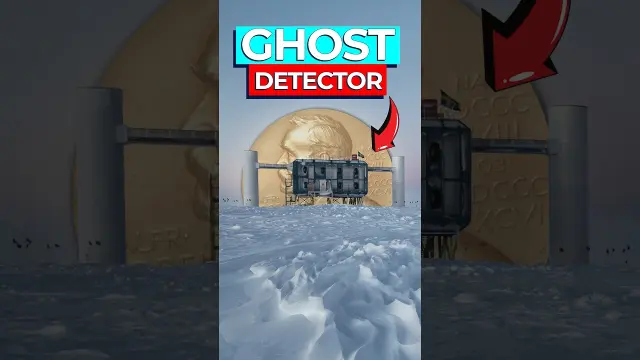
 Physicist Honored for a Telescope That Detects Ghost Particles
#Neutrinos
4 ideas
Physicist Honored for a Telescope That Detects Ghost Particles
 Explaining the Nobel Prize in Physics and the IceCube Detector
 The Neutrino Story Behind a Solo Physics Nobel Prize
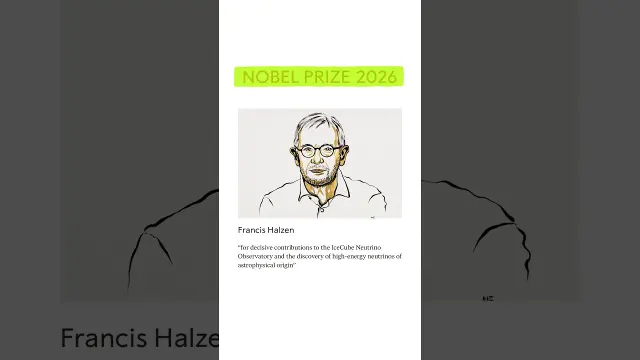 How a Telescope Buried in Antarctic Ice Won a Physics Nobel
Get new #Neutrinos ideas by email
Every Thursday: the week's best ideas, with the newest from #Neutrinos.
Related tags
Neutrinos: A Beginner's Guide to Ghost Particles
A neutrino is a fundamental particle with almost no mass and no electric charge. It belongs to the lepton family, the same group as the electron, and it interacts only through the weak nuclear force and gravity. That single fact explains almost everything strange about it: with no charge to push against and no strong force to hold it, a neutrino can pass through the entire Earth without touching a single atom. Billions of them cross your body every second, and you never notice.
Where they come from
Neutrinos are produced wherever atomic nuclei transform. The Sun converts hydrogen into helium in its core, and that process releases a steady flood of them, which is why sunlight arrives with an invisible neutrino accompaniment. Cosmic rays striking the atmosphere create them. Radioactive decay in rock and in the human body produces them. Nuclear reactors emit them in enormous numbers, and supernovae release most of their energy in a brief neutrino burst.
The particle was first proposed as a way out of a puzzle: radioactive beta decay seemed to lose energy and momentum, and a small, invisible, neutral particle carrying both away was the neatest explanation. It took decades to confirm, because a particle that ignores matter is a particle that ignores detectors. The eventual confirmation came from watching for the rare occasions when one does interact.
Read more
Three flavours, and a disappearing act
Neutrinos come in three types, or flavours, each paired with a charged partner: the electron neutrino, the muon neutrino and the tau neutrino. A source that makes one kind can later be found making another. This mixing, usually called oscillation, is the behaviour that made the particles so interesting to physicists, since it can only happen if neutrinos have mass. Their masses are extraordinarily small, far lighter than any other known particle with mass.
How we detect them
Detection relies on the rare interaction: a neutrino meets a nucleus and produces a charged particle, which then leaves a trace of light or charge in a large volume of material. Detector designs follow the same principle at very different scales.
- Water and ice detectors watch for faint cones of blue light from fast-moving particles, and are built deep underground or deep in polar ice to shield them from cosmic rays.
- Liquid scintillator detectors use tanks of oil-like fluid viewed by light sensors, suited to reactor and geophysical neutrinos.
- Gallium and chlorine experiments counted atoms converted by solar neutrinos, a slow radiochemical approach.
- Radio detectors listen for faint pulses in ice or salt, aiming at the highest energies.
What beginners should know
The common confusion is to imagine neutrinos as dangerous radiation. They are not: the same weak interaction that makes them hard to catch makes them essentially harmless. The second is to think of them as a solved subject. Oscillation settled one question and opened others, including how the three masses are ordered and whether neutrinos are their own antiparticles.
If you want to follow the field, learn what a cross-section is and how background noise is suppressed; those two ideas explain most detector design. Beyond physics, neutrino detection offers a way to look inside the Sun, watch a collapsing star, and probe the Earth's interior, all through particles that barely notice anything at all.
#Neutrinos: frequently asked questions
What is a neutrino in simple terms?
A neutrino is a tiny fundamental particle with almost no mass and no electric charge. It belongs to the lepton family and interacts so weakly that it can pass through matter with almost no effect.
Where do neutrinos come from?
Neutrinos are made anywhere atomic nuclei change, such as in the Sun, in radioactive decay, in nuclear reactors, and in powerful cosmic events like supernovae. They are constantly being produced all around us, even inside the Earth and the human body.
How do scientists detect neutrinos if they barely interact?
Researchers use very large detectors and wait for the rare case when a neutrino hits a nucleus and creates a charged particle. That secondary particle can leave a faint flash of light or a trace of charge in water, ice, liquid scintillator, or other detector materials.
Why are there different kinds of neutrinos?
Neutrinos come in three flavours: electron, muon, and tau. A neutrino can change from one flavour to another as it travels, a behavior called oscillation, which is one of the biggest clues that neutrinos have mass.
Are neutrinos dangerous to people?
No, neutrinos are not dangerous in the usual sense. They pass through your body all the time, but they interact so weakly that they almost never affect anything, which is why they are considered essentially harmless.
Videos come from YouTube and posts from Instagram; titles and summaries are our own. All rights belong to their creators.