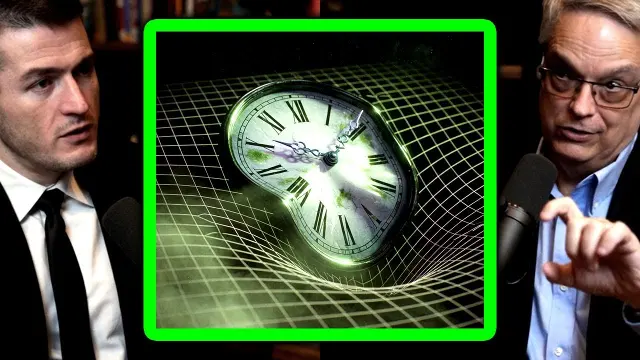
 Particle Physicist Explains Why Time Is a Mystery
#Particle Physics
3 ideas
Particle Physicist Explains Why Time Is a Mystery
 Brian Greene on AI and the Yang-Mills Gauge Theory Proof
 The Neutrino Story Behind a Solo Physics Nobel Prize
Get new #Particle Physics ideas by email
Every Thursday: the week's best ideas, with the newest from #Particle Physics.
Related tags
Particle Physics: A Guide to the Building Blocks of Matter
Particle physics is the branch of physics that asks what matter is made of at the smallest scale anyone has been able to probe, and what holds it together. Where chemistry deals with atoms and molecules, particle physics goes inside the atom: to the nucleus, to the protons and neutrons within it, and to the quarks and gluons inside those.
What the field studies
The modern picture is called the Standard Model. It describes a small set of fundamental particles and the forces that act between them. Matter particles come in two families: quarks, which combine to form protons and neutrons, and leptons, of which the electron is the best-known example. Each has heavier relatives that exist only briefly. Force-carrying particles mediate the interactions: the photon for electromagnetism, gluons for the strong force that binds nuclei, and the W and Z bosons for the weak force, which is responsible for certain kinds of radioactive decay. The Higgs boson is associated with the mechanism that gives particles mass. Gravity, the fourth force, is not yet described by this framework, which is one reason physicists keep looking beyond it.
How the work is done
Read more
Most experimental particle physics happens at accelerators, machines that speed up beams of particles and bring them into collision. Detectors arranged around the collision point record the debris: tracks, energies, and the identities of particles flying outward. Because these events are tiny and rare, experiments collect enormous numbers of collisions and rely on statistics to separate real signals from background noise. Theory and experiment pull on each other constantly; predictions guide what to look for, and surprises redirect the theory.
A second, quieter tradition looks upward. Cosmic rays arriving from space, and observations of the universe at large, offer natural laboratories at energies no machine can reach. Neutrino experiments, often buried deep underground to escape interference, study particles that pass through ordinary matter almost untouched.
Main directions
Work tends to cluster around a few questions: whether there are particles and forces beyond the known ones, why matter survived in greater quantity than antimatter, what dark matter consists of, and how to reconcile the small-scale picture with gravity. Some researchers build and run experiments, some develop detectors and electronics, and some work primarily on theory or computation.
If you are just starting
Begin with the conceptual map rather than the mathematics: know the difference between matter particles and force carriers, and understand that "fundamental" means "no known internal structure" rather than "simple." Conservation laws — energy, momentum, charge — are the working tools of the field, and most reasoning follows from them. Learn to read a Feynman diagram as a kind of shorthand for an interaction. Be patient with the vocabulary; it is dense but finite. And keep a clear sense of scale: the objects involved are far smaller than anything in ordinary experience, which is exactly why the experiments must be so large.
#Particle Physics: frequently asked questions
How can someone begin learning particle physics if they are new to it?
Start with the big picture: what counts as matter, what particles carry forces, and why conservation laws matter. It helps to get comfortable with the standard model vocabulary and simple interaction diagrams before moving into heavier math.
What background do I need to study particle physics seriously?
A solid foundation in basic physics and mathematics is important, especially ideas about motion, energy, and waves. As you go further, you will also need algebraic and calculus-based thinking to follow how particles interact and how experiments are analyzed.
How do I choose between experimental and theoretical particle physics?
Choose experimental work if you enjoy building detectors, analyzing collision data, and making sense of signals hidden in noise. Choose theory or computation if you like abstract reasoning, models, and using predictions to explain what experiments might reveal.
What does a particle physicist actually study beyond atoms?
The field looks inside atoms to the nucleus and then deeper to the constituents of protons and neutrons, along with the particles that carry forces between them. It also asks bigger questions about dark matter, antimatter, and how the known framework might fit with gravity.
What are common mistakes beginners make when learning particle physics?
A common mistake is treating the subject as if it is only about tiny objects, when it is really about relationships, symmetries, and interactions. Another is trying to memorize terms without understanding the roles of matter particles, force carriers, and the conservation laws that connect them.
Videos come from YouTube and posts from Instagram; titles and summaries are our own. All rights belong to their creators.