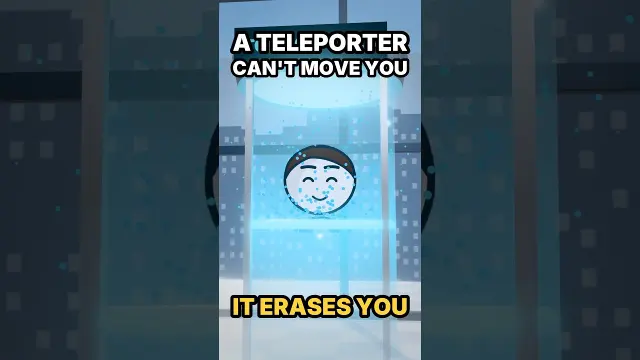
 Why Physics Says a Teleporter Would Have to Erase You
#No-Cloning Theorem
1 ideas
Why Physics Says a Teleporter Would Have to Erase You
Get new #No-Cloning Theorem ideas by email
Every Thursday: the week's best ideas, with the newest from #No-Cloning Theorem.
Related tags
The No-Cloning Theorem: Why Quantum States Can't Be Copied
Imagine someone hands you a quantum system in a state you know nothing about and asks for two identical copies. Classical intuition says this is easy: read the information off and write it down twice. Quantum mechanics says no. The no-cloning theorem states that no physical process can take an arbitrary, unknown quantum state and produce two perfect copies of it. Whatever you do, you can never end up with two systems that both reproduce the original exactly.
It is one of the foundational results of quantum information theory, and it is not an engineering limitation to be overcome with better devices. It follows from the deep structure of the theory itself.
Where it comes from
Quantum states are described mathematically as vectors, and the allowed transformations are linear: they preserve the relationships between states, including a quantity called the inner product that measures how alike two states are. A cloning device would have to map a state, together with a blank system, onto two identical copies of that state — and do so for every possible input.
Read more
Now compare two different states. Linearity requires the inner product between the two joint systems after cloning to stay equal to the inner product of the two original states. But if each original has really become a pair of identical copies, the inner product between the joint systems is the square of the original inner product. The original value would therefore have to equal its own square. That holds only for 0 or 1, meaning the states are either perfectly distinguishable or identical.
The consequence is precise but narrow: you can only copy a set of states you can tell apart with certainty. And for such a set, the "copying" is really just preparation — you already know what to make. For anything genuinely unknown, no.
What it does not forbid
- Preparing as many identical systems as you like, as long as you know which state you are preparing.
- Copying the two basis states of a qubit — a simple controlled operation does that without difficulty.
- Moving a state elsewhere. Quantum teleportation transfers a state without ever duplicating it, and it consumes the original in the process.
- Making imperfect copies. Approximate cloning is possible; the copies simply do not match the original perfectly, and the more faithful you want them, the less certain the success.
Why it matters
The theorem is what makes quantum communication trustworthy. An eavesdropper cannot quietly duplicate a transmitted state and read it at leisure; any attempt to extract information leaves detectable traces. It shapes how quantum computers protect their data, since error correction has to work without making backup copies in the ordinary sense. It also marks the sharpest difference between classical and quantum information: classical bits are freely duplicable, and quantum states are not.
Getting it right
Two common mix-ups are worth avoiding. The theorem is often confused with the uncertainty principle — related in spirit, but a different statement. It is also confused with the idea that measurement disturbs a system; true, but the no-cloning result is about what any process at all can achieve, measurement included. And it applies only to unknown states. If you know exactly how a system was prepared, you can build it again as often as you like.
A useful habit is to think of it as a trade: no copying without disturbance somewhere in the process. Understand that, and much of quantum information theory starts to make sense.
#No-Cloning Theorem: frequently asked questions
Can I copy a quantum state I know nothing about?
No. No physical process can take an arbitrary, unknown quantum state and leave you with two systems that both match the original exactly. This is not a matter of building a better device; the prohibition follows from the linear structure of quantum theory itself, so no amount of engineering will remove it.
Are there situations where copying still works?
Yes, whenever the state is not actually unknown to you. States you can tell apart with certainty can be reproduced as many times as you like, but that is really preparation from a known recipe rather than duplication. The same holds for the simple basis states of a qubit, which a straightforward controlled operation copies without trouble.
Does quantum teleportation get around the no-cloning rule?
It does not, because teleportation is transport, not duplication. The state reappears at the destination while the original is consumed in the process, so at no point do two matching copies exist. It lets you move an unknown state without ever reading or replicating it.
Can I at least make an almost-perfect copy?
Approximate cloning is permitted, and it is genuinely useful, but the output never matches the input exactly. There is a trade-off: the closer you want the copies to be to the original, the less reliably the procedure succeeds. So imperfection is not a flaw to be engineered away, it is built into the task.
Is this the same as the uncertainty principle or the idea that measurement disturbs a system?
They are related in spirit but they are separate statements, and mixing them up is one of the most common mistakes. Measurement disturbance says that looking at a system changes it; no-cloning says something stronger, about what any process whatsoever can achieve, measurement included.
Why does it matter outside of theory?
It is what makes secure quantum communication trustworthy, because an eavesdropper cannot quietly duplicate a transmitted state and study the copy later. Any attempt to extract the information leaves traces that the parties can detect. It also shapes how quantum computers guard their data, since error correction has to work without keeping ordinary backup copies.
Videos come from YouTube and posts from Instagram; titles and summaries are our own. All rights belong to their creators.