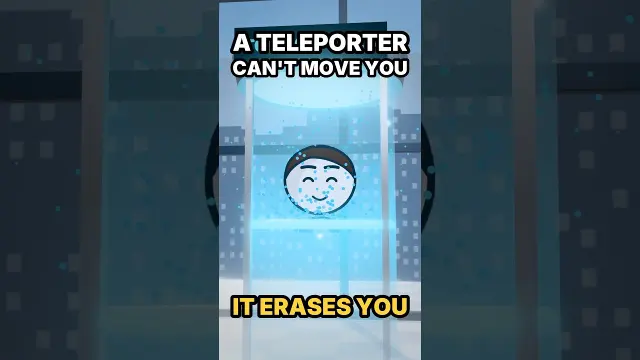
 Why Physics Says a Teleporter Would Have to Erase You
#Teleportation
1 ideas
Why Physics Says a Teleporter Would Have to Erase You
Get new #Teleportation ideas by email
Every Thursday: the week's best ideas, with the newest from #Teleportation.
Related tags
Teleportation: Portals, Beams and Impossible Journeys
Teleportation is the dream of arriving without the journey — of stepping out of one place and into another with nothing in between. You will find it in myths, in ghost stories, in science fiction and in the quiet wish, on a crowded platform, to simply be home. It is less a technology than a picture of escape, which is why it keeps coming back in art, film and imagination.
Where the idea comes from
Instant movement appears in folklore across many cultures: helpful spirits that carry a hero across a kingdom in a breath, magic shoes, flying carpets, doorways that open onto somewhere else. The modern version arrives with the scientific age, when writers began asking what a machine might do. The word itself is a twentieth-century coinage, invented by a writer cataloguing reports of strange and unexplained events, and it was soon taken up by storytellers who preferred wires and engines to older kinds of magic. Since then the idea has belonged mostly to fiction — a way to move a story somewhere new without spending pages on the trip.
The main kinds
Read more
In storytelling, teleportation usually takes one of a few shapes. There is the body dissolved and rebuilt: a beam of light, a shimmer, a pattern of particles reassembled elsewhere. There is the doorway: a portal, mirror, arch or ring that joins two places and stays open. There is the swap, where two things exchange positions at once. And there is the gentler, stranger version — the traveller who never moves at all, but whose mind or double appears somewhere far away.
Worth knowing: teleportation also exists as a real laboratory term, but not the kind in stories. In quantum information science it describes the transfer of a quantum state from one particle to another, using entanglement and an ordinary communication channel. Nothing physical is beamed anywhere, and the original state is not copied. It is a fascinating corner of physics, but it is not a way to move a suitcase.
Picturing it
Because no one has seen teleportation, images of it are built from light and uncertainty. Streaming particles, lens flares, rings of energy, silhouettes caught mid-dissolve, doors standing alone in a landscape. Cool blues and violets read as technological; warm golds and greens read as magic. Motion blur and double exposure suggest a body between two states. Restraint helps: a single bright line through fog can say more than a wall of effects.
If you are starting out
Decide first whether your teleportation is science or spell — the two have different visual grammars, and mixing them carelessly muddies the picture. Keep a clear before and after: the place left behind and the place arrived at, even if one is only implied. Leave a trace at the destination, a glow, a ripple, a scatter of dust, so the eye understands what happened. And let the empty space do some work; the gap where a person used to be is often the most affecting part of the image.
Teleportation, in the end, is a way of talking about distance and longing. Whether you draw it as a machine or a doorway, the feeling is the same: somewhere else, at once.
#Teleportation: frequently asked questions
How do I picture teleportation when nobody has actually seen it happen?
Build the image out of suggestion rather than hardware: light, blur, particles caught mid-dissolve, a doorway standing alone with nothing behind it. What sells the effect is the sense of a body caught between two states, not a detailed machine. Treat the picture as a mood about distance rather than a diagram of a device.
Should my teleportation read as science or as magic?
Pick one before you start, because the two carry different visual languages — one leans on sleek surfaces, circuitry and cold light, the other on ornament, texture and warm glow. Mixing them without a purpose makes the picture feel unsure of itself. Whichever you choose, commit to it fully and let a single detail from the other world intrude only if you want deliberate strangeness.
What mistakes make a teleportation illustration fall flat?
The usual trap is piling on effects until the subject disappears — a wall of sparks and lens flares with no story inside it. Another is losing the before and after, so the viewer can't tell what moved or where from. And forgetting the trace left at the arrival point leaves the eye with nothing to explain what just happened.
How can I make a teleportation picture feel emotional instead of just flashy?
Lean on absence. The empty space where someone stood, an abandoned object, a faint residue at the destination — these carry more charge than a bright beam. Teleportation at its heart is about longing for somewhere else, so aim for that feeling rather than for spectacle.
Is teleportation real, or only a story?
As the stories imagine it — a person or object vanishing here and appearing there — it belongs entirely to fiction, folklore and film. The term does have a genuine use in physics, but it refers to transferring a quantum state between particles, with nothing solid being moved or copied. It is a fascinating idea in its own right, yet it is not a way to travel.
Which colours and techniques work best for a teleportation scene?
Cool blues and violets read as technological, while warm golds and greens read as enchanted, so let your choice follow the kind of story you're telling. Motion blur and double exposure are useful for showing someone caught between two places. Restraint matters most: one clean line of light through fog often says more than a crowded composition.
Videos come from YouTube and posts from Instagram; titles and summaries are our own. All rights belong to their creators.