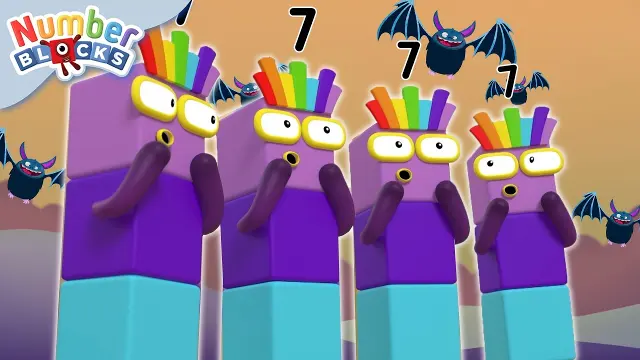
 The Spooky Sevens Halloween Math Compilation
#Number Seven
1 ideas
The Spooky Sevens Halloween Math Compilation
Get new #Number Seven ideas by email
Every Thursday: the week's best ideas, with the newest from #Number Seven.
Related tags
The Number Seven: Maths, Luck and Everyday Life
Seven sits quietly between six and eight, and yet it carries more stories than almost any other number. It is small enough to count on one hand and old enough to appear in the earliest calendars, games and stories we know. Whether you meet it in a maths lesson or in a fairy tale, it rewards a second look.
A number with unusual habits
In arithmetic, seven is a prime number: it can only be divided evenly by one and by itself. You cannot build it by multiplying two smaller whole numbers, which makes it one of the building blocks of the number system.
It has other curiosities too. Divide one by seven and you get 0.142857142857, a string that repeats forever, and the digits in that string simply rearrange themselves as the fraction grows. Seven is also one less than eight, and it can be written as two multiplied by itself three times, minus one. Shapes with seven sides are called heptagons.
Read more
Where seven comes from
The seven-day week is very old, and it is often traced to the seven moving lights that early sky-watchers could see: the Sun, the Moon and the five planets bright enough to follow with the naked eye. That pattern of seven shaped calendars long before anyone wrote down why.
Seven also appears in the oldest lists of wonders, in traditional counts of virtues and vices, and in the seven notes that make up the familiar musical scale. The rainbow is traditionally described as having seven colours, a number that has more to do with how people like to organise ideas than with where one colour ends and the next begins.
Seven in daily life and in luck
In many places seven is treated as a fortunate number, and in others there is a flicker of wariness about it. Either way, it is a number people notice.
You can find it working quietly in the objects around you. On a standard die, the faces on opposite sides always add up to seven, so however the cube lands, one of each pair is hidden from you. Board games, card games and children's counting rhymes lean on seven constantly, partly because it is easy to remember and partly because it sounds satisfying.
Getting comfortable with seven
If the seven times table is the one that refuses to stick, try splitting it. Seven of anything is five of it plus two of it, so 7 × 8 becomes 5 × 8 plus 2 × 8, which is 40 plus 16, or 56. The pair 7 × 8 = 56 is easy to hold on to because the digits run in order: five, six, seven, eight.
For larger numbers, there is a tidy test for divisibility. Double the last digit, subtract it from the rest of the number, and see whether what remains divides by seven. Take 84: double the 4 to get 8, subtract from 8, and you are left with zero, so 84 is a multiple of seven.
None of this needs to be memorised in one sitting. Like most numbers, seven becomes friendlier the more often you play with it.
#Number Seven: frequently asked questions
What is it that makes the number seven special?
Seven is a prime number, meaning nothing smaller except one divides into it evenly, so it works as a basic building block of arithmetic. It also shows up in an unusual range of places, from the seven-day week and the musical scale to traditional lists of virtues and vices. That mix of mathematical tidiness and cultural weight is why it keeps getting noticed.
How do I help a child who keeps stumbling over the seven times table?
Break seven into a five and a two, then multiply each part separately and add the results together. The seven-times-eight fact is worth pointing out on its own, because its digits follow one another in order and make it easy to remember. Short, repeated practice beats trying to lock the whole table down in one go.
How can I tell whether a larger number is a multiple of seven?
Take the final digit off, double it, and subtract that from the digits left behind. If the result divides cleanly by seven, the original number does too, and if it does not, neither does the number you started with. Repeating the step on the leftover number works for longer figures.
Why is seven so tied to luck, in both directions?
Because seven sits in so many familiar patterns, it lingers in the mind more than its neighbours, and people tend to attach strong feelings to the numbers they notice most. In some places that feeling leans toward good fortune, in others toward caution, so the same number carries opposite meanings depending on where you are. Either way it stands out in a way most numbers do not.
Where does the seven-day week come from?
It is very old, and it is usually connected to the seven moving lights early sky-watchers could follow without instruments, namely the Sun, the Moon and the brightest planets. That habit of grouping things by seven shaped calendars long before anyone recorded a reason for it. The pattern has simply outlasted the beliefs that produced it.
Are there playful ways to explore seven with children?
Games are the easiest route, since dice, board games and counting rhymes lean on seven again and again. A standard die is a good starting point, because the two opposite faces always make seven between them, so one of each pair is always hidden. Seasonal themes and spooky or silly framing can keep the interest going without any pressure to memorise.
Videos come from YouTube and posts from Instagram; titles and summaries are our own. All rights belong to their creators.