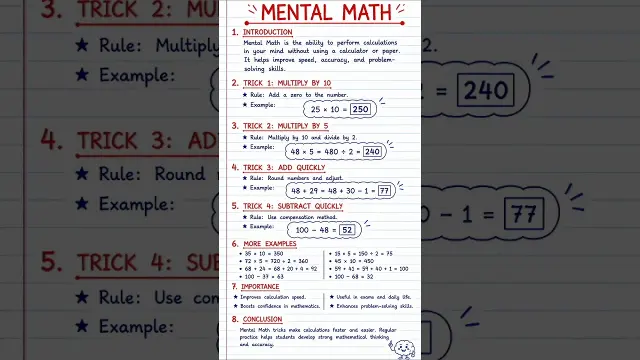
 Fast Calculation Techniques and Mental Math Tricks
#Number Tricks
1 ideas
Fast Calculation Techniques and Mental Math Tricks
Get new #Number Tricks ideas by email
Every Thursday: the week's best ideas, with the newest from #Number Tricks.
Related tags
Number Tricks for Everyday Mental Math
What number tricks are
Number tricks are simple ways of working with numbers that make calculation faster, easier, or more intuitive. They are often based on patterns, grouping, rounding, and breaking numbers into smaller parts. People use them in everyday life for shopping, cooking, planning, checking bills, or solving quick sums without reaching for a calculator.
These tricks are not about memorizing complicated rules. They are about noticing how numbers behave and using that to your advantage. With a little practice, you can become quicker at adding, subtracting, multiplying, and estimating.
Where they come from
Read more
Mental arithmetic has been used for as long as people have counted. Traders, teachers, students, and anyone who worked with numbers before calculators relied on shortcuts and pattern-based methods. Many number tricks come from the same basic ideas used in arithmetic, just arranged in a more practical way.
Some methods are taught in school, while others are passed along as handy everyday techniques. You may also find playful number tricks that seem magical at first but are really built on simple properties of numbers.
Common kinds of number tricks
A few useful types include:
- Rounding and adjusting: round one number up or down, then correct the result.
- Breaking apart numbers: split a number into tens and ones, or into friendly parts like 100, 50, or 25.
- Using doubles and halves: if one number is easy to double, multiply through smaller steps.
- Making ten, one hundred, or another base number: this helps with addition and subtraction.
- Spotting patterns: some sums, products, and sequences become easier once you recognize their structure.
For example, instead of adding 48 + 27 all at once, you can think of 48 + 20 + 7, then combine the parts. This kind of thinking is simple, but it saves effort and reduces mistakes.
What beginners should know
Start with the methods that feel most natural. You do not need to learn every trick at once. The best approach is to practice with small examples until the steps become familiar.
A few helpful habits:
- Keep numbers flexible in your mind rather than fixed in one form.
- Look for easy pairs, like numbers that make 10, 100, or 1,000.
- Check your work by estimating the answer first.
- Use the method that is simplest, not the one that looks cleverest.
It also helps to stay calm. Mental math becomes much easier when you slow down for a moment and choose a clear strategy.
Practical ways to use them
Number tricks are especially useful in daily life. You might use them to work out a tip, compare prices, divide ingredients, or estimate time and distance. They are also valuable for building confidence with numbers in general.
The goal is not perfection. The goal is to make numbers less intimidating and more manageable. As you practice, you may find that many calculations can be handled in your head with less effort than you expected.
Videos come from YouTube and posts from Instagram; titles and summaries are our own. All rights belong to their creators.