 The Original Biggest Numbers Discussed by Numberphile
#Numberphile
3 ideas
The Original Biggest Numbers Discussed by Numberphile
 Ridiculously Big Numbers Generated by Rubik's Cube Combinations
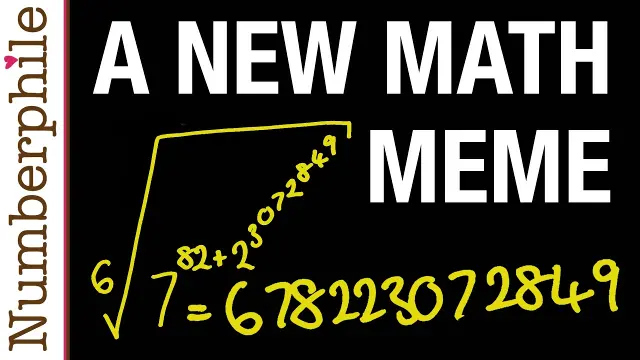 A New Math Meme Created by Matt Parker
Get new #Numberphile ideas by email
Every Thursday: the week's best ideas, with the newest from #Numberphile.
Related tags
Number Puzzles and the Beauty of Numbers
What number puzzles are
Number puzzles are a branch of recreational mathematics that explores numbers for curiosity, pattern, and play. They can include arithmetic tricks, sequences, paradoxes, prime numbers, combinatorics, and problems that look simple at first but lead to unexpected ideas. People have enjoyed number games for centuries because they reveal how logic and imagination can work together.
At their best, number puzzles are not about memorizing formulas. They are about noticing relationships: how numbers behave, how patterns repeat, and how a small rule can create a surprising result. That makes them appealing whether you love maths already or are only just warming up to it.
Where the interest comes from
Read more
The fascination with numbers is ancient. Long before modern classrooms, people used numbers for counting, trade, measurement, astronomy, and keeping track of time. Over time, mathematicians and puzzle-makers began turning those practical tools into challenges and curiosities. Some of the earliest number problems were posed for entertainment as well as for thought.
Today, number puzzles appear in books, classrooms, games, and online videos. They can be a way to explain mathematical ideas in a friendly, approachable form. They often show that mathematics is not only about getting the right answer, but also about asking a good question.
Common kinds of number puzzles
There are many styles of number-based puzzles, and each one highlights a different part of mathematics:
- Pattern puzzles: spotting sequences and predicting the next term
- Logic puzzles: using clues to narrow down possibilities
- Arithmetic tricks: short calculations that reveal surprising results
- Prime number puzzles: exploring numbers that have only two factors
- Combinatorics problems: counting arrangements and choices
- Paradoxical problems: questions that seem impossible until you look more closely
Some are best solved by calculation. Others reward testing examples, drawing diagrams, or simply thinking carefully about what the question is really asking.
What to know as a beginner
If you are new to this kind of mathematics, start with simple problems and be patient with yourself. A puzzle can be useful even if you do not solve it immediately. Often the value is in the process: trying a method, spotting a pattern, or learning why an obvious answer is not quite right.
A few helpful habits:
- Write things down instead of keeping them in your head
- Check small cases first
- Look for structure, not just speed
- Ask what assumptions the problem depends on
- Be willing to try a different approach
It also helps to remember that a neat trick is not always a deep theorem. Some puzzles are meant to entertain, while others point toward larger mathematical ideas. Both can be worthwhile.
Why people enjoy them
Number puzzles are satisfying because they offer a clear challenge and a clean payoff. They can make abstract maths feel playful and human. Even a small problem can open the door to bigger ideas about symmetry, infinity, chance, or proof. If you enjoy finding order in unexpected places, this is a rich and lasting part of mathematics to explore.
Videos come from YouTube and posts from Instagram; titles and summaries are our own. All rights belong to their creators.