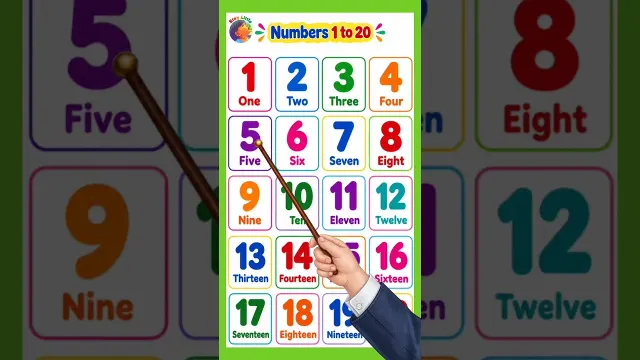
 Fast Counting From One to Twenty for Children
#Numbers 1 to 20
1 ideas
Fast Counting From One to Twenty for Children
Get new #Numbers 1 to 20 ideas by email
Every Thursday: the week's best ideas, with the newest from #Numbers 1 to 20.
Related tags
Numbers 1 to 20: A Simple Counting Guide
What numbers 1 to 20 are
Numbers from 1 to 20 are the first part of the counting system most people learn. They help you count objects, tell how many there are, compare small amounts, and build confidence with early maths. At this stage, the main goal is to recognise each number, say it in order, and understand that each number stands for a quantity.
You will often see these numbers in everyday life: on clocks, house numbers, calendars, game scores, page numbers, and in simple counting activities. Learning them well gives you a strong base for later maths, including larger numbers, addition, and subtraction.
How children usually learn them
Read more
The easiest way to learn numbers 1 to 20 is by using several skills together:
- Saying the numbers aloud in order
- Recognising the written digits
- Matching a number to a group of objects
- Counting small sets one by one
- Writing the numbers by hand
Many children first learn the sequence by repetition, then begin to connect each word with its digit and its amount. This connection is important, because memorising the order is not the same as understanding what the numbers mean.
Common ways to practise
There are many simple, everyday ways to practise numbers 1 to 20:
- Count toys, steps, fruit, or buttons
- Point to each object as you say the number
- Trace or copy the digits on paper
- Put number cards in the correct order
- Ask a child to find a certain number among several choices
- Count forward and backward slowly when ready
Using real objects is especially helpful at first, because it makes the idea of counting concrete. Once the child is comfortable, pictures and written numbers can be added.
What beginners should know
A few ideas are worth keeping in mind:
- The order matters: 1 comes before 2, 2 before 3, and so on
- Each object should be counted once
- The last number said tells how many there are
- Some numbers are easier to recognise than others, so practice is normal
- Learning slowly and often is better than trying to do too much at once
If a child mixes up a number or skips one, that is usually part of learning. Short, regular practice is more helpful than long sessions.
Simple tips for learning
To make numbers 1 to 20 easier to remember, keep practice calm and playful. Count familiar things together during daily routines, such as setting the table or tidying up. Use clear, large digits when showing written numbers. Repeat the same number range often until it feels natural.
If you are teaching a child, try to keep the tone light and encouraging. Celebrate small steps, because confidence matters as much as accuracy. Once 1 to 20 feels easy, the same method can be used for higher numbers too.
#Numbers 1 to 20: frequently asked questions
How do I start teaching numbers 1 to 20 to a young child?
Begin with the spoken sequence, saying the numbers aloud together in order, then add the written digits once the rhythm feels familiar. Tie each number to something real — laying out toys, counting steps, or pointing to objects one at a time. Short, everyday practice while you set the table or tidy up works better than a single long lesson.
What do I need to practise numbers 1 to 20 at home?
Nothing special: objects to count, paper to trace digits on, and a set of number cards are enough. Everyday items like buttons, fruit, or blocks are actually the most useful while a child is still building the link between a number and an amount. Once counting real things feels easy, you can move on to pictures and written numbers.
Should my child be able to write the numbers as well as say them?
Recognising and saying the numbers usually comes first, with writing following as the hand gets steadier. Let them trace or copy large digits rather than aiming for neat, small handwriting straight away. Writing is a separate skill from counting, so it's normal for one to be stronger than the other for a while.
Why does my child skip a number or count the same object twice?
That's a typical stage of learning, not a sign of a problem — the rules of counting take time to settle in. Gently model pointing to each object once as you say the number, and slow the pace down. Regular brief practice with real items fixes this more reliably than correcting them mid-count.
What are some playful ways to practise counting up to twenty?
Count whatever's at hand during the day: stairs, grapes on a plate, toys being packed away, or the seconds while waiting. Ordering number cards, hunting for a particular number around the house, and counting forward then backward all add variety. Keeping it light and stopping while it's still fun matters more than covering a lot at once.
How do I know when my child is ready to move past twenty?
When they can recognise the digits, say the sequence without prompts, and match a number to the right amount of objects, the groundwork is there. From that point, the same routine — count, point, trace, order — carries over to bigger numbers. Confidence is the best signal, so wait until it feels easy rather than pushing ahead.
Videos come from YouTube and posts from Instagram; titles and summaries are our own. All rights belong to their creators.