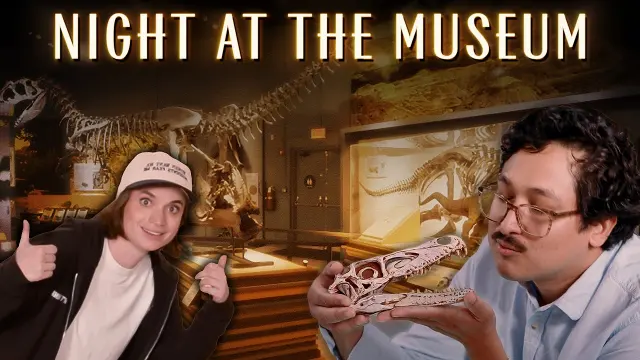
 We Spent The Night At The Museum of Paleontology
#Paleontology
1 ideas
We Spent The Night At The Museum of Paleontology
Get new #Paleontology ideas by email
Every Thursday: the week's best ideas, with the newest from #Paleontology.
Related tags
Paleontology: A Guide to Reading the Fossil Record
Paleontology is the study of ancient life through its physical remains. It sits at the meeting point of biology and geology: paleontologists read the history of living things from fossils, the traces that organisms left behind in rock, amber, ice or sediment. Where archaeology studies human societies through their objects, paleontology reaches back far further, to creatures and ecosystems that vanished long before people existed. The word itself joins the Greek palaios, "old", ontos, "being", and logos, "study" — the science of ancient beings.
How fossils come to be
Most organisms leave nothing at all. Soft tissues decay quickly, and scavengers and weathering finish the work. A fossil usually needs a rapid burial — in river mud, lake bed, volcanic ash or sea floor — where oxygen and bacteria are scarce. Over long spans, minerals from groundwater seep into bone or shell and gradually replace its original material, turning it to stone. Other fossils are impressions: footprints, burrows, leaf prints, or the delicate carbon films of fish and ferns. Some of the finest specimens are preserved in amber or frozen ground, where whole bodies survive in extraordinary detail.
The main branches
Read more
Vertebrate paleontology deals with animals with backbones — fish, amphibians, reptiles, dinosaurs and their bird descendants, and mammals. Invertebrate paleontology covers the vast majority of fossil species: shells, corals, trilobites, ammonites, insects. Paleobotany studies fossil plants and pollen, which are invaluable for reconstructing ancient climates. Micropaleontology works with microfossils, the tiny remains of plankton and spores that let geologists date and correlate rock layers. Paleoecology reconstructs how extinct organisms lived together, while taphonomy asks how remains decayed and came to be buried — the study of what happens between death and discovery.
What a fossil can tell you
A skeleton reveals size, posture and how an animal moved; teeth reveal diet; wear patterns reveal behaviour. Growth rings in bone and shell record seasons and age. Chemical signatures in enamel hint at what an animal drank and where it ranged. Footprints and trackways preserve motion itself, sometimes including moments of interaction between species.
If you want to start
Learn some geology first — rocks, strata, deep time — because fossils only make sense in their context. Read about the fossil record of your own region, and visit natural history museums with an eye for how exhibits are assembled. Join a local geology or natural history society; field trips with experienced people teach more than any book. Collecting rules vary widely from place to place, and many sites are protected, so always check what is permitted before you pick anything up. Above all, record where a find came from: a specimen without its location loses much of its scientific value.
Paleontology rewards patience. It is a discipline of fragments and inference, where a single tooth can open a window onto an entire lost world.
#Paleontology: frequently asked questions
What is the difference between paleontology and archaeology?
Paleontology reads the history of living things from fossils — remains and traces left in rock, amber, ice or sediment — reaching back to creatures that vanished long before people existed. Archaeology studies human societies through the objects they made and left behind. The two overlap in method but sit in very different stretches of time.
How do I get started in paleontology if I have no background?
Begin with geology rather than with fossils: rocks, strata and the idea of deep time, because a fossil only means something in the context of the layer it came from. Read about the fossil record of your own region and visit natural history museums, watching how exhibits are put together. Joining a local geology or natural history society is the fastest way in, since field trips with experienced people teach more than books do.
Which branch of paleontology should I focus on?
It depends on what draws you: vertebrate paleontology covers animals with backbones, invertebrate paleontology covers the great majority of fossil species such as shells, corals and ammonites, and paleobotany deals with fossil plants and pollen. Micropaleontology works with tiny remains that help date rock layers, while paleoecology and taphonomy ask how extinct organisms lived together and how their remains came to be buried. Start with whatever your local rocks actually contain.
Do I need special equipment or permission to collect fossils?
Rules vary widely from place to place and many sites are protected, so always check what is permitted before you pick anything up. Beyond that, the essentials are simple: something to record with, wrapping for fragile pieces, and a way to note exactly where each find came from. A specimen without its location loses much of its scientific value.
What mistakes do beginners make most often?
The common one is picking up a specimen and not recording where it was found, which strips away most of what a fossil could tell a researcher. Another is treating fossils as curiosities rather than as evidence, ignoring the rock layer, the surrounding sediment and the other fragments nearby. Collecting without checking local rules, or without permission on protected land, is the mistake that causes the most trouble.
What can a single fossil actually tell us?
A skeleton reveals size, posture and how an animal moved, teeth reveal diet, and wear patterns reveal behaviour, while growth rings in bone and shell record seasons and age. Chemical signatures in enamel hint at what an animal drank and how far it ranged, and footprints preserve motion itself. Even a lone tooth can open a window onto an entire lost world.
Videos come from YouTube and posts from Instagram; titles and summaries are our own. All rights belong to their creators.