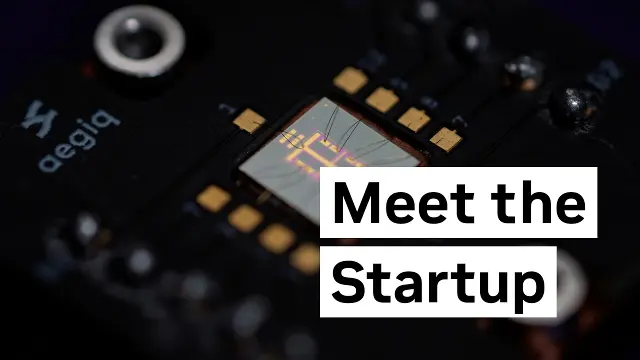
 Aegiq Builds Photonic Quantum Computers for Fiber Networks
#Photonic Quantum Computing
1 ideas
Aegiq Builds Photonic Quantum Computers for Fiber Networks
Get new #Photonic Quantum Computing ideas by email
Every Thursday: the week's best ideas, with the newest from #Photonic Quantum Computing.
Related tags
Photonic Quantum Computing: A Guide to Light-Based Qubits
Quantum computers promise a different way of processing information, one in which certain problems are approached through the mathematics of superposition and entanglement rather than through step-by-step classical logic. Photonic quantum computing is one branch of that effort: instead of trapping atoms or building superconducting circuits, it uses particles of light.
What it is
A photon is the smallest unit of light. Because light carries information naturally and moves quickly through both free space and optical fibre, photons can serve as qubits, the basic units of quantum information. Photonic processors therefore resemble advanced optical instruments more than they resemble the silicon chips we are used to: light is generated, guided through waveguides and beam splitters, interfered with other light, and finally measured with sensitive detectors that count single photons.
The two main approaches
Read more
The field divides broadly in two.
Discrete-variable photonics encodes quantum information in properties that have a small set of distinct values, such as the polarisation of a photon or which of several paths it takes. This is the picture closest to textbook quantum mechanics and it is intuitive to reason about.
Continuous-variable photonics instead encodes information in the continuous properties of a light field, most often its amplitude and phase in a squeezed state of light. Many operations here are easier to implement experimentally, but the information can sit in a very large state space that is harder to characterise and to error-correct.
In both approaches, computation is carried out with a limited toolkit: single-photon sources, interferometers, and photon counting. Because photons barely interact with one another, two-qubit operations are not a simple matter. Practical schemes often make them probabilistic, or replace a sequence of gates with a fixed pattern of entanglement, prepared in advance and consumed by measurement.
Why light appeals
Photons are unusually well isolated from their surroundings, so they carry quantum information with relatively little of the noise that plagues other hardware. Photonic circuits can operate without deep cryogenics, can be fabricated with techniques borrowed from the semiconductor industry, and connect naturally to the fibre networks that already span the world. That last point matters for any future in which several quantum processors must be linked together.
Where the difficulty lies
Light's independence is also its problem. Photons are lost, in waveguides, at components, and in detectors, and a lost photon cannot simply be replaced. Sources must produce identical photons reliably and one at a time. Detectors must register faint signals. Because interactions between photons are weak, error correction is demanding, and most schemes assume a large overhead of auxiliary states to build one dependable logical qubit. Photonic demonstrations, such as boson sampling, have also proved that a machine is doing something classically hard without that amounting to a useful computation.
If you are starting out
Learn the optics: interference, phase, polarisation, and how a waveguide circuit maps onto a matrix. Then learn the quantum formalism, particularly the state-vector description and measurement. Reading the two approaches side by side helps, because a squeezed state and a single-photon path encoding are describing the same kinds of questions in different language. Keep expectations measured; this is a research field, and progress is best read in the literature rather than in announcements.
#Photonic Quantum Computing: frequently asked questions
How should a beginner start learning photonic quantum computing?
Start with the optics rather than the quantum theory: interference, phase, polarisation, and the way a waveguide circuit with beam splitters maps onto a matrix acting on the light. Once that picture feels natural, learn the quantum formalism behind it, especially how a state vector is written and how measurement works. Reading the discrete-variable and continuous-variable approaches side by side is the fastest way to see that they are asking the same questions in different language.
What background do I actually need before studying this field?
Comfort with linear algebra is essential, since photon paths and interferometers are described as vectors and matrices, and some familiarity with classical wave optics makes the experiments legible. You do not need a cryogenics or superconducting-circuit background, which is part of what makes photonics approachable, but hands-on experience with lasers, single-photon sources and detectors helps enormously if you intend to work in a lab. Expect to read papers rather than tutorials once you are past the basics.
Discrete-variable or continuous-variable photonics: which should someone focus on?
Discrete-variable encoding, which uses properties like polarisation or which path a photon takes, is the closer match to textbook quantum mechanics and is easier to reason about and to teach. Continuous-variable encoding, which uses the amplitude and phase of a squeezed light field, often makes the physical operations simpler to implement but places the information in a vast state space that is harder to characterise and to correct. Many people learn discrete-variable first for intuition and then move to continuous-variable once the experimental trade-offs matter to them.
How do you keep a photonic circuit from degrading?
There is no maintenance routine in the usual sense, because the loss happens as light travels: photons disappear in waveguides, at components and at detectors, and a lost photon cannot be put back. The practical answer is engineering discipline rather than care, meaning low-loss fabrication, efficient coupling between components, reliable single-photon sources and detectors sensitive enough to register very faint signals. Everything downstream, including error correction, is designed around the assumption that some photons will not arrive.
What mistakes do newcomers to photonic quantum computing make?
The most common is reading a striking demonstration, such as boson sampling, as evidence of a useful machine, when it may only show that a device is performing something classically hard. Another is treating the two encoding approaches as rival hardware rather than two descriptions of the same physics, which leads to confused comparisons. A third is following announcements instead of the literature, which is where progress in a research field is actually legible.
Can someone build a photonic quantum processor as a hobby project?
Realistically no, not the hardware: it needs single-photon sources that emit identical photons one at a time, interferometers stable at the scale of a wavelength, and detectors able to count individual photons, none of which is a kitchen-table item. What is genuinely accessible is simulation, writing code that models interferometers as matrices and reproduces the statistics of photon interference, which builds the intuition the hardware demands. From there the sensible next step is a teaching lab or a research group rather than a home build.
Videos come from YouTube and posts from Instagram; titles and summaries are our own. All rights belong to their creators.