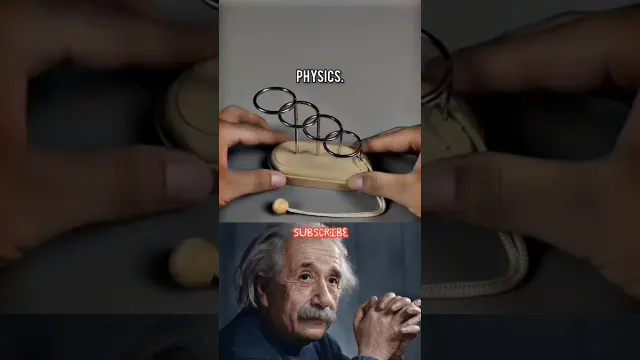
 A Simple Physics Demonstration and the Principles Behind It
#Physics Principles
1 ideas
A Simple Physics Demonstration and the Principles Behind It
Get new #Physics Principles ideas by email
Every Thursday: the week's best ideas, with the newest from #Physics Principles.
Related tags
Physics Principles: A Beginner's Guide to How Things Work
Physics is the study of matter, motion, force and energy — the attempt to describe, in as few rules as possible, why the world behaves the way it does. It is the oldest of the natural sciences and the one that reaches furthest, from the spin of a galaxy to the jiggle of an atom. What makes it distinctive is not the subject matter so much as the method: propose a simple rule, test it against measurement, and discard it the moment reality disagrees.
The principles you meet first are the ones that govern ordinary things. Newton's laws describe how an object stays still or keeps moving until something pushes it, how a push produces acceleration in proportion to mass, and how every action is matched by an equal and opposite reaction. Alongside these sit conservation laws — energy is never created or destroyed, only converted from one form to another; momentum in a closed system stays the same. These are not separate facts to memorise but shortcuts that let you predict outcomes without tracking every detail.
From there physics widens into territories. Thermodynamics deals with heat, temperature and the direction in which processes run, and it explains why some changes are irreversible even though nothing in the underlying motion forbids them. Waves and optics cover sound, light, reflection and refraction. Electromagnetism unites electricity and magnetism into a single framework and underlies everything from a motor to a radio. Modern physics adds relativity, which reshapes our ideas of space and time at extreme speeds and masses, and quantum mechanics, which describes matter at the smallest scales where the familiar rules stop holding.
Beginners often ask which to learn first. The practical answer is mechanics: it is intuitive, visible and gives you the vocabulary — force, work, energy, momentum — that later topics borrow constantly. Learn to draw a diagram of the situation, label the forces, and only then reach for an equation. Most confusion in physics comes from skipping that step. Pay attention to units, too; they are a check on your reasoning and will catch mistakes that algebra alone won't.
Read more
Learning by doing
Physics rewards hands-on exploration more than most subjects. A pendulum, a rolled ball, a glass of water and a torch will demonstrate oscillation, acceleration, refraction and reflection without any equipment. Change one thing at a time, predict what will happen, then look. The gap between prediction and result is where the learning lives.
It also helps to keep a rough sense of scale. Knowing that a metre is about a stride, that a second is about a heartbeat, and that everyday speeds are modest gives you a feel for whether an answer is plausible. Physicists call this a sanity check, and it is often more useful than precision.
Finally, accept that physics is built on models rather than certainties. A model is a deliberate simplification — a frictionless surface, a point mass, an ideal gas — and its value lies in how well it predicts, not in whether it is literally true. Understanding that early makes the subject far less mystifying, and far more enjoyable to explore.
#Physics Principles: frequently asked questions
How do I start learning physics?
Start with motion and forces, because they are visible in everyday life and give you the vocabulary — force, work, energy, momentum — that later topics reuse constantly. Begin each problem by drawing the situation and labelling what pushes or pulls on what, and only then reach for an equation. That habit prevents most of the confusion beginners run into.
What do I need to try a simple physics demonstration at home?
Nothing special — a pendulum made from a weight on a string, a ball to roll, a glass of water and a torch are enough to show oscillation, acceleration, refraction and reflection. The point is not the equipment but the method: change one thing at a time, predict the outcome, then watch what actually happens. The gap between your prediction and the result is where the learning happens.
Which branch of physics should I choose to study first?
Mechanics is the practical entry point, since it deals with objects you can see and time with your own senses. Once that feels solid, heat and thermodynamics, then waves and light, become much easier to absorb because the same ideas about energy and conservation keep reappearing. Relativity and quantum mechanics are best left until the ordinary rules feel familiar, since they are defined by how they depart from those rules.
What are the common mistakes people make when learning physics?
The most frequent is jumping to a formula before understanding the situation, which is why sketching a diagram and identifying the forces comes first. Another is ignoring units, when they are in fact a free check on whether your reasoning holds together. A third is treating a model as literal truth rather than a deliberate simplification whose value lies in how well it predicts.
How can I tell whether a physics answer is plausible?
Keep a rough sense of scale — roughly how long a stride is, roughly how long a heartbeat lasts, roughly how fast everyday things move — and compare your result against it. Physicists call this a sanity check, and it catches errors that the algebra alone will happily let through. It is usually more useful than chasing extra precision.
Videos come from YouTube and posts from Instagram; titles and summaries are our own. All rights belong to their creators.