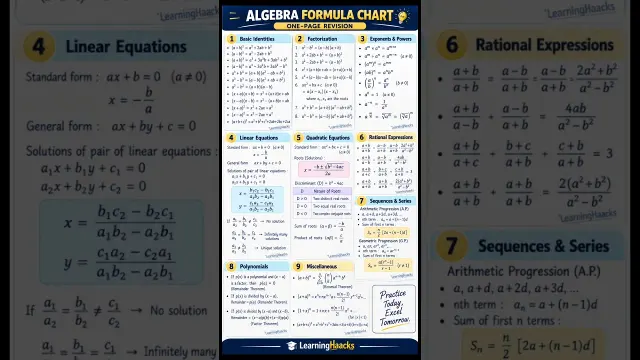
 All important algebra formulas in one revision sheet
#Polynomials
1 ideas
All important algebra formulas in one revision sheet
Get new #Polynomials ideas by email
Every Thursday: the week's best ideas, with the newest from #Polynomials.
Related tags
Polynomials: A Beginner's Guide to the Basics
A polynomial is one of the simplest and most useful objects in mathematics: an expression built from numbers and variables combined only by addition, subtraction and multiplication, with variables raised to whole-number powers. That restriction is the whole idea. You may write 3x² − 5x + 7 or a + b, but not 1/x, √x or x raised to a fraction — those break the rule and belong to other families of expressions.
The name itself joins the Greek prefix poly-, meaning "many", to the element -nomial we know from binomial, which comes from the Latin nomen, "name". So the word is best read simply as a name for expressions of many terms. The study of such expressions goes back to ancient Babylonian and Greek mathematics, where problems about areas and lengths were solved in geometric language, and it grew into symbolic algebra through Indian, Persian and later European mathematicians. What we now write with letters and exponents is the result of centuries of translating geometry into shorthand.
How a polynomial is built
Each separate piece of a polynomial is called a term, and every term is made of a coefficient (the number in front) and a variable part with a whole-number exponent. In 4x³ the coefficient is 4 and the exponent is 3. Terms with the same variable part are called like terms and can be combined; terms with different powers cannot.
Read more
The highest exponent in the expression gives the polynomial its degree, and the degree is the single most informative thing about it. A degree-one polynomial is linear, degree two is quadratic, degree three cubic. A polynomial with one term is a monomial, two terms a binomial, three a trinomial. The degree tells you, among other things, how many solutions an equation built from it can have.
What beginners should practise first
Two habits carry you a long way. The first is arranging terms in order of descending exponent before doing anything else, which makes addition, subtraction and comparison far clearer. The second is combining like terms carefully, paying attention to signs, since most early mistakes come from a lost minus rather than from misunderstanding.
After that come multiplying, using the distributive property term by term, and factoring, which is multiplication run backwards. Recognising a few standard patterns — a squared sum, a difference of two squares — saves a great deal of work. Long division of polynomials follows the same rhythm as dividing numbers.
Where polynomials are used
Polynomials describe relationships that grow at a steady, accelerating or reversing rate: the path of a thrown object, the curve of a profit margin, the shape of a bridge arch. They are also the raw material of approximation — many complicated functions can be approximated by polynomials as closely as needed — which is why they sit at the heart of numerical computing, engineering and statistics.
A practical note: check your answer by substituting a simple number such as x = 1. If both sides of a claimed identity give the same value there, your algebra is probably sound. It is a quick habit, and it catches a surprising number of slips.
#Polynomials: frequently asked questions
What makes an expression a polynomial?
It is built only from numbers and variables joined by addition, subtraction and multiplication, with every variable raised to a whole-number power. Anything that divides by a variable, takes a root of one, or uses a fractional exponent falls outside the family and belongs to another kind of expression.
What should a complete beginner practise first?
Learn to read one term at a time: the number in front is the coefficient and the small raised figure is the exponent. Then get used to writing the terms in descending order of exponent and combining only those whose variable parts match exactly, since that habit makes everything afterwards clearer.
How can I tell which kind of polynomial I am looking at?
Two labels carry most of the information. The highest exponent gives the degree, which names it linear, quadratic or cubic, while the number of separate terms tells you whether it is a monomial, binomial or trinomial. The degree is the more revealing of the two, because it hints at how many solutions an equation built from it can have.
What mistakes do people make most often with polynomials?
Losing a minus sign is the classic slip, usually while combining like terms or distributing a negative across a bracket. The other frequent error is merging terms whose powers differ, or multiplying only the first piece inside a bracket instead of every piece.
Why bother learning to factor?
Factoring is simply multiplication run in reverse, so it lets you see the structure hiding inside a long expression. It is what turns a complicated polynomial into something you can solve, simplify or compare, and a few standard patterns cover a surprising share of the cases you will meet.
Is there a fast way to check my work?
Yes: drop an easy value in place of the variable and work out each side of your claimed identity separately. If they match, your algebra is very likely sound, and if they don't, you have caught the error before it travels any further.
Videos come from YouTube and posts from Instagram; titles and summaries are our own. All rights belong to their creators.