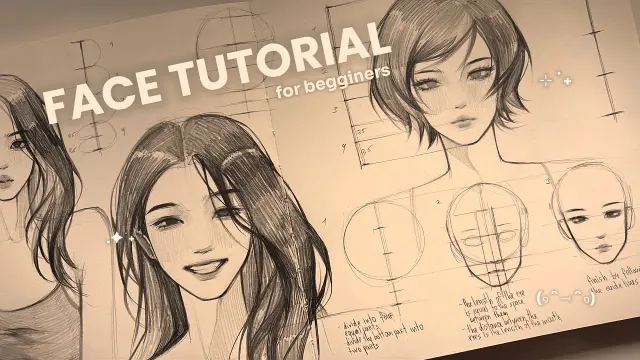
 Easy Semi-Realism Face Drawing Tutorial for Beginners
#Portrait Sketch
1 ideas
Easy Semi-Realism Face Drawing Tutorial for Beginners
Get new #Portrait Sketch ideas by email
Every Thursday: the week's best ideas, with the newest from #Portrait Sketch.
Related tags
Portrait Sketching: A Beginner's Guide to Drawing Faces
A portrait sketch is a drawing of a person's face and head, usually made with pencil, charcoal, pastel or ink. It can be a quick study of a few minutes or a carefully developed drawing of a few hours, but it shares one aim: to capture something of the person, not just the arrangement of their features. Portraits have been drawn for as long as people have made marks, and sketching remains the most common way artists learn to work from life, because a face is endlessly demanding and endlessly rewarding.
What makes a sketch different from a finished portrait
A sketch is exploratory. It shows the search for a likeness — the lines that were tried and adjusted, the notes in the margin, the areas left deliberately loose. A finished portrait tends to resolve every part of the drawing; a sketch leaves some of it as suggestion. Many sketchers find this the freeing part: the drawing does not have to be correct in every detail, only convincing in the places that matter, usually the eyes and the overall shape of the head.
Main approaches
Read more
- Construction drawing: building the head from simple forms — a sphere for the cranium, a tapering shape for the jaw — then placing features along measured proportions.
- Gesture sketching: working fast to catch pose, tilt and expression before the subject moves.
- Structural or block-in drawing: using straight lines and flat planes, often with a shaded mass for shadow, before any softening.
- Line-only drawing: contour and cross-contour lines, with little or no shading.
- Tonal drawing: building form with soft graphite, charcoal or pastel, using light and shadow instead of outlines.
Basic things worth knowing
The proportions of the head are worth practising until you can judge them by eye: the eyes sit roughly halfway down the skull, the distance between the eyes is about the width of one eye, the base of the nose falls about halfway between the eyes and the chin, and the ears occupy roughly the same vertical span as the eyebrows to the nose. These are averages, and the interest of a face lies in how it departs from them.
Learn to see values — how dark or light each area is — and to squint at your subject so detail drops away and the big shapes emerge. Draw from life whenever you can; photographs are useful, but they flatten form and freeze an expression that a living subject subtly changes.
Practical tips
- Start with the whole head before any feature, and keep stepping back from your paper.
- Check your drawing against the subject upside down or in a mirror to catch errors your eye has learned to ignore.
- Keep your pencil loose and your lines light at first; a hard outline is difficult to correct.
- Draw the same face several times in one sitting, each sketch quicker than the last.
- Accept that likeness is cumulative — most sketches fail somewhere, and the next one teaches you where.
Above all, sketch often and without fuss. A small, cheap sketchbook and a single pencil are enough, and the habit of drawing faces regularly will teach you more than any single piece of advice.
#Portrait Sketch: frequently asked questions
How do I start portrait sketching if I've never drawn a face before?
Begin with the overall shape of the head rather than jumping to the eyes or mouth, since features placed before the big form is established rarely sit right. Keep your first lines light and loose so mistakes are easy to adjust, and work from a live person whenever possible instead of relying only on photographs.
What materials do I actually need for portrait sketching?
A small sketchbook and a single pencil are genuinely enough to begin, and most people overbuy before they have drawn anything. As you go on you can add charcoal, pastel or ink for different qualities of line and tone, but the habit of drawing regularly matters far more than the supplies.
Which sketching approach should I choose: construction, gesture, or tonal drawing?
It depends on what you want to capture: construction drawing builds the head from simple forms and suits careful study, gesture sketching catches pose and expression quickly, and tonal drawing builds form through light and shadow instead of outlines. Many artists move between them in the same session, blocking in loosely and then resolving the parts that carry the likeness.
How do I keep a sketch looking like the person?
Likeness tends to live in the eyes and the overall shape of the head rather than in every detail, so put your effort there and leave other areas as suggestion. Checking your drawing upside down or in a mirror reveals errors your eye has stopped noticing, and drawing the same face repeatedly in one sitting sharpens your judgement quickly.
What are the common mistakes beginners make with portrait sketches?
The usual ones are starting with a hard outline, drawing features before the whole head is placed, and never stepping back from the paper. Another is expecting each attempt to succeed — most sketches go wrong somewhere, and the next one is where you learn what went astray.
Can I use a photo instead of drawing from life, and how should I care for my sketches?
Photographs are useful for practice, but they flatten form and freeze an expression that shifts constantly in a living subject, so draw from life when you can. Store finished sketches flat and away from damp and direct light, and avoid touching the surface of charcoal or pastel work, which smudges easily.
Videos come from YouTube and posts from Instagram; titles and summaries are our own. All rights belong to their creators.