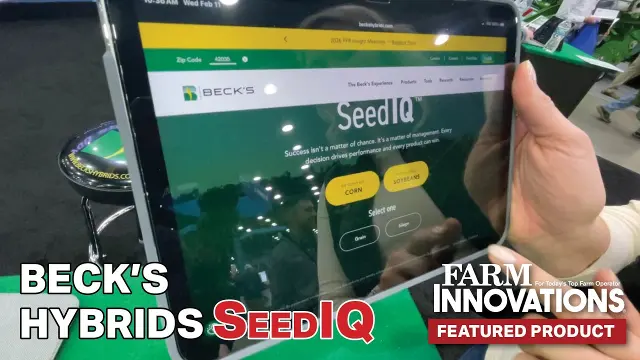
 SeedIQ Platform Delivers Practical Farm Research Insights
#Precision Farming
1 ideas
SeedIQ Platform Delivers Practical Farm Research Insights
Get new #Precision Farming ideas by email
Every Thursday: the week's best ideas, with the newest from #Precision Farming.
Related tags
Precision Farming: A Practical Guide to Farming by the Metre
Precision farming is the practice of managing a field in small, measured units instead of treating it as one uniform block. Rather than applying the same seed rate, fertiliser or spray across a whole paddock, a precision approach varies these inputs according to what each part of the field actually needs. The aim is straightforward: better use of inputs, less waste, and a clearer record of what happened where.
The idea grew out of two developments that reached farms in the late twentieth century: satellite positioning accurate enough to place a machine in a field, and sensors that could measure yield while harvesting. Once a combine could map where grain came from, and a tractor could know its own position to the centimetre, the field became something that could be described as data rather than only as soil underfoot.
The main techniques
- Guidance and auto-steer. Positioning systems keep machines on straight, evenly spaced passes, reducing overlap and driver fatigue. Section and nozzle control switches individual implements off where they would otherwise double-apply.
- Variable rate application. Seed, fertiliser, lime and spray are applied at different rates across a field, driven by maps or by live sensors on the machine.
- Soil and crop sensing. Grid soil sampling, soil scans, satellite or drone imagery and canopy sensors reveal variation that the eye misses from the cab.
- Yield mapping and record keeping. Harvest data, combined with input records, shows which zones respond and which do not.
- Data management. Farm management software ties these layers together into field zones, work records and reports.
Read more
What beginners should know
Start with the problem, not the technology. Ask what variation in the field is actually costing you — overlap on spraying, uneven establishment, a wet corner that never yields — and choose the smallest tool that addresses it. Guidance is usually the easiest entry point and pays back quickly through reduced overlap.
Be sceptical of precision without accuracy. Positioning, calibration and machine setup matter more than the maps themselves; a beautifully zoned map applied by an uncalibrated spreader is worse than useless. Take your time over soil sampling density and consistent depth, because every later decision rests on that baseline.
Build zones you can work with. A handful of stable management zones is more useful than dozens of small ones you cannot interpret or farm. Check results: leave a strip under your previous practice as a comparison, and look at it honestly over several seasons rather than one.
Finally, keep records that outlive the machine. Data trapped in a single display or a single brand of software is hard to use later; export what you can and keep backups. Precision farming rewards patience and clear observation more than it rewards buying the newest hardware, and the farms that benefit most are usually the ones that measure carefully before they change anything.
#Precision Farming: frequently asked questions
How do I get started with precision farming without overcomplicating things?
Start by naming the variation in your field that is actually costing you money, such as overlapping spray passes, patchy establishment or a wet corner that never yields well. Then pick the smallest tool that addresses that specific problem rather than building a whole system at once. Guidance and auto-steer are usually the gentlest entry point, because they deliver quick, visible savings before you move on to mapping and variable rates.
What do I need before I can apply inputs at variable rates?
You need a trustworthy baseline more than clever maps: consistent soil sampling at a sensible density and depth, a calibrated machine, and positioning you can rely on. From that baseline you can build a few stable management zones that mean something agronomically and that you can actually farm. Investing in accuracy before precision is what stops an elegant zone map from being undone by an uncalibrated spreader.
Which precision farming technique should I choose first?
Choose the one that matches the problem you have already identified and the records you already keep. If your main loss is overlap on spraying or spreading, section control and guidance will pay back soonest. If your main question is why parts of a field underperform, sensing and yield mapping are the better starting point, because they answer a question rather than just saving inputs.
How do I keep a precision farming setup working well over time?
Treat calibration and machine setup as ongoing habits rather than a one-off task, because positioning drift and mis-set implements quietly undo the benefit of good maps. Keep sampling consistent in density and depth so that seasons can be compared honestly. Revisit your zones periodically instead of letting an old map dictate decisions indefinitely.
How will I know whether precision farming is actually paying off?
Leave a strip under your previous practice as a comparison and look at it over several seasons rather than judging on one. Combine harvest data with your input records so you can see which zones respond and which simply absorb cost. The honest comparison, not the technology itself, is what tells you whether to continue or change course.
What are the common mistakes beginners make?
The most frequent is buying hardware before understanding the problem, which leaves expensive kit doing very little. Another is creating too many small zones that nobody can interpret or manage, when a handful of stable ones would serve better. A third is letting data live inside a single display or a single software package, so keep exports and backups that will still be usable when the machine is replaced.
Videos come from YouTube and posts from Instagram; titles and summaries are our own. All rights belong to their creators.