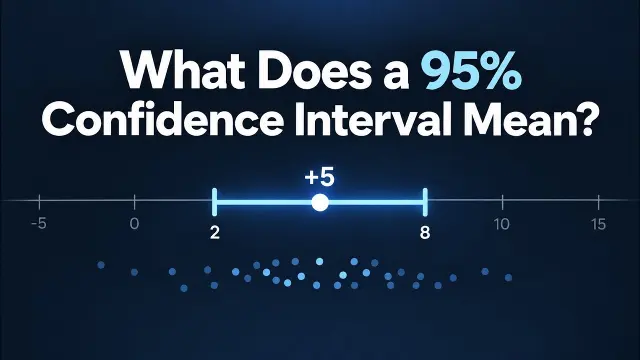
 What a 95% Interval Really Says: A Visual Walkthrough
#Precision
1 ideas
What a 95% Interval Really Says: A Visual Walkthrough
Get new #Precision ideas by email
Every Thursday: the week's best ideas, with the newest from #Precision.
Related tags
Precision: What It Means and Why It Matters
Precision is one of those words you meet everywhere and rarely stop to define. In its simplest sense it describes how closely repeated measurements of the same thing agree with one another. Step on a kitchen scale five times and get the same number each time, and the scale is precise. Get five different numbers, and it is not, however convincing any single reading looks.
Precision is not accuracy
The two words get used interchangeably, but they describe different things. Precision is about consistency; accuracy is about closeness to the truth. A scale can be perfectly precise and still be wrong: badly calibrated, it may give the same reading every time while that reading sits well above the real weight. The reverse happens too — readings scattered around the true value can average out well while each one is unreliable on its own. You want both, and you cannot assume accuracy just because the numbers keep repeating.
Where precision shows up
Read more
- Measurement: how finely an instrument resolves a value, and how much its readings drift between attempts.
- Statistics: how much an estimate would shift if you repeated the study on a fresh sample. Larger samples and less variable data generally give tighter estimates.
- Computing: how many digits a number can hold before rounding creeps in. Financial and scientific calculations can go quietly wrong when values are stored with too little room.
What makes an estimate more precise
More data helps, but not endlessly: precision improves quickly at first and then slowly, so doubling a sample rarely halves the uncertainty. Cleaner measurement often helps more than volume — a handful of careful readings usually beats a large pile of noisy ones. It also pays to separate variation you can control from variation you cannot.
Reading intervals without overreading them
A confidence interval is the usual way of putting precision into words: instead of a single number you get a range and a stated level of confidence, commonly 90% or 95%. The interval is not a promise that the truth lies inside it. It describes how the procedure behaves across many repetitions — intervals built this way capture the true value most of the time, though any one of them may miss. A wide interval means little precision, a narrow one more, provided the method itself is sound.
Starting points
- Report how much your numbers can reasonably vary, not just the numbers themselves.
- Round at the end of a calculation, not at every step along the way.
- Check your instrument or method against a known standard before trusting repeatability alone.
- Be wary of false precision: a result quoted to six decimals from rough inputs is not truer for the extra digits.
Precision tells you how much you can trust a repeated answer to stay put. Knowing its limits is what keeps you from mistaking steadiness for correctness.
#Precision: frequently asked questions
What is the difference between precision and accuracy?
Precision describes how closely repeated measurements of the same thing agree with each other, while accuracy describes how close those measurements are to the true value. An instrument can be perfectly consistent and still be wrong if it is badly calibrated, and readings can scatter around the truth without any single one being dependable. You want both, and repeating numbers alone never guarantee that you have them.
How can I make my measurements or estimates more precise?
Start with cleaner measurement rather than simply more of it, since a few careful readings usually beat a large pile of noisy ones. Adding data does tighten an estimate, but the benefit shrinks quickly, so doubling the amount rarely halves the uncertainty. It also helps to separate the variation you can control from the variation you cannot.
What does a confidence interval actually tell me?
A confidence interval expresses precision as a range rather than a single figure, paired with a stated level of confidence. It is not a promise that the true value sits inside that particular range; it describes how intervals built this way behave across many repetitions, capturing the truth most of the time while any one of them may miss. A narrower interval means more precision, as long as the method behind it is sound.
What is false precision and how do I avoid it?
False precision is the habit of quoting a result to many decimal places when the inputs were rough, which makes a number look more trustworthy without making it truer. Keep your rounding until the end of a calculation instead of at every step, and report how much your figures could reasonably vary alongside the figures themselves. Checking your instrument or method against a known standard also keeps repeatability from being mistaken for correctness.
Which common mistakes weaken precision the most?
Rounding at every stage of a calculation, trusting an uncalibrated instrument because it keeps giving the same reading, and confusing consistency with correctness are the usual culprits. In computing, storing values with too little room lets rounding creep in quietly and skew results. Reporting a single number with no sense of its spread hides the very thing precision is meant to describe.
Videos come from YouTube and posts from Instagram; titles and summaries are our own. All rights belong to their creators.