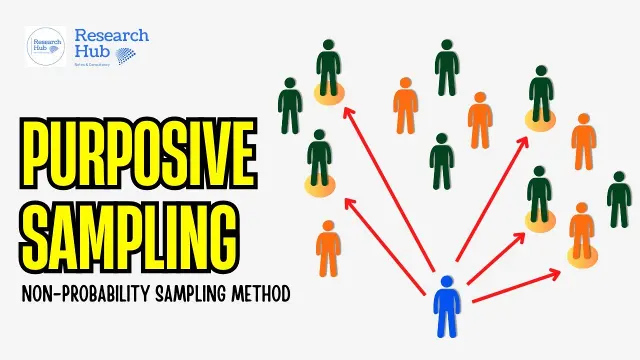
 Understanding Purposive Sampling in Research
#Purposive Sampling
1 ideas
Understanding Purposive Sampling in Research
Get new #Purposive Sampling ideas by email
Every Thursday: the week's best ideas, with the newest from #Purposive Sampling.
Related tags
Purposive Sampling: Choosing Participants on Purpose
Purposive sampling — also called judgmental or selective sampling — is a way of choosing participants for research based on what the researcher knows about them, rather than by random selection. Instead of giving everyone in a population an equal chance of being picked, you deliberately choose the people, cases or documents that can best answer your question. It belongs to the family of non-probability sampling methods, which means the results are not meant to be generalised to a wider population in a statistical sense. What you gain instead is depth: rich, detailed information from sources chosen for a reason.
Where it comes from
Purposive sampling grew out of qualitative research traditions in the social sciences, where the aim is often to understand meaning, process and context rather than to measure how common something is. Researchers working with interviews, case studies, ethnography and document analysis needed a logic of selection that matched that aim. If you want to understand how a decision was made, choosing a random stranger is far less useful than choosing someone who was actually in the room.
The main types
Read more
Several variants appear again and again in research design:
- Maximum variation sampling deliberately includes a wide range of cases, so that patterns shared across very different participants stand out.
- Homogeneous sampling does the opposite, focusing on a tightly defined group so that a particular experience can be described in detail.
- Typical case sampling selects ordinary, representative examples of a phenomenon.
- Extreme or deviant case sampling looks at unusual cases, which can throw normal practice into relief.
- Critical case sampling picks the case most likely to confirm or challenge an idea.
- Expert sampling draws on people with specialised knowledge of the topic.
These are often combined, and the choice depends entirely on the question you are asking.
What beginners should know
The first lesson is that "purposive" does not mean "convenient". Selecting whoever is easiest to reach is a different method with different weaknesses. Your selection needs a stated rationale: for each participant, you should be able to explain why they were included and what they contribute.
The second is that the criteria should be settled before recruitment begins, at least in outline. Write down what makes someone eligible — a role, an experience, a characteristic, a document type — and apply it consistently, even if the criteria evolve as you learn.
The third is transparency. Because judgement plays a role, readers need to see whose judgement it was and how it was applied. Describe how you found people, why you approached them, how many declined, and where the sample stopped growing.
Practical tips
Sample size in purposive work is usually guided by saturation — the point at which new participants stop adding new information — rather than by a formula. Expect to justify your stopping point rather than simply report a number.
Keep a short sampling log: date, who, why chosen, and what they added. It protects you from unconscious bias towards people who are easy to talk to or who agree with you. Also consider seeking out cases that might contradict your emerging interpretation, not only those that confirm it.
Finally, be honest about reach. Purposive samples support careful analytical claims, not population estimates, and naming that limitation clearly strengthens rather than weakens your work.
#Purposive Sampling: frequently asked questions
What is purposive sampling in simple terms?
It is a way of picking participants on purpose rather than at random, choosing the people, cases or documents that can actually answer your question. It sits among the non-probability methods, so the aim is depth and detail rather than a snapshot of a whole population. You trade breadth for information you could not get from a random stranger.
How is purposive sampling different from just asking whoever is easiest to reach?
Picking the most convenient people is a separate approach with its own weaknesses, and it does not become purposive just because you chose them yourself. The distinguishing feature is a stated reason: for every participant you should be able to say why they were included and what they contribute. If you cannot give that reason, the selection is convenience wearing a different label.
Which type of purposive sampling should I choose?
Let your research question decide. If you want to see what holds across very different cases, spread wide; if you want one experience described closely, narrow to a tightly defined group; and if unusual practice is the point, deliberately seek the odd case out. Typical, critical and expert variants serve other questions again, and mixing two of them is common.
How do I know when I have enough participants?
Stop when new participants stop telling you anything new, rather than when you hit a target figure. What matters is being able to explain why you stopped where you did. Keeping a simple log of who you approached, why, and what each one added makes that explanation easy to write and protects you from drifting towards people who are pleasant to talk to.
What mistakes should a beginner avoid?
The usual ones are treating the method as an excuse for convenience, settling the eligibility criteria only after recruitment has started, and leaving the reader unable to see whose judgement shaped the sample. Another is looking only for cases that confirm the interpretation you are forming. Say plainly how you found people, why you approached them, and how many declined.
Can I generalise from a purposive sample?
Not in a statistical sense, and claiming otherwise is where such work gets into trouble. What the sample supports is careful analytical argument about meaning, process and context. Naming that limit openly reads as rigour, not as an admission of weakness.
Videos come from YouTube and posts from Instagram; titles and summaries are our own. All rights belong to their creators.