 Understanding the Quadratic Formula in Algebra
#Quadratic Formula
1 ideas
Understanding the Quadratic Formula in Algebra
Get new #Quadratic Formula ideas by email
Every Thursday: the week's best ideas, with the newest from #Quadratic Formula.
Related tags
Quadratic Formula Guide
What the quadratic formula is
The quadratic formula is a standard rule for finding the solutions of a quadratic equation, which is an equation written in the form ax^2 + bx + c = 0. It is one of the most useful tools in algebra because it works for any quadratic equation, even when the factors are not easy to see.
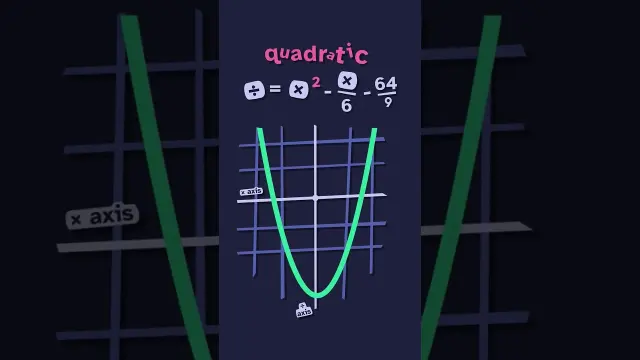
A quadratic equation describes a parabola when you graph it, so the formula is closely connected to curves, turning points, and roots. The solutions found by the formula are often called zeros or roots, because they are the values of x that make the equation equal to zero.
The formula itself
Read more
The quadratic formula is:
x = (-b ± √(b² - 4ac)) / 2a
Here, a, b, and c are the numbers from the equation ax^2 + bx + c = 0.
If you are new to it, it helps to remember that the formula gives two possible answers because of the plus-or-minus sign. Sometimes the two answers are different, sometimes they are the same, and sometimes there are no real-number solutions.
When to use it
You can use the quadratic formula for any quadratic equation once it is written in standard form. It is especially helpful when:
- the equation does not factor easily
- you want to check your answer after factoring
- you need exact solutions rather than estimating from a graph
- you want to know whether the equation has real solutions
The expression under the square root, b² - 4ac, is called the discriminant. It tells you something about the type of solutions:
- if it is positive, there are two real solutions
- if it is zero, there is one real solution
- if it is negative, there are no real solutions, only complex ones
How to use it well
Begin by making sure the equation is in standard form and set equal to zero. Then identify a, b, and c carefully. Small sign mistakes are very common, especially when b or c is negative.
A good habit is to write the formula first, then substitute the values clearly before simplifying. Take your time with the square root and the fraction, and check whether the expression inside the radical can be simplified.
Helpful beginner tips
- Always compare your equation to ax^2 + bx + c = 0 first.
- Keep track of signs with extra care.
- If possible, simplify the square root before finishing.
- Check your answers by substituting them back into the original equation.
- If the equation does not have integer roots, that does not mean you made a mistake.
Why it matters
The quadratic formula is valuable because it gives a reliable method, not just a shortcut. Whether you are solving a homework problem, studying graph shapes, or learning algebra more deeply, it gives you a clear path from equation to answer. Once you understand how it works, many quadratic problems become much easier to approach.
Videos come from YouTube and posts from Instagram; titles and summaries are our own. All rights belong to their creators.