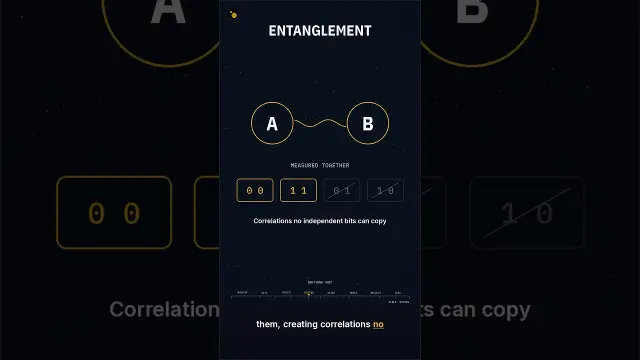
 How Quantum Computers Use Interference to Cancel Wrong Answers
#Quantum Gates
2 ideas
How Quantum Computers Use Interference to Cancel Wrong Answers
 Hadamard and CNOT Gates Explained by IBM's Olivia Lanes
Get new #Quantum Gates ideas by email
Every Thursday: the week's best ideas, with the newest from #Quantum Gates.
Related tags
Quantum Gates: A Beginner's Guide to Quantum Circuits
Quantum gates are the elementary operations performed on qubits, the quantum equivalent of the logic gates that act on ordinary bits. A classical gate takes bits in and puts bits out, flipping or combining them according to fixed rules. A quantum gate does the same job in a much larger space: it transforms the state of one or more qubits while they remain in a quantum superposition, so it can act on many possible inputs at once.
Why they look the way they do
A qubit is not simply a zero or a one. Its state is described by a pair of amplitudes, which together fix the probabilities of measuring zero or one and also carry a relative phase. Gates manipulate those amplitudes. Mathematically, each gate is a unitary transformation, meaning it preserves the total probability and can always be undone by another gate. Reversibility is therefore not a quirk of some gates but a property of all of them: every quantum gate has an inverse gate that restores the previous state exactly. Classical logic works differently. A gate such as AND discards information, since many different inputs give the same output, and it cannot be run backwards. This is not a problem in practice, because classical circuits are built from reversible pieces by keeping the inputs around and writing the answer to a spare bit. On the quantum side, no such trick is available for copying an unknown state, so the reversibility of the gates themselves carries the whole burden.
Measurement is the exception. Reading a qubit collapses its state to a definite outcome and cannot be reversed, which is why measurement is usually drawn separately from the gates in a circuit diagram.
Read more
The gates worth learning first
The single-qubit gates form the alphabet. The Pauli gates are the simplest: X flips a qubit the way a NOT gate does, Z leaves the measurement probabilities untouched but shifts the phase, and Y does both. The Hadamard gate is the workhorse of nearly every quantum algorithm, since it turns a definite state into an even superposition of zero and one. Phase gates such as S and T rotate the phase by smaller and smaller fractions of a full turn, and general rotation gates let you dial in an arbitrary angle. Together these gates can approximate any single-qubit operation to whatever precision you need.
Two-qubit gates create the correlations that make quantum computing distinctive. The controlled-NOT, or CNOT, flips a target qubit only when a control qubit is one. Applied to a superposition, it produces entanglement, a joint state that cannot be described by describing the parts separately. The controlled-Z and the SWAP gate do related jobs. Larger constructions such as the Toffoli gate, which flips its target only when both of its control qubits are one and leaves it alone otherwise, show how more complex logic is built by composing simple pieces.
Practical advice for beginners
Start by drawing circuits rather than by chasing algebra. A circuit is read left to right, with each qubit on its own horizontal line and each gate a box or symbol on that line.
Learn to predict a gate's effect on the basis states first, then on superpositions. Most confusion comes from forgetting that a gate acts on the whole state at once, not on a single branch of it.
Remember that real hardware is noisy. Gates are never perfect, and qubits lose their state over time, which is why error correction matters so much in the field.
Finally, keep the global picture in view: any quantum algorithm is just a carefully chosen sequence of these few operations, followed by a measurement at the end.
#Quantum Gates: frequently asked questions
How do I start learning quantum gates if I have no physics background?
Start with circuit diagrams rather than equations: they show each qubit as a horizontal line and each gate as a symbol placed in order from left to right, which makes the flow of a computation easy to follow. Once a drawing feels familiar, look at what the same gate does to a plain zero or one before trying to understand its effect on a superposition. Working visually first keeps the algebra from arriving before the intuition does.
What do I actually need in order to practise with quantum gates?
Nothing beyond a way to draw and simulate circuits, since the gates themselves are just reversible transformations you can work through on paper or in a simulator. A notebook for sketching diagrams is genuinely useful, because predicting what a circuit will output and then checking it is where most of the learning happens. Real hardware is optional and, at the beginner stage, more of a distraction than a help.
Which gates are worth learning first?
Begin with the small set that everything else is built from: the ones that flip a qubit, the one that shifts its phase without changing measurement odds, and the one that turns a definite state into an even superposition. From there, add a two-qubit gate that acts on one qubit only when another is set, because that is what produces entanglement. Everything more elaborate is composed from these pieces, so there is no need to memorise a long catalogue.
How do I take care of a quantum circuit so the results stay trustworthy?
The main thing to manage is noise: gates are never exact and qubits drift out of their state over time, so shorter circuits with fewer operations generally give cleaner answers. Running the same circuit repeatedly and comparing outcomes tells you how much of what you see is signal and how much is error. This is also why error correction is treated so seriously in the field rather than as an afterthought.
What is the most common beginner mistake with quantum gates?
Assuming a gate acts on one branch of a superposition at a time, when it actually transforms the whole state at once, including the phase relationships between branches. The second frequent slip is forgetting that measurement is not a gate: it collapses the state irreversibly and belongs at the end of a circuit, drawn apart from the operations. Keeping both points in mind clears up most of the confusion people hit early on.
Videos come from YouTube and posts from Instagram; titles and summaries are our own. All rights belong to their creators.