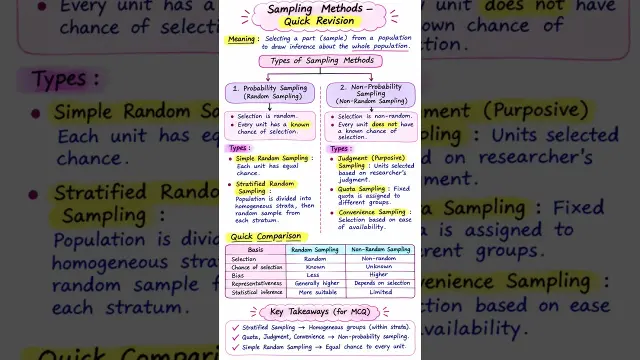
 Random and Non-Random Sampling Methods for Research Aptitude
#Quota Sampling
1 ideas
Random and Non-Random Sampling Methods for Research Aptitude
Get new #Quota Sampling ideas by email
Every Thursday: the week's best ideas, with the newest from #Quota Sampling.
Related tags
Quota Sampling: Definition, Types and How It Works
Quota sampling is a way of building a sample in which the researcher decides in advance how many people to include from each group within a population, then selects those people by any convenient means. The groups, or quotas, usually mirror characteristics such as age, gender, income, region or education. The aim is a sample that looks like the wider population in its main proportions, even though the individuals inside each quota were not chosen at random.
Where it comes from
The technique grew out of market research and public-opinion polling in the early twentieth century, when researchers needed quick answers without a full list of everyone in the population. Rather than draw names from a register, an interviewer could stand in a high street or visit homes and keep a tally of the kinds of people already recruited. That practical logic still explains most of its use today.
How it works
Read more
The work begins with a decision about which characteristics matter. If you know that a city is roughly half women and half men, and that a certain share of households rent rather than own, those proportions become the targets. The researcher then records the profile of each person recruited and stops filling a category once its target is reached.
Proportional and non-proportional quotas
In proportional quota sampling, the quotas follow the known makeup of the population, so a group that forms a fifth of the population fills a fifth of the sample. In non-proportional quota sampling, the researcher deliberately over-recruits small groups in order to say something useful about them, accepting that the overall sample no longer matches the population's proportions. Some studies also use controlled quotas, adding rules about where or how people may be approached, to limit obvious bias in who gets asked.
Quota sampling and stratified sampling
The two are often confused because both divide a population into groups. The difference lies in the final step. Stratified sampling chooses randomly within each group; quota sampling does not. That single distinction governs everything that follows.
What to be careful about
Because selection inside each quota is left to the recruiter, the sample reflects their choices, their route and their willingness to approach certain people. Quiet, busy or hard-to-reach people tend to be missed, and interviewers may unconsciously favour those who resemble them or seem agreeable. For this reason, quota samples cannot support a calculated margin of error, and results should be read as descriptive rather than as precise estimates of the population. It is also wise to check how the quotas were defined, whether they are proportional, and how the recruiters were briefed.
Practical tips for beginners
- Choose a small number of variables that genuinely relate to what you are studying; too many make quotas impossible to fill.
- Base targets on reliable, up-to-date population figures where you can find them.
- Record refusals and incomplete interviews, not just successful ones.
- Report clearly that the sample is non-random, so readers do not over-read the findings.
Used with honesty about its limits, quota sampling remains a fast, inexpensive and often sensible tool, particularly for exploratory work and for research where no full list of the population exists.
#Quota Sampling: frequently asked questions
What is quota sampling in simple terms?
It is a way of assembling a sample where the researcher first decides how many people to include from each group in a population, then fills those slots by whatever convenient means are available. The groups usually mirror traits like age, gender, income, region or education, so the finished sample resembles the wider population in its main proportions. The people within each group, however, are not picked at random.
How is quota sampling different from stratified sampling?
Both approaches split a population into groups, which is why they are so often confused. The difference is in the last step: stratified sampling selects people randomly inside each group, while quota sampling leaves that selection to the recruiter's convenience. That single distinction is what determines how much confidence you can place in the results.
Should I use proportional or non-proportional quotas?
Proportional quotas follow the known makeup of the population, so a group that makes up a small share of the whole fills a correspondingly small share of the sample. Non-proportional quotas deliberately over-recruit smaller groups so you can say something useful about them, at the cost of the overall sample no longer matching the population. Choose proportional when you want a representative picture, and non-proportional when a particular subgroup is the point of the study.
How do I get started, and which characteristics should I set quotas on?
Begin by deciding which characteristics genuinely matter for what you are studying, then base your targets on reliable, current population figures. Keep the number of variables small, because too many quotas quickly become impossible to fill. Some researchers also add rules about where and how people may be approached, which helps limit obvious bias in who ends up being asked.
What mistakes should I watch out for?
The biggest risk is that selection inside each quota is left to the recruiter, so quiet, busy or hard-to-reach people tend to be missed and interviewers may gravitate toward those who seem agreeable or resemble them. Because of this, results should be read as descriptive rather than as precise estimates, and no margin of error can be calculated. Record refusals and incomplete interviews alongside successful ones, and state plainly that the sample is non-random so readers do not over-read the findings.
When is quota sampling a sensible choice?
It suits fast, inexpensive exploratory work, especially when no full list of the population exists and a full random draw is impractical. It is also useful when you need to reach a particular subgroup that would be hard to find through random selection alone. It is less appropriate when you need precise, generalisable estimates of a population.
Videos come from YouTube and posts from Instagram; titles and summaries are our own. All rights belong to their creators.