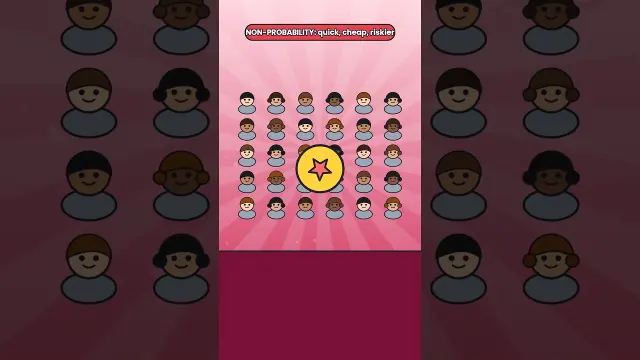
 Sampling Techniques Explained With a Biryani Analogy
#Probability Sampling
5 ideas
Sampling Techniques Explained With a Biryani Analogy
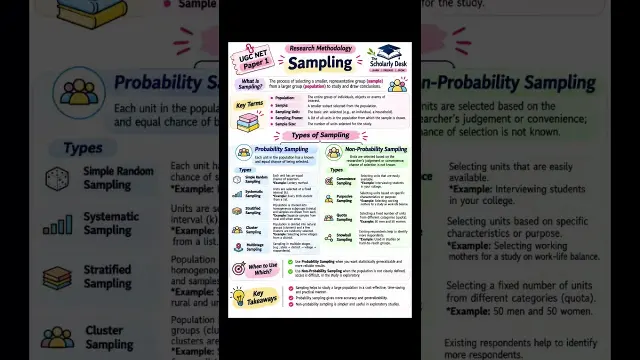 Probability vs Non-Probability Sampling for UGC NET Paper 1
 Sampling Theory for CFA Level 1: Populations, Samples and Sampling Error
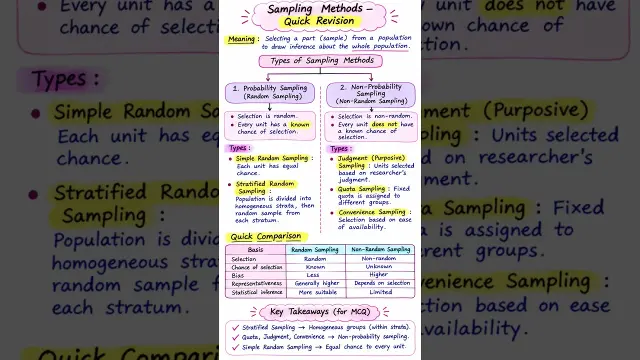 Random and Non-Random Sampling Methods for Research Aptitude
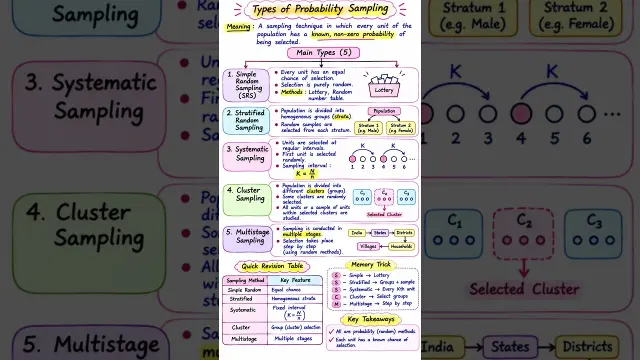 Five Types of Probability Sampling Explained for Research Exams
Get new #Probability Sampling ideas by email
Every Thursday: the week's best ideas, with the newest from #Probability Sampling.
Related tags
Probability Sampling: A Beginner's Guide to Fair Samples
When researchers want to learn something about a large group, they rarely study every member of it. Instead they study a smaller set, the sample, and use it to reason about the whole. Probability sampling is the family of methods that makes this reasoning defensible, because each member of the population is selected through a known, non-zero chance mechanism rather than through convenience or personal choice.
Why the selection mechanism matters
The defining feature of probability sampling is randomness combined with a known probability of selection. That combination is what allows researchers to estimate how far a sample result might stray from the truth of the full population. A convenience sample, gathered from whoever is easiest to reach, may still be useful for early exploration, but it offers no dependable way to say how confident anyone should be in the findings. It also tends to over-represent people who are available, willing, or easy to contact, which quietly distorts the picture.
The main kinds
Read more
- Simple random sampling: every member of the population has an equal chance, usually drawn by lottery or a random number generator from a complete list.
- Systematic sampling: researchers pick a random starting point and then select every nth item from a list. It is simple to carry out, but can misbehave if the list has a hidden repeating pattern.
- Stratified sampling: the population is divided into groups that share something relevant, such as age band or region, and random samples are drawn from each. This helps ensure smaller groups are represented.
- Cluster sampling: the population is split into clusters such as schools, villages or clinics, some clusters are chosen at random, and everyone inside the chosen ones is studied. Practical when a full list of individuals does not exist.
- Multistage sampling: clusters are selected, then sub-clusters within them, and so on, with random selection at each step.
What beginners should keep in mind
Start with the population you actually want to describe, then find or build the list you will draw from. That list, the sampling frame, is the weak point of most studies: if it leaves people out, no amount of random drawing will repair the gap.
Decide on sample size before collecting data rather than after, since a sample chosen because results looked promising is no longer a probability sample. Be alert to non-response, too. Even a perfectly drawn sample can drift when the people who decline differ systematically from those who take part, so follow-up efforts matter.
Document how the sample was drawn, so readers can judge the result. For most everyday research questions, a modest, honestly drawn random sample is worth far more than a large, poorly chosen one.
#Probability Sampling: frequently asked questions
How do I start using probability sampling in a study?
Start by defining the exact population you want to describe, then build a sampling frame that lists the members you can actually draw from. From there, choose a random selection method and decide in advance how you will handle non-response and missing cases.
What do I need before I can do probability sampling?
You need a clear target population, a usable list or frame, and a selection process that gives each member a known chance of being chosen. It also helps to plan your sample size early and document the steps so the process can be checked later.
Which type of probability sampling should I choose?
Choose simple random sampling when you have a complete list and want the most straightforward random draw. Use stratified sampling when you need smaller subgroups to be represented, and cluster or multistage sampling when a full list of individuals is hard to get or reach.
What is the biggest mistake people make with probability sampling?
A common mistake is relying on a weak sampling frame that leaves out parts of the population, because randomness cannot fix missing coverage. Another frequent problem is ignoring non-response, which can quietly shift the sample away from the group you meant to study.
When is probability sampling better than convenience sampling?
Probability sampling is better when you need findings that can be defended as a fair picture of a larger population. Convenience sampling can be useful for quick exploration, but it is much weaker when you want confidence in how well the sample reflects the whole group.
Videos come from YouTube and posts from Instagram; titles and summaries are our own. All rights belong to their creators.