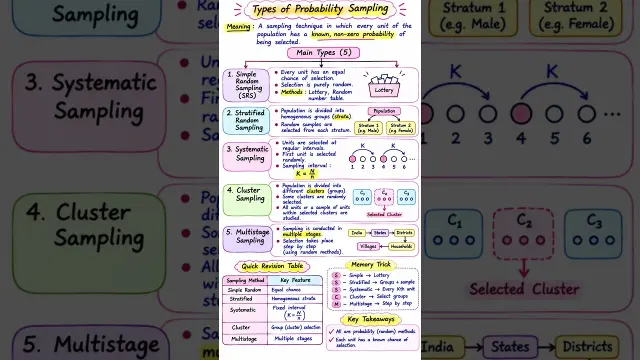
 Five Types of Probability Sampling Explained for Research Exams
#Stratified Sampling
3 ideas
Five Types of Probability Sampling Explained for Research Exams
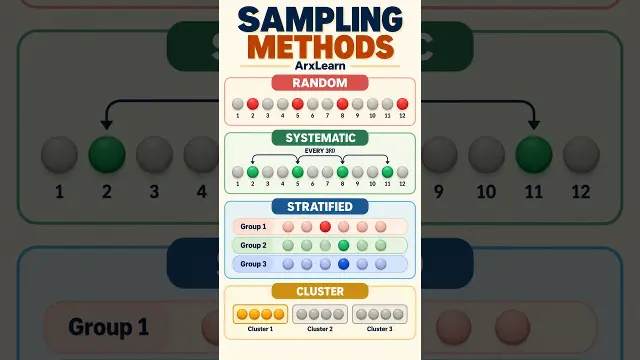 Random, Stratified, Cluster and Systematic Sampling in Animation
 Understanding the Stratified Sampling Technique
Get new #Stratified Sampling ideas by email
Every Thursday: the week's best ideas, with the newest from #Stratified Sampling.
Related tags
Stratified Sampling: A Practical Guide to Better Samples
Stratified sampling is a way of selecting part of a larger group for study so that the result describes the whole. The population is first divided into strata: subgroups that are internally similar and clearly different from one another. A sample is then drawn from every stratum, usually at random within each one. Because each subgroup is represented by design rather than by luck, the overall picture is steadier and more complete.
How it works
The method rests on one simple idea: variation inside a group is easier to handle than variation across the whole population. If you split a group into parts that share something important, the differences within each part shrink, and a small sample from that part can be trusted to resemble it. Common strata are age bands, income levels, regions, firm size, product category, or any characteristic known to relate to what you are measuring.
Forming the strata requires information about every unit in the population, which is the practical limit of the technique. You need a list that records the stratifying characteristic for each person or item, and that list has to be reasonably accurate. Where it is missing, stratification is not possible and other designs are used instead.
Read more
Main kinds
Proportional allocation gives each stratum a share of the sample matching its share of the population. A stratum holding a tenth of the population supplies a tenth of the sample. This is the simplest approach and produces estimates for the whole population that are at least as precise as a plain random sample, and usually better.
Disproportionate or optimal allocation deliberately over-samples small or highly variable strata. This is done when reliable results are needed for each subgroup separately, or when some strata vary more than others and therefore need more observations to pin down. The trade-off is that the sample no longer mirrors the population, so the results must be weighted back before totals are calculated.
Why it is used
The gains are twofold. Precision improves because the between-stratum differences, which would otherwise blur the estimate, are handled by construction rather than left to chance. And coverage is guaranteed: every subgroup appears, so no small but important segment disappears from the results. Stratified sampling also makes administration easier, since fieldwork can be organised and supervised group by group.
The costs are real too. The design is more complex to plan, requires prior information, and demands care at the analysis stage, especially when allocation is disproportionate. Mistakes in weighting can be more damaging than the imprecision stratification was meant to fix.
What beginners should know
Choose strata that are mutually exclusive and together cover everyone. Keep the number of strata modest relative to the sample size, so that every stratum receives enough observations to say something. Remember that strata are not the same as clusters: a cluster is sampled whole, while a stratum contributes only a sample.
Finally, decide early whether you need a good estimate for the population as a whole or for each stratum, because that answer determines the allocation and the weighting.
#Stratified Sampling: frequently asked questions
What is stratified sampling in simple terms?
It is a sampling method where you first split a population into meaningful subgroups and then take a sample from each one. This helps the final sample reflect the whole group more evenly than relying on chance alone.
How do I start setting up a stratified sample?
Start by deciding which characteristic matters most for the study, then divide the population into clear, non-overlapping subgroups based on that trait. You also need a reliable list showing which unit belongs to which subgroup before you can sample.
When should I choose proportional or disproportionate stratified sampling?
Choose proportional allocation when you want the sample to resemble the population structure as closely as possible. Use disproportionate allocation when some subgroups need extra attention or when a smaller or more variable subgroup needs more observations for a stable result.
What information do I need before using stratified sampling?
You need accurate background information for every item or person so you can place each one into the right subgroup. Without that complete classification, you cannot build the strata properly and may need a different sampling method.
What are the most common mistakes to avoid with stratified sampling?
A common mistake is creating too many strata or making them too small, which can leave each group with too few observations. Another frequent error is forgetting to adjust the analysis when the sample was taken disproportionately, which can distort the final results.
Videos come from YouTube and posts from Instagram; titles and summaries are our own. All rights belong to their creators.