
Understanding the Stratified Sampling Technique
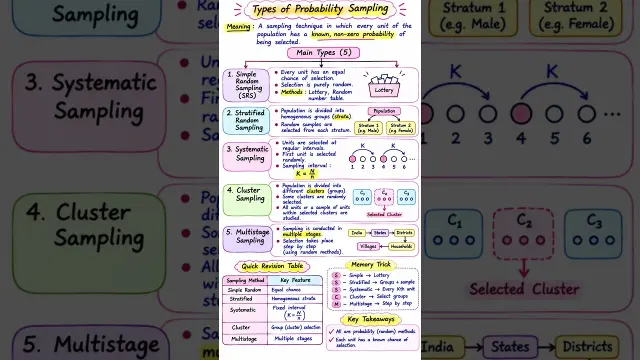
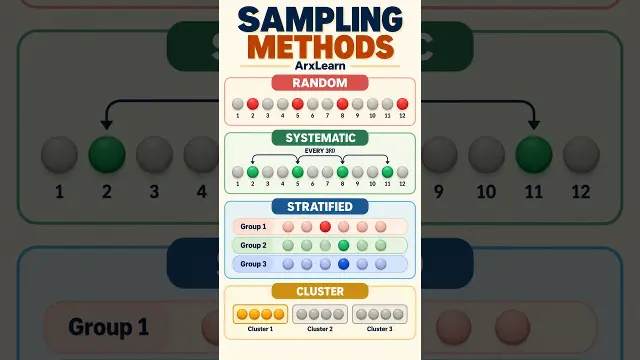
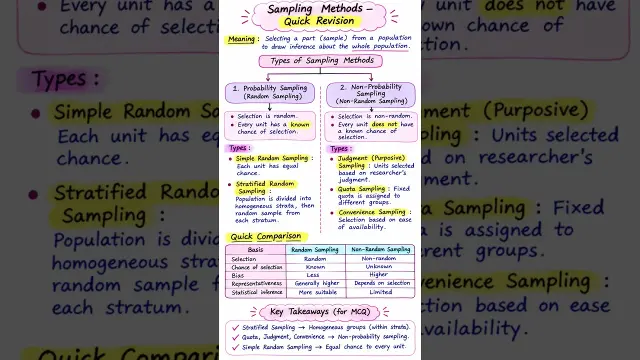
This lecture discusses stratified sampling, where a population is divided into distinct subgroups to ensure fair representation.
YouTube · Research-Hub · 16 November 2025 Watch on YouTube
Tried this idea? Show how yours turned out.
I made thisHow to do it
What you need
- Population to study
- Shared characteristics for grouping (age, gender, income, location)
- Random sampling method
Step by step
- Define the population you want to study.
- Divide the population into distinct subgroups, or strata, based on a shared characteristic such as age, gender, income, or location.
- Draw a random sample from within each stratum.
- Combine the samples so every key group is represented in the study.
- Compare the results across subgroups to capture variation.
Tips
- Choose strata that actually differ in ways relevant to what you are studying, so the groups are meaningful.
- Make sure every stratum gets sampled — skipping one loses the representativeness you are after.
- This approach pays off most when the population is diverse and the survey is large.
Written by Tagrazzi from the original's description and photo.
The title and summary are written by Tagrazzi; the video belongs to its creator and plays from YouTube.






Comments (0)
No comments yet. Be the first to comment.
Sign in to write a comment.