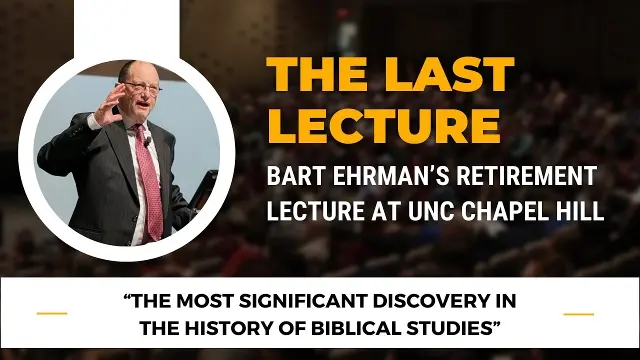
 Bart Ehrman's Final Lecture on Biblical Studies at UNC
#Retirement Lecture
1 ideas
Bart Ehrman's Final Lecture on Biblical Studies at UNC
Get new #Retirement Lecture ideas by email
Every Thursday: the week's best ideas, with the newest from #Retirement Lecture.
Related tags
Retirement Lecture: A Scholar's Farewell Address
A retirement lecture is the talk a teacher or scholar gives near the end of a working life in research and teaching. It is not a conference paper and not a farewell party speech, though it often sits somewhere between the two: a formal occasion with an audience, a lectern and a title, in which a career is looked back on and thought through in public.
Where the custom comes from
The idea grows out of the older European university habit of the public lecture, when professors taught by speaking to a room rather than by distributing texts. When a chair changed hands, the outgoing holder was given the hall one final time. The form survives in many countries under different names — valedictory lecture, farewell lecture, final lecture, or the German Abschiedsvorlesung — and it has spread well beyond Europe, into departments of every discipline. What stays constant is the shape of the event: one speaker, one occasion, an audience of colleagues, students, family and old friends.
What it is for
Read more
A retirement lecture does several things at once. It marks an ending, and gives a department and a wider circle of listeners a chance to acknowledge a body of work. It lets the speaker say out loud what they have spent decades thinking about, and why it mattered. And it is often the only moment when a specialist addresses a genuinely mixed room, so it tends to be more reflective and less technical than ordinary teaching.
Common forms
- The retrospective, tracing a line of inquiry from early questions to late conclusions.
- The state-of-the-field lecture, weighing where a discipline has arrived and what remains open.
- The teaching lecture, an hour on a subject the speaker always loved and never had room to teach.
- The personal essay, where the argument carries more autobiography than usual.
If you are the one speaking
Choose a subject broad enough for the least specialised person in the room, and narrow enough that you still have something to say. Write for the ear, not the page. Say plainly what you owe to teachers, students and colleagues, and name them if you wish to — this is the moment for it. Keep to your time; a good lecture ends while people still want more. If you can, leave a written copy behind, since these talks are rarely published and are easily lost.
If you are in the audience
Arrive on time, sit forward, and listen for the argument underneath the anecdotes. Ask a real question afterwards rather than making a speech of your own. And if you were once a student of the speaker, say so — the presence of former students is part of what makes the occasion what it is.
Whether you are giving or attending one, a retirement lecture is best treated as a gift of attention: an hour set aside to take a lifetime of work seriously, in the company of the people who watched it happen.
Videos come from YouTube and posts from Instagram; titles and summaries are our own. All rights belong to their creators.