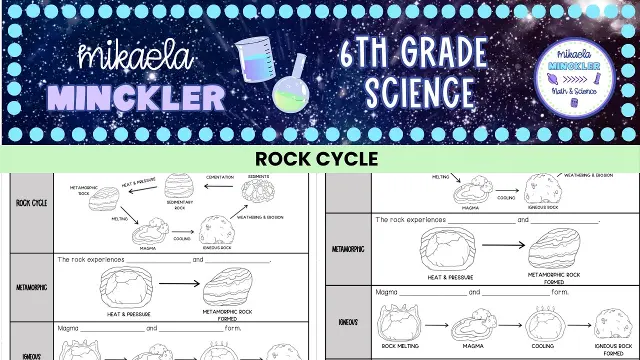
 The Rock Cycle Explained: Guided Notes for Sixth Grade Science
#Rock Cycle
1 ideas
The Rock Cycle Explained: Guided Notes for Sixth Grade Science
Get new #Rock Cycle ideas by email
Every Thursday: the week's best ideas, with the newest from #Rock Cycle.
Related tags
The Rock Cycle: How Earth Recycles Stone
Every stone you have ever picked up has a history, and the rock cycle is the story of how those histories connect. It describes the set of processes that turn one kind of rock into another over and over again, driven by heat from inside the Earth, pressure, water, wind and gravity. Nothing about it is quick: the cycle works on timescales of thousands to millions of years, which is why rocks feel like the most permanent things around us even though they are constantly being remade.
The three families of rock
Geologists sort rocks into three broad groups, defined by how they formed rather than what they are made of.
Igneous rocks solidify from molten material. Magma that cools slowly deep underground produces coarse crystals you can see, while lava that spills out and cools quickly forms fine-grained rock, and sometimes glass. Granite and basalt are familiar examples at opposite ends of that spectrum.
Read more
Sedimentary rocks are built from pieces of older rocks. Weathering breaks stone down into fragments, and water, wind or ice carries them away; they settle in layers, get buried, and are pressed and cemented together. Some sedimentary rock instead forms from dissolved minerals or from the accumulated remains of living things. Layers, called strata, are the giveaway.
Metamorphic rocks are rocks that were changed without melting. Buried deep or caught in a mountain-building collision, existing rock is subjected to intense heat and pressure, and its minerals reorganise into new arrangements. Limestone becomes marble, shale becomes slate, granite becomes gneiss.
How the cycle connects them
The paths between the three are many, and none is compulsory. Melt any rock and it can cool into igneous rock. Weather and erode any rock and its debris can become sedimentary rock. Bury and squeeze any rock and it can turn metamorphic. Metamorphic rock can melt, or be eroded, or be metamorphosed again. The cycle is a web of possible routes, not a fixed loop with numbered stages.
Two engines keep it running. Internal heat, from the planet's formation and from radioactive decay within it, drives melting, mountain building and the slow churn of the mantle. External energy from the sun drives weather, rivers, glaciers and wind, which wear rock down and move it around.
Reading the record
Because each rock type records the conditions that made it, rocks work as a history book. A rock with large crystals cooled slowly. A layer of rounded pebbles says water once flowed there. Folded bands say the rock was squeezed. Beginners learning the cycle do well to handle real specimens: identify the texture first, then ask what conditions could have produced it. That single habit carries you a long way, whether you are a student studying for a test or simply curious about the stones underfoot.
#Rock Cycle: frequently asked questions
What is the rock cycle in simple terms?
It is the ongoing set of natural processes that turn one kind of rock into another — melting, cooling, weathering, burying, squeezing — driven by the Earth's internal heat and by energy from the sun. Nothing is destroyed and nothing is permanent: a stone at the surface can eventually be melted, buried or rebuilt into something new. It is better pictured as a web of possible routes than as a loop with numbered steps.
What do I need to start learning about the rock cycle?
You really only need a few real rock samples and a habit of looking closely at texture before anything else. Ask what the grain size, layering or banding tells you about the conditions that formed the stone, since the texture is the evidence. A notebook for sketches helps, and a simple chart of the main rock groups is useful for organising what you notice.
How do I tell the main rock types apart?
Start with how the rock formed rather than what colour it is. Igneous rock came from molten material and shows crystals or a glassy surface; sedimentary rock is made of fragments or dissolved minerals and usually shows layers; metamorphic rock was changed while solid, so it often shows banding or a reorganisation of its minerals. Once you can sort by origin, the specific names follow much more easily.
How does one rock actually become another kind?
Melting any rock lets it cool into igneous rock, weathering and erosion of any rock can produce sediment that hardens into sedimentary rock, and burying or squeezing any rock can turn it metamorphic. There is no required order, so a metamorphic rock might melt next, or crumble and be carried away, or simply be squeezed again. That flexibility is the point — the pathways cross rather than follow a fixed sequence.
What mistakes do beginners make with the rock cycle?
The most common one is treating it as a strict circle where every rock must pass through each stage in turn, which is not how it works. Another is identifying a rock by colour or by a single memorable example instead of by its texture and origin. It also helps to remember that the changes happen over enormously long spans of time, so the cycle is something we infer from evidence rather than watch happening.
What hands-on ideas work well for studying the rock cycle?
Collecting local stones and sorting them by texture is the simplest and most effective activity, because it forces you to reason from evidence. Sketching and labelling the possible routes a single specimen could take next turns the diagram into a thinking exercise rather than something to memorise. Comparing two very different examples side by side, such as a coarse crystalline rock and a layered one, makes the link between texture and formation click.
Videos come from YouTube and posts from Instagram; titles and summaries are our own. All rights belong to their creators.