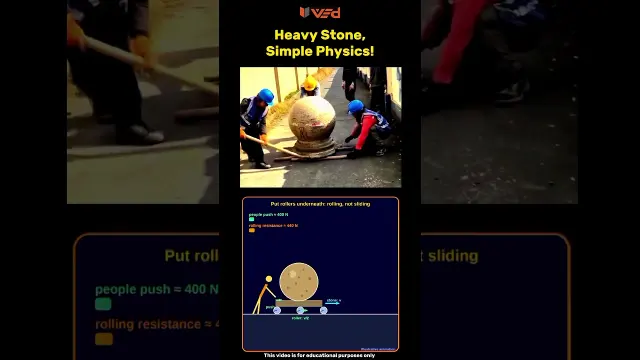
 How Rollers Let Workers Move a Massive Stone Sphere
#Rolling Motion
2 ideas
How Rollers Let Workers Move a Massive Stone Sphere
 The Ball-in-Spoon Trick Explained by Rolling Motion
Get new #Rolling Motion ideas by email
Every Thursday: the week's best ideas, with the newest from #Rolling Motion.
Related tags
Rolling Motion: How Wheels, Balls and Rollers Move
Rolling motion is what happens when an object turns as it travels: a wheel, a ball, a cylinder, a barrel, a rolling pin. The shape turns around its own centre and moves forward at the same time, and the two motions are tied together. It is one of the most useful kinds of movement there is, because it lets something heavy glide along the ground instead of being dragged across it.
Two motions at once
Watch a bicycle wheel closely and you can see both parts. The hub moves forward in a straight line, while every point on the rim circles the hub. At the point where the wheel touches the ground, the two motions cancel out for an instant, so that spot is momentarily still. At the top of the wheel they add together, which is why the top of a wheel moves faster than the axle. That is a good thing to picture whenever you are trying to understand a rolling problem: the contact point is the hinge of the whole motion.
Why friction is a friend here
Read more
It sounds backwards, but rolling depends on friction. Without grip at the contact point, a wheel would spin in place like a wheel stuck in snow, and a ball would slide instead of turning. Friction is what converts a push into a turn. When there is not enough of it, you get slipping; when there is too much of it, a wheel can lock and skid. The sweet spot, where the surface of the object travels exactly as fast as its centre and nothing rubs, is called rolling without slipping.
Rolling versus sliding
Sliding drags a surface along the ground; rolling lays the surface down and lifts it again, so the touching parts barely scrape. This is why a heavy stone ball can be pushed by hand on flat ground, and why logs placed under a load turn a hauling job into a gentle nudge. Rollers, ball bearings and wheels are all versions of the same idea: replace sliding with turning.
Rolling resistance — the small, steady drag that remains — comes mostly from the surfaces deforming slightly as they meet. A hard ball on a hard floor runs further than a soft one, which is why material matters as much as shape.
Shapes that roll well
- Spheres roll in any direction, which makes them unstable to steer but wonderfully free.
- Cylinders and wheels roll in one plane only, which is exactly what you want for a cart or a rolling pin.
- Cones do not travel in a straight line: the wide end covers more ground than the narrow tip on each turn, so a cone rolls in a curve.
- A sphere on a pair of parallel rails follows the rails straight ahead, held in place by the groove they form.
- Wheels are usually paired with an axle so the turning is controlled and shared.
What to notice when you try it
Start on a gentle slope and watch how a ball and a cylinder behave differently. Notice that a heavier ball does not automatically beat a lighter one — how the mass is spread through the shape matters as much as the weight. Try rolling a jar lid and a coin; the small differences in rim and balance change everything.
Rolling motion rewards patience. Once you have watched it closely a few times, wheels, bearings and rollers stop looking like separate inventions and become one idea in different clothes.
#Rolling Motion: frequently asked questions
What do I actually need to try rolling motion at home?
A round object and a sloped surface are really all it takes — a ball, a jar lid, a coin, a rolling pin, or a wheeled toy. A gentle incline such as a board propped on a book lets you watch the motion slowly enough to notice what happens. A hard, smooth floor works better than carpet, because soft surfaces deform and steal the roll.
How do I choose between a ball, a cylinder and a cone for a project?
Pick a sphere when you want freedom of direction, since it rolls wherever it is pushed. Choose a cylinder or wheel when the path should stay straight, which is why carts and rolling pins use them. A cone is the playful option — it curves as it goes, because its wide end travels further than its narrow tip on every turn.
Why does my wheel spin in place instead of moving forward?
That usually means there is not enough grip where the object meets the ground, so the push turns into spinning rather than travel. Rolling needs friction at that contact point to convert a shove into a turn. A slightly rougher surface, or less force applied more steadily, generally gets the wheel rolling properly.
Does a heavier ball always roll further?
No — how the mass is distributed through the shape matters as much as the total weight. A hard ball on a hard floor tends to travel further than a soft one, because soft surfaces squash slightly as they meet and that small deformation drags on the motion. Comparing two objects of similar size but different material is the quickest way to see this.
How should I store and look after things that roll?
Keep rolling surfaces clean and dry, since grit at the contact point is what causes scraping and uneven wear. Store round and cylindrical items so their rims are not resting on a hard edge, which can flatten or dent them over time. If a piece starts wobbling or wandering instead of tracking straight, check for a ding in the rim or a bent axle before anything else.
What is a common mistake when demonstrating rolling motion?
The usual one is starting on too steep a slope, so everything moves too fast to observe and the object simply skids. Start shallow and watch the same object more than once — the interesting differences show up in the second and third run. Another frequent slip is assuming the whole object moves at one speed, when the top of a wheel is actually travelling faster than the axle.
Videos come from YouTube and posts from Instagram; titles and summaries are our own. All rights belong to their creators.