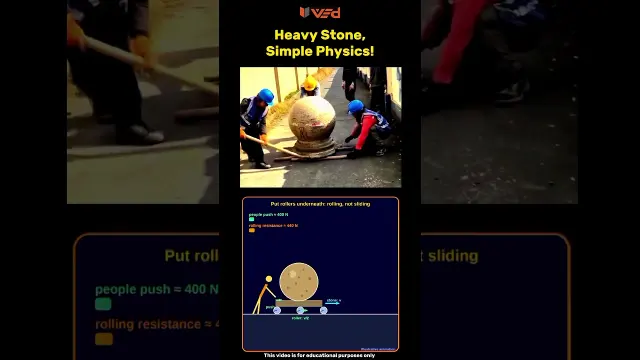
 How Rollers Let Workers Move a Massive Stone Sphere
#Mechanics
3 ideas
How Rollers Let Workers Move a Massive Stone Sphere
 The Ball-in-Spoon Trick Explained by Rolling Motion
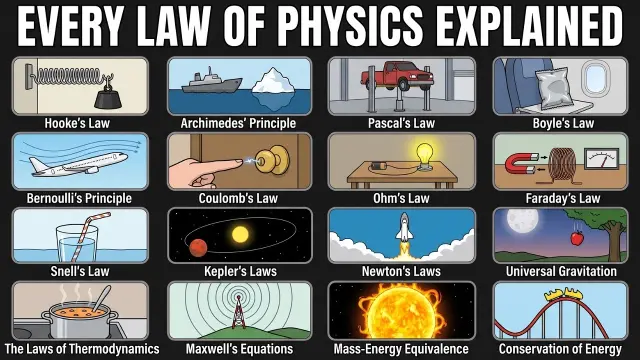 Sixteen Laws of Physics Explained With Everyday Objects
Get new #Mechanics ideas by email
Every Thursday: the week's best ideas, with the newest from #Mechanics.
Related tags
Mechanics: How Forces Shape the World Around Us
Mechanics is the branch of physics that asks the plainest questions: why a ball falls back down, why a bicycle stays upright while it rolls, why a shelf holds or fails. It studies motion, the forces that cause or prevent it, and the way energy and momentum pass between objects. Nearly every other part of physics is built on top of it, which is why it is usually the first subject a student meets and the one that stays most visibly useful long afterwards.
Its subject matter is not only the dramatic. Mechanics covers a cup resting on a table (nothing moving, forces balanced) just as much as a rocket climbing out of the atmosphere. The habit of mind it teaches is the same in both cases: look at an object, work out everything pushing or pulling on it, and let the arithmetic follow.
The main branches
- Statics deals with objects at rest, where all the forces cancel out. It underlies the design of buildings, ladders, beams and shelves.
- Kinematics describes motion in terms of position, speed and acceleration, without asking what causes it.
- Dynamics connects motion to force and mass, and explains why a push produces the change it does.
- Fluid mechanics handles liquids and gases, covering everything from water in a pipe to the lift under an aeroplane wing.
- Orbital and celestial mechanics applies the same rules to planets, moons and satellites, where gravity does almost all the work.
Read more
Ideas worth learning early
Force is not the same as movement. A constant push does not produce constant speed; on the contrary, an object with no net force on it keeps doing exactly what it was doing, whether that is standing still or cruising along. This trips up almost every beginner, because everyday life is full of friction that hides the rule.
Mass and weight are also frequently confused. Mass is how much matter an object contains; weight is the force gravity exerts on that mass, which changes if you travel somewhere with different gravity.
Habits that make it easier
Draw the picture. Sketch the object, then mark every force acting on it with an arrow. Most difficulties in mechanics are solved on paper before any numbers appear.
Track your units. A calculation in mixed units tends to produce an answer that looks reasonable and is wrong.
Estimate first. Decide roughly what the answer should be, then compute. If the two disagree, trust the estimate and look for the mistake.
Check the extremes. Ask what happens when a value becomes very large or very small; if the result makes no sense there, the formula was misapplied.
Mechanics rewards patience rather than memorisation. Once you can see the forces clearly, the mathematics tends to fall into place.
#Mechanics: frequently asked questions
How should I start learning mechanics if I’m a beginner?
Start with simple situations you can picture clearly, like a book on a table or a ball rolling on the floor. Draw the object, mark every force acting on it, and only then move on to the equations. That habit makes the rest of mechanics much easier to follow.
What do I need to understand before studying mechanics?
You mainly need comfort with basic algebra, simple graphs, and careful units. It also helps to know the difference between force, motion, mass, and weight, because those ideas are often mixed up at first. With those foundations, the core ideas become much clearer.
Which branch of mechanics should I focus on first?
If you are just starting out, statics and kinematics are usually the easiest places to begin because they separate balance and motion from the causes behind them. After that, dynamics shows how forces change motion, which ties the whole subject together. Fluid and orbital mechanics can come later when you want to see the same rules in more specialized settings.
What are the most common mistakes people make in mechanics?
A very common mistake is treating force and motion as if they were the same thing, when they are not. Another is confusing mass with weight, or forgetting to check units carefully. It also helps to estimate the answer first, because that makes errors much easier to spot.
What everyday problems or ideas can mechanics help explain?
Mechanics is useful for understanding why a shelf holds, why a bicycle stays upright while moving, or how a cup can remain at rest even though gravity is acting on it. It also explains rolling motion, lifting, and even how planets and satellites move. In other words, it turns ordinary objects into clear examples of force and motion.
Videos come from YouTube and posts from Instagram; titles and summaries are our own. All rights belong to their creators.