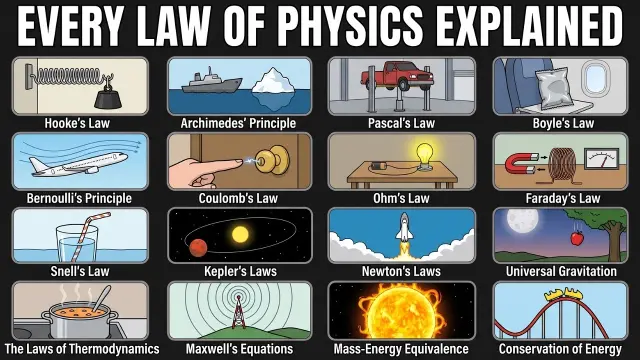
 Sixteen Laws of Physics Explained With Everyday Objects
#Newton
1 ideas
Sixteen Laws of Physics Explained With Everyday Objects
Get new #Newton ideas by email
Every Thursday: the week's best ideas, with the newest from #Newton.
Related tags
Newton: His Laws, Gravity and the Birth of Modern Physics
Isaac Newton was an English mathematician and natural philosopher whose work in the late seventeenth century gave physics the shape it still carries today. He is best known for three things that turned out to be one thing: a set of laws describing how objects move, a law describing how they pull on each other, and a mathematical method for calculating change. Together they explained, for the first time, why an apple falls and why the Moon does not.
The three laws of motion
Newton's laws are usually stated plainly, but each one repays a second look.
- The first law says an object keeps doing what it is doing — staying still, or moving in a straight line at a steady speed — unless a force acts on it. This is why you lurch forward when a bus brakes: your body was already moving and nothing pushed you to stop.
- The second law links force, mass and acceleration. The same push moves a light object more than a heavy one, which is why a shopping trolley is easy to start and a loaded one is not.
- The third law says forces come in pairs: push on a wall and the wall pushes back on you. Rockets work this way, throwing gas downward to be pushed upward.
Read more
Gravity, understood as a universal force
Before Newton, falling objects and orbiting planets were treated as separate puzzles. His insight was that the same attraction operates everywhere: every mass pulls on every other mass, more strongly when the masses are large and more weakly as the distance between them grows. That single idea accounted for tides, the paths of comets and the curve of a thrown ball, and it held sway for over two centuries until Einstein refined it.
Light, colour and a new mathematics
Newton also experimented with prisms and showed that white light is a mixture of colours, not a single pure substance — a result that surprised his contemporaries. Alongside this, he developed what is now called calculus, a way of handling quantities that change continuously. He was secretive about his methods, and the question of who got there first caused a long and bitter dispute with Leibniz, who had arrived at similar ideas independently.
What beginners should keep in mind
Physics rewards patience more than memorisation. Learn the three laws as statements about forces and motion rather than as slogans, and always ask what forces are acting and in which direction. Sketch the situation before you calculate anything; most confusion comes from an unexamined picture, not from the arithmetic. Watch ordinary objects — a spinning coin, a swinging door, a ball rolling uphill — and try to account for what you see. Newton himself worked this way, moving between careful observation, rough experiment and mathematics, and treating an unanswered question as an invitation rather than a failure.
#Newton: frequently asked questions
What is the best way to start learning about Newton's ideas?
Start with the laws of motion and read them as statements about forces rather than as slogans to memorise. Pick up one ordinary object nearby and ask what is pushing or pulling on it, since that single habit carries most of the understanding. Sketch the situation before you calculate anything, because most confusion comes from an unexamined picture.
What do I actually need before studying his work?
No special equipment is required; curiosity and a willingness to look carefully at ordinary things go a long way. Some comfort with basic algebra and geometry helps once you move from the ideas to the calculations. Patience matters far more than speed or memorisation, since the subject rewards slow, repeated observation.
Which of his ideas should a beginner focus on first?
The laws of motion are the natural entry point, particularly the pairing of forces and the way every push comes with a push back. From there, universal gravitation shows why falling objects and orbiting bodies turn out to be the same puzzle rather than separate ones. Light, colour and the mathematics of change can wait until the mechanics feel familiar.
How can I keep the ideas from slipping away after I read them?
Come back to them through objects rather than through notes: watch a spinning coin, a swinging door or a ball rolling uphill and try to account for what you see. Revisiting the same phenomena with the laws in mind is what turns a definition into intuition. Treating an unanswered question as an invitation rather than a failure keeps the habit alive.
What mistakes do beginners make most often?
The usual one is memorising the laws as slogans without ever asking which forces act and in which direction. Another is skipping the sketch and jumping straight into arithmetic, which produces a confusion that looks like a maths problem but is not one. Rushing to formulas before the picture is clear is the root of most of it.
Can these ideas be explored with everyday experiments?
Yes, and they are often clearer that way than through a textbook diagram. A rolling ball, a loaded shopping trolley or a balloon releasing air each raises a question you can answer with forces alone. Observe first, then try to explain what you saw before reaching for any calculation.
Videos come from YouTube and posts from Instagram; titles and summaries are our own. All rights belong to their creators.