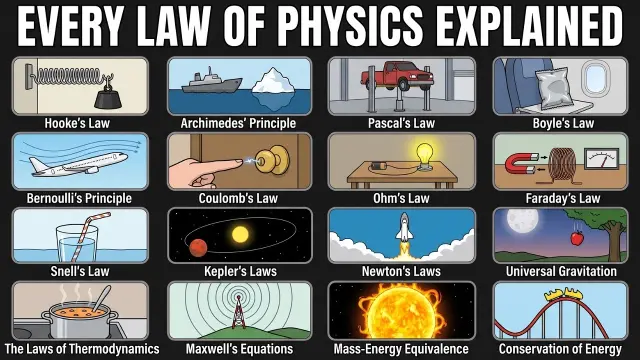
 Sixteen Laws of Physics Explained With Everyday Objects
#Physics Laws
1 ideas
Sixteen Laws of Physics Explained With Everyday Objects
Get new #Physics Laws ideas by email
Every Thursday: the week's best ideas, with the newest from #Physics Laws.
Related tags
Physics Laws: A Beginner's Guide to How the Universe Works
A law of physics is a short, careful statement about the way something in nature behaves, again and again, everywhere we have looked. It might say that energy is never created or destroyed, that a moving object keeps moving unless something pushes it, or that heat flows from hot towards cold. These statements are the backbone of the subject: they let us predict what will happen next, from a dropped cup to the motion of a distant star.
What a law is, and what it is not
A law describes a pattern; it does not explain why the pattern exists. That job belongs to theory, which offers a picture of the underlying machinery. The two work together: a law tells you what to expect, a theory tells you why. It is also worth knowing that laws are not carved in stone. They are the best descriptions we have, held for as long as experiments keep agreeing with them, and quietly revised when something does not fit.
Where laws come from
Read more
Almost all of them begin with observation. Someone notices a regularity, measures it patiently, and tries to express it in the smallest possible number of words or symbols. The process usually involves idealisation: ignoring friction, air resistance or the size of an object so the essential pattern becomes visible. Only afterwards does the messy real world get put back in, as corrections. Many laws first appear as summaries of experiment and are later found to follow from something deeper, which is one reason physics feels so tidy in hindsight.
The main families
- Mechanics covers motion, forces, and the great conservation principles of energy and momentum.
- Thermodynamics deals with heat, work and the direction in which processes run, including why some changes happen one way and not the other.
- Electromagnetism describes electric charge, currents, magnets and light, which turn out to be parts of one story.
- Waves and optics cover how vibrations travel and how images form.
- Gravitation and relativity describe falling bodies, orbits and what happens at enormous speeds or masses.
- Quantum physics governs the very small, where predictions become probabilities rather than certainties.
Running through all of them is a single idea worth holding on to: certain quantities are conserved. Energy, momentum and electric charge can move around and change form, but the total stays put. Many problems become simple once you ask what is conserved.
What beginners should know
Start with vocabulary, because the words are used precisely. Force, mass, energy, work, power and momentum each mean something narrower than in everyday speech. Units matter as much as numbers, and checking that an equation's units balance will catch a surprising number of mistakes.
Learn laws as relationships rather than formulas to memorise. Ask what happens if one quantity doubles, or if it goes to zero. Sketch the situation before reaching for symbols. Try predictions on ordinary things: a rolling ball, a swinging door, a cooling cup of tea. And be patient with the mathematics; it is the language these laws are written in, and fluency grows with use.
Above all, trust measurement over intuition. Common sense was formed in a small, slow corner of the world, and physics is what happens when you look past it.
#Physics Laws: frequently asked questions
How do I start learning physics laws if I have no background?
Begin with the vocabulary, since words like force, mass, energy, work and momentum carry a narrower meaning in physics than in everyday talk. Once those are clear, take one law at a time and describe it in your own words before touching any formula. Sketching the situation and testing a prediction on something ordinary, like a rolling ball or a cooling cup of tea, builds understanding faster than reading on.
What do I actually need to study physics laws?
Curiosity, patience with a little mathematics, and something to write on are the essentials. A notebook for sketches and worked examples helps more than expensive equipment, because most early laws can be seen with everyday objects at home. The main requirement is a willingness to trust careful observation over gut feeling.
Which area of physics should I look at first?
Mechanics is the natural entry point, as it covers motion, forces and the conservation of energy and momentum, and the ideas reappear everywhere else. From there, thermodynamics or waves and optics are comfortable next steps because they connect to things you can watch happening. Quantum physics and relativity are best saved until the basics feel familiar, since they overturn ordinary intuition.
How do I keep the laws from blurring together once I have learned a few?
Treat each law as a relationship rather than a line to memorise, asking what changes when one quantity doubles or drops to zero. Checking that units balance on both sides of an equation catches a great many mix-ups along the way. Grouping laws by family, and noting which quantities stay conserved, gives you a structure to hang new material on.
Can physics laws be shown with everyday objects for a project or display?
Yes, and this is one of the most engaging ways to present them, since each law can be paired with an object that demonstrates the pattern. A swinging door, a spinning top or a ball rolling to a stop all illustrate familiar principles without any special setup. Choose objects people recognise, then explain what the object shows rather than how the apparatus works.
What mistakes do beginners make most often?
The commonest is memorising formulas without seeing the relationship behind them, which collapses as soon as a problem looks unfamiliar. Another is skipping the sketch and reaching straight for symbols, or forgetting that units matter as much as numbers. A third is trusting intuition over measurement, when intuition was formed in a small, slow corner of the world.
Videos come from YouTube and posts from Instagram; titles and summaries are our own. All rights belong to their creators.