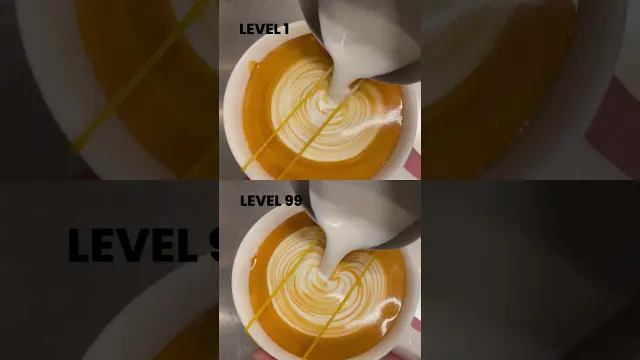
 Rosetta Latte Art With Slower, Wider Wiggles
#Rosetta
1 ideas
Rosetta Latte Art With Slower, Wider Wiggles
Get new #Rosetta ideas by email
Every Thursday: the week's best ideas, with the newest from #Rosetta.
Related tags
Rosetta Latte Art: A Beginner's Guide to the Feather
The rosetta is one of the best-known patterns in free-pour latte art: a fan of overlapping leaves or feathers spreading from the base of the cup, tapering to a stem as the milk is drawn through the design. It is made entirely by pouring steamed milk into espresso, with no tools and no drawing afterwards — which is why it has become a kind of benchmark for anyone learning to work behind an espresso machine or simply wanting a nicer cup at home.
How the pattern works
A rosetta is the result of two things happening at once. The milk is poured from a height at first, which pushes it down through the crema and lets it settle underneath rather than on top. Then the pitcher is lowered close to the surface, and the milk floats, forming the white shapes that contrast with the darker espresso.
The leaves come from a small, steady side-to-side movement of the pitcher while the milk flows. Each swing lays down a little arc of foam. As the cup fills, those arcs push forward into the ring already there, and the pattern builds outward into a fan. The final move is to raise the pitcher and draw a thin stream back through the centre of the design, which pulls the arcs into points and forms the stem.
Read more
What beginners should know
Most failed rosettas are a milk problem before they are a pouring problem. The milk needs to be stretched enough to hold a shape but not so much that it sits in stiff blobs. Properly textured milk looks glossy and paint-like, moves as one body in the pitcher, and gives a smooth, thin ribbon when poured. A good habit is to practise the texture first, then the pour.
Useful starting points:
- Keep the first pour high and gentle, and lower the pitcher only when you want the white to appear.
- Move the pitcher from the wrist, not the whole arm, and keep the swings small at first.
- Pour into a cup with a rounded bottom and hold it tilted, straightening it as the pattern grows.
- Slow down. Wide, deliberate swings usually produce a cleaner fan than fast, tight ones.
- Accept that the pull-through is the hardest part; a rosetta with a slightly crooked stem still tastes fine.
Variations
Once the basic motion feels natural, people vary the number of leaves, the width of the fan, or the speed of the wiggle to make tighter stacks or broader, softer shapes. Some pour a simple heart or tulip first and finish with a rosetta on top. None of these variations change the essentials: well-textured milk, a controlled height change, and a steady, relaxed hand.
Videos come from YouTube and posts from Instagram; titles and summaries are our own. All rights belong to their creators.