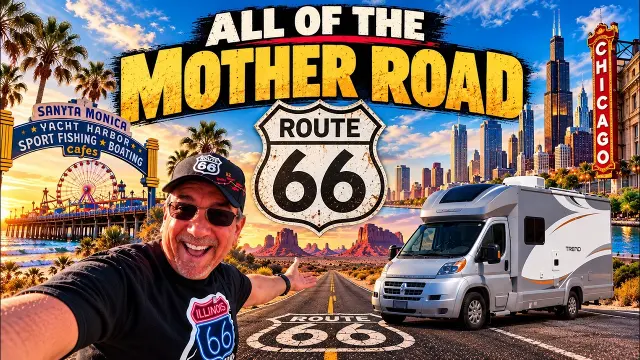
 The Complete Route 66 Road Trip from Chicago to Santa Monica
#Route 66
1 ideas
The Complete Route 66 Road Trip from Chicago to Santa Monica
Get new #Route 66 ideas by email
Every Thursday: the week's best ideas, with the newest from #Route 66.
Related tags
Route 66: A Guide to America's Mother Road
Route 66 is the highway that became a story. Stretching roughly 2,400 miles from Chicago, Illinois to Santa Monica, California, it crosses eight states and a landscape that shifts from prairie to desert to ocean. It was laid out in 1926 as part of the first numbered national highway system, and in 1985 it was officially removed from the map, replaced by the faster interstates. What survived is something rarer than a road: a shared idea of what driving across America should feel like.
How the road got its names
The highway earned its nicknames slowly. John Steinbeck called it the "Mother Road" in The Grapes of Wrath, and the name stuck to the route that carried thousands of families westward during the Dust Bowl years. A popular song promised that you could "get your kicks on Route 66," and the phrase entered the language. Long before that, promoters billed it as the "Main Street of America" because it threaded through the middle of so many towns rather than skirting them.
What remains today
Read more
Because the old road was decommissioned rather than erased, much of it is still drivable. In places it survives as a frontage road beside the interstate; elsewhere it turns into gravel or simply ends. What draws travellers are the details: hand-painted neon signs, motor courts with individual cabins, roadside diners, and attractions built purely to make a passing driver slow down. The old highway also runs through varied ground, from the brick-paved streets of small Midwestern towns to the painted desert of the Southwest and the mountains of Arizona. Kansas holds the shortest stretch of the route, while Oklahoma and Missouri claim some of the longest.
Driving it yourself
There is no single Route 66 to follow. The road changed alignment many times, so guidebooks and local signs often disagree about which segment is the "real" one — and that ambiguity is part of the appeal. A few practical habits help. Plan shorter days than you would on an interstate; the old road is slow, and the pleasure is in the stopping. Carry a paper map, since signage is inconsistent and phone coverage thin in stretches of the desert. Book lodging ahead in remote areas, and check opening hours for small museums, which often keep seasonal schedules. If you only have a week, choose one region rather than racing the whole length.
The spirit of it
Route 66 is less a place than a way of travelling: attentive, unhurried, curious about the towns that other roads pass by. Whether you drive a hundred miles of it or all of them, the reward is the same — a sense of the country at ground level, one main street at a time.
#Route 66: frequently asked questions
Is Route 66 still drivable today?
Yes, though not as one continuous, signposted highway. The route was retired from the official map rather than torn up, so long stretches survive as frontage roads beside the interstates, while other segments dwindle into gravel or stop altogether. Driving it means stitching those pieces together and accepting the occasional detour.
What should I prepare before setting off on Route 66?
Plan shorter driving days than you would on an interstate, because the old road is slow and the reward is in stopping often. Carry a paper map, since signage is inconsistent and phone coverage can vanish in remote stretches. Book lodging ahead in thinly populated areas and check the seasonal opening hours of small museums before you count on them.
Which section of Route 66 should I pick if I can't drive the whole thing?
Choose one region and settle into it rather than trying to race the full length. There is no single authentic alignment anyway, since the road was rerouted many times and guidebooks and local signs often disagree, so a smaller area lets you follow the older loops at your own pace. Many travellers pick a landscape that appeals to them — prairie towns, desert, or mountains — and build the trip around that.
Do I need a special vehicle for Route 66?
An ordinary car handles most of the classic alignments, since the drivable portions are largely paved. A few surviving stretches turn to gravel or rough chip seal, so check road conditions locally before committing to an obscure segment. What matters more than the vehicle is patience and a willingness to turn around when a road fades out.
What are the most common mistakes people make on a Route 66 trip?
The usual one is over-scheduling: treating the old highway like an interstate and measuring the day in distance rather than in stops. Relying entirely on a phone for navigation and opening hours is another, since coverage and signage both thin out. Assuming every guidebook agrees on the route leads to frustration too — the ambiguity is part of the experience.
What is there to actually see and do along Route 66?
The appeal is in the details rather than the landmarks: hand-painted neon, motor courts with individual cabins, roadside diners, and attractions built purely to make a driver slow down. Small-town main streets, brick paving in older Midwestern towns, and the shifting scenery from prairie to desert carry much of the character. The pleasure comes from noticing them at ground level instead of passing by at highway speed.
Videos come from YouTube and posts from Instagram; titles and summaries are our own. All rights belong to their creators.