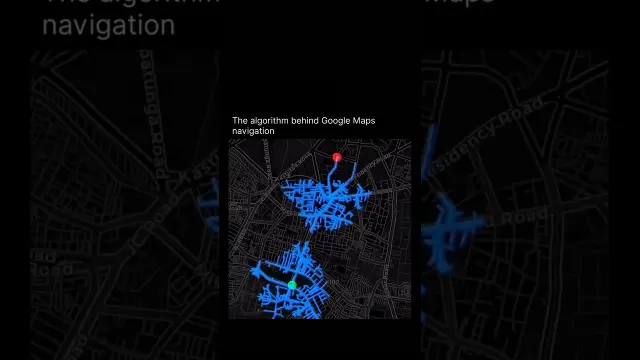
 Understanding the Routing and Navigation Algorithms Behind Google Maps
#Routing Algorithms
1 ideas
Understanding the Routing and Navigation Algorithms Behind Google Maps
Get new #Routing Algorithms ideas by email
Every Thursday: the week's best ideas, with the newest from #Routing Algorithms.
Related tags
Routing Algorithms Explained
Routing algorithms are the methods computers use to choose a path from one place to another across a network. They appear in many settings, from internet traffic and mobile networks to maps, transport systems, and logistics. Their job is to decide how data, vehicles, or other resources should move so the journey is efficient, reliable, and possible at all.
What routing algorithms do
At their core, routing algorithms solve a pathfinding problem. They look at a network made up of points and connections, then choose a route according to a goal such as the shortest path, the least cost, the fastest travel time, or the most reliable connection. In a digital network, this may mean sending packets of information. In a navigation system, it may mean choosing roads.
A routing algorithm usually has to balance several factors:
- Distance
- Travel time
- Congestion or traffic
- Link quality or capacity
- Reliability and availability
Read more
Main types of routing
There are several broad families of routing algorithms, each suited to different situations.
- Shortest-path routing: Finds a route with the lowest total cost according to a chosen measure. This cost may be distance, time, or another value.
- Distance-vector routing: Each node shares information about how far it is from other nodes and updates its own choices based on neighbors.
- Link-state routing: Each node builds a more complete view of the network and calculates routes from that map.
- Hierarchical routing: Large networks are divided into areas or regions to make routing easier to manage.
- Adaptive routing: Routes change in response to network conditions such as congestion or failures.
- Static routing: Routes are set in advance and change only when manually updated.
Common ideas behind the algorithms
Many routing methods use graph theory. The network is treated as a graph, with nodes and edges. The algorithm searches for the best path through that graph. Some methods work by exploring all possible options in a structured way, while others build a path step by step using information from neighboring nodes.
A key idea is trade-offs. The best route in theory may not be the best route in practice if it takes too long to calculate or changes too often. That is why real systems often favor a good-enough route that can be found quickly and updated when needed.
What to keep in mind as a beginner
If you are learning routing algorithms, start by understanding graphs, weights, and path cost. Once those basics feel clear, it becomes easier to understand why different algorithms behave differently. It also helps to remember that the “best” route depends on the goal. A shortest path is not always the fastest, and the fastest route is not always the most reliable.
Practical uses
Routing algorithms help keep networks efficient and services responsive. They are important in:
- Internet communication
- Mobile and wireless networks
- GPS and navigation systems
- Delivery and transport planning
- Robot movement and automation
In practice, good routing is about choosing wisely under changing conditions. That balance between speed, accuracy, and flexibility is what makes routing algorithms such a central part of modern systems.
Videos come from YouTube and posts from Instagram; titles and summaries are our own. All rights belong to their creators.