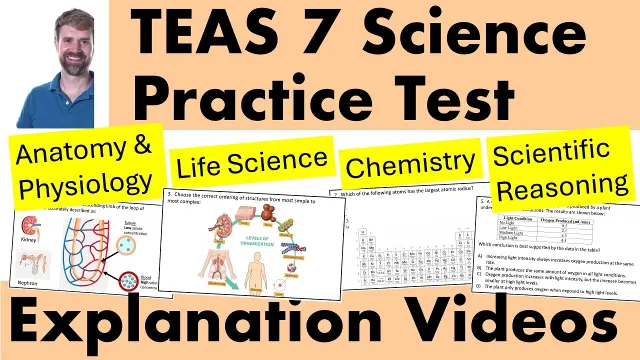
 ATI TEAS Science Practice Test Mini Lessons
#Science Test
1 ideas
ATI TEAS Science Practice Test Mini Lessons
Get new #Science Test ideas by email
Every Thursday: the week's best ideas, with the newest from #Science Test.
Related tags
Science Test Preparation Guide
What a science test is
A science test is a way of checking how well you understand scientific ideas and how to use them to answer questions. It may appear in school, entrance exams, placement tests, or professional training, depending on the setting. Some science tests focus on general knowledge, while others ask you to read charts, interpret experiments, or apply what you know to new situations.
Science is broad, so the exact content can vary a lot. A test might include biology, chemistry, physics, earth science, or a mix of all four. It may also ask about the scientific method, measurement, data analysis, and lab safety. In many cases, the goal is less about memorizing isolated facts and more about showing that you can reason clearly and understand how science works.
What science tests usually cover
Read more
The topics on a science test depend on the level and purpose of the exam, but common areas include:
- Living systems: cells, body systems, genetics, ecology, and basic life processes
- Matter and chemistry: atoms, elements, mixtures, reactions, and properties of materials
- Force and motion: energy, simple machines, movement, and basic physics ideas
- Earth and space: weather, rocks, the water cycle, planets, and natural processes
- Scientific skills: reading graphs, understanding variables, drawing conclusions, and using evidence
Some tests are mostly multiple choice, while others may include short answers, diagrams, or data tables. If you know the format in advance, you can prepare more effectively.
Main kinds of science questions
Science test questions often fall into a few patterns:
- Recall questions ask you to remember a definition or concept
- Application questions ask you to use a principle in a new example
- Data questions ask you to interpret a graph, table, or experiment
- Comparison questions ask you to notice similarities and differences
- Reasoning questions ask you to explain why something happens
When you meet a question, read it carefully and look for clues in the wording. Science tests often reward steady thinking more than speed alone.
How to prepare well
Start by reviewing the major topics one by one instead of trying to memorize everything at once. Use short study sessions and return to difficult ideas more than once. It also helps to practice with diagrams, labels, and simple experiments, because science is easier to remember when you connect it to real examples.
A few useful habits:
- Learn key vocabulary, but also make sure you understand the meaning behind the words
- Practice reading graphs and tables slowly and accurately
- Review mistakes and ask what the correct answer tells you
- Explain ideas out loud in your own words
- Use simple examples from daily life to make concepts clearer
Practical tips for test day
On the day of the test, pace yourself and do not rush the first question. If a question seems hard, mark it and return later if allowed. Pay close attention to words like “most likely,” “best explanation,” and “except,” since small details can change the answer.
If you are unsure, eliminate obviously wrong choices first. In science tests, a careful process often matters more than a perfect memory. Stay calm, read each question fully, and trust the preparation you have done.
Videos come from YouTube and posts from Instagram; titles and summaries are our own. All rights belong to their creators.