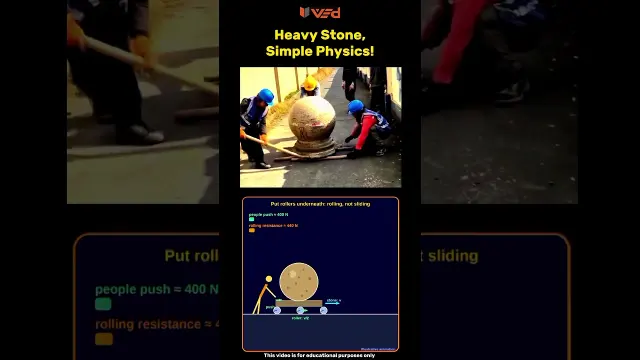
 How Rollers Let Workers Move a Massive Stone Sphere
#Simple Machines
1 ideas
How Rollers Let Workers Move a Massive Stone Sphere
Get new #Simple Machines ideas by email
Every Thursday: the week's best ideas, with the newest from #Simple Machines.
Related tags
Simple Machines, Explained for Beginners
Simple machines are the oldest tools there are: devices with at most one moving part that change the direction or the amount of force a job needs. A plank wedged under a heavy box, a rope running through a pulley, the screw in a jar lid. You use several of them in a single morning without noticing — prying a nail, turning a doorknob, carrying a load up the stairs instead of straight up. None of them need electricity or a motor, which is why they still turn up in workshops, kitchens, and gardens.
Where the idea comes from
The idea is much older than the word. Builders of the classical era moved enormous stone the way you can try at home: lay rollers under a block and roll it forward, because rolling resists far less than dragging; drag loads up sloped paths; pry free what you cannot lift with a lever. Experience came first, and the physics came later. The machines themselves are still just a plank, a rope, or a piece of metal shaped a certain way.
The six kinds
Read more
- A lever: a rigid bar that pivots on a fixed point. The farther your hand is from the pivot, the more your push is multiplied. A crowbar, a broom handle, a seesaw.
- A wheel and axle: a wheel turning around a central shaft. One turn moves the axle far, and the ratio of their radii sets the advantage. Doorknobs, steering wheels.
- A pulley: a rope running through a grooved wheel. One pulley just changes direction — pulling down is easier than lifting up — while several together share the load so you pull with less force.
- An inclined plane: a ramp. Pushing a load up a gentle slope takes less force than lifting it straight up; stairs are an inclined plane in steps.
- A wedge: two inclined planes back to back. An axe, a knife, a doorstop. The thinner the edge, the more it multiplies your push.
- A screw: an inclined plane wrapped around a rod. Turning it turns rotation into a straight-line pull: jar lids, bolts, corkscrews.
What beginners should know
The one rule behind all six is a trade-off. A simple machine never returns more work than you put in; it only rearranges it. Where a lever or a ramp cuts the force you need, it stretches the distance you must push or turn. Friction steals a little along the way, so real tools feel a touch worse than the ideal. And most things you own are compound machines: several simple ones working together. Scissors are two levers with wedge-shaped blades, and a wheelbarrow is a lever balanced on a wheel. Once you can name the pieces, almost any tool makes sense.
Everyday tips
- Match the machine to the job: split firewood with a wedge rather than by prying, move heavy things by rolling them on log or casters the way old builders rolled stone, and get a heavy box into a car with a plank as a ramp.
- The longer the effort arm of a lever, the easier the lift — that is why you hold a crowbar by its very end.
- Keep wedges sharp. A rounded edge has to be shoved in rather than slipped in, and the advantage vanishes.
- Treat friction as a quiet tax: a dry, groaning pulley is lost force. Clean and oil moving parts where you can.
Videos come from YouTube and posts from Instagram; titles and summaries are our own. All rights belong to their creators.