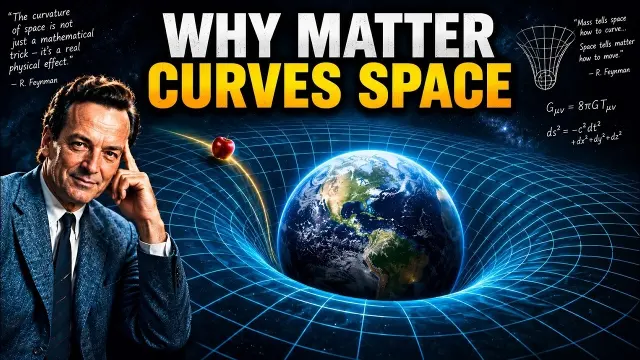
 Feynman's Explanation of How Matter Curves Space and Time
#Spacetime
2 ideas
Feynman's Explanation of How Matter Curves Space and Time
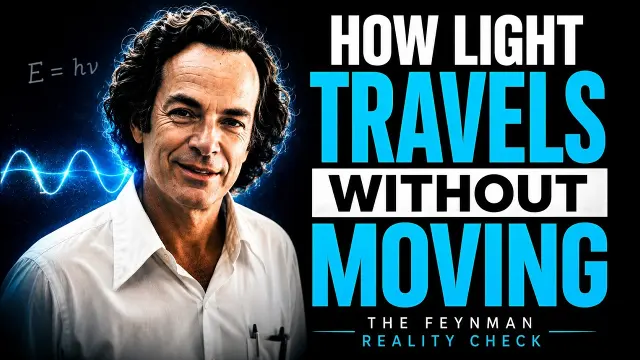 Light, Speed and Spacetime: A Feynman-Inspired Explanation
Get new #Spacetime ideas by email
Every Thursday: the week's best ideas, with the newest from #Spacetime.
Related tags
Spacetime: How Space and Time Form One Fabric
Spacetime is the idea that the three dimensions of space and the one dimension of time are not separate things but parts of a single structure. Rather than asking where something happens and, separately, when, physics treats both as coordinates in one four-dimensional map. An event is then a point with four numbers attached: three for position, one for the moment.
The concept grew out of a problem that puzzled physicists in the early twentieth century. Light seemed to travel at the same speed for everyone, no matter how fast the observer was moving — something that ordinary notions of space and time could not accommodate. Albert Einstein resolved this in his theory of relativity by treating measurements of length and duration as depending on the observer's motion, while the combined geometry of space and time stays consistent. Hermann Minkowski, a mathematician, gave this union its clearest form, showing that space and time could be drawn together as a four-dimensional geometry with its own rules for measuring distance between events.
A central feature of that geometry is that the shortest path between two events is not what intuition suggests. In spacetime, the "distance" between events combines spatial separation and time difference with opposite signs, and this unusual rule is what produces effects such as time passing more slowly for a fast-moving object than for a slow one. These effects are tiny in everyday life but real, and they matter for anything that depends on precise timing.
Gravity as geometry
Read more
Relativity goes further: rather than imagining gravity as a force pulling objects across space, it describes mass and energy as shaping the geometry of spacetime, and objects as travelling along the straightest available paths through that shaped geometry. This is the sense in which matter "curves" space and time. What looks like a planet being pulled toward a star is, in this picture, the planet following the natural path through a region of geometry the star has altered. The idea predicts phenomena — such as light bending near massive bodies and clocks running at different rates at different heights — that have been confirmed by observation.
What beginners should keep in mind
- Spacetime is not a substance or a backdrop sitting in some larger container; it is the relational structure that distances and durations are measured against.
- "Curved" is a geometric description, not a claim that space is like a bent sheet. Two-dimensional rubber-sheet pictures are analogies and break down if taken literally.
- Time is not simply another direction in space. Its distinct sign in the geometry is what distinguishes past from future and allows cause and effect to have a fixed order.
- Everyday intuition fails mainly because the effects are extreme only near very large masses or at very high speeds.
Reading about spacetime rewards patience. Start with the basic idea of events and coordinates, then the notion of an invariant interval, and only then move to curvature. Each step rests on the one before it.
Videos come from YouTube and posts from Instagram; titles and summaries are our own. All rights belong to their creators.