 Sabrina Pasterski on Celestial Holography and Unifying Physics
#General Relativity
2 ideas
Sabrina Pasterski on Celestial Holography and Unifying Physics
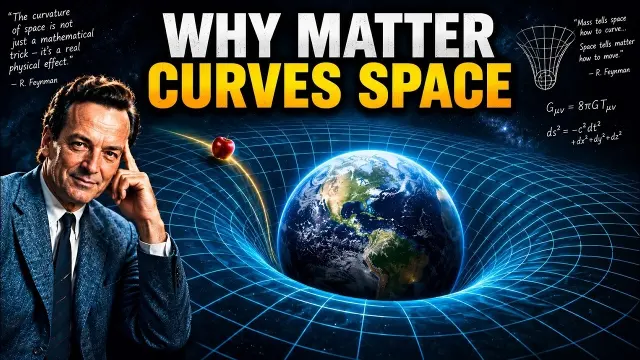 Feynman's Explanation of How Matter Curves Space and Time
Get new #General Relativity ideas by email
Every Thursday: the week's best ideas, with the newest from #General Relativity.
Related tags
General Relativity: A Beginner's Guide to Curved Spacetime
General relativity is the modern theory of gravity. Instead of treating gravity as a force that reaches across space to pull objects together, it describes gravity as the shape of space and time themselves. Mass and energy bend the geometry of the universe, and everything else — planets, light, falling apples, clocks — simply follows the curves it finds.
An idea that begins with a simple question
The theory grew out of something anyone can wonder about: what does a falling person actually feel? Someone in free fall feels weightless. Someone standing on the ground feels pressed against it. From this ordinary observation comes the equivalence principle — locally, being at rest in a gravitational field is indistinguishable from accelerating. Follow that thought patiently and you are pushed toward surprising conclusions: light must bend near massive bodies, and gravity cannot be a force in the ordinary sense at all. Space and time have to become flexible, and describing that flexibility requires a considerable amount of geometry.
Spacetime tells matter how to move
Read more
The heart of the theory is a dialogue between two things: matter and geometry. Matter and energy curve spacetime; the curvature, in turn, tells matter how to move. Objects in free fall take the straightest available path through curved spacetime, and near a star that straightest path looks to us like an orbit. There is no additional tug — the motion is a consequence of the shape of the stage.
What the theory describes
- Light bends around massive objects, so distant galaxies can appear magnified, stretched or shown more than once.
- Clocks run at slightly different rates depending on where they sit in a gravitational field.
- Matter can collapse into black holes, regions where spacetime curves so steeply that nothing escapes.
- Accelerating masses send ripples through spacetime itself, known as gravitational waves.
- Applied to the universe as a whole, the theory supplies the framework for cosmology.
If you want to learn it
Begin with special relativity, because the vocabulary of spacetime, reference frames and invariants comes from there. Then build the mathematical tools: calculus, linear algebra, and afterwards differential geometry — manifolds, the metric, curvature, tensors. The physics is not harder than the mathematics; most people struggle because they meet both at once.
Practical tips
- Keep the equivalence principle as your anchor. When an equation confuses you, ask what a freely falling observer would see.
- Draw light cones. Sketching causality makes abstract statements concrete.
- Check every result against Newtonian gravity in the weak-field, slow-motion limit. If it does not reduce to the old theory where the old theory works, something is wrong.
- Be patient with index notation and tensor algebra. Fluency comes from working examples, not from reading them.
- Read more than one exposition. Different authors unlock different parts of the subject.
You do not need to master the full mathematics to appreciate the idea. What general relativity asks of you is a willingness to give up a comfortable picture — gravity as a pull — in exchange for a stranger and more elegant one: a universe whose geometry is shaped by what it contains.
#General Relativity: frequently asked questions
What is general relativity in plain terms?
It is the modern description of gravity, and it replaces the image of a pull acting across space with the idea that space and time themselves bend around mass and energy. Objects then move along the straightest paths available in that curved geometry, which is why an orbit looks like a curve to us. In this picture gravity is not a force being transmitted but a property of the stage everything moves on.
How should a complete beginner start learning general relativity?
Start with special relativity, because the language of spacetime, reference frames and invariants is introduced there and everything later builds on it. Only once those ideas feel natural should you move on to the geometry of curved spacetime. Trying to absorb the physics and the mathematics at the same moment is the most common reason people get stuck.
What background do I need before tackling the theory?
You need calculus and linear algebra first, and after that the tools of differential geometry: manifolds, the metric, curvature and tensors. The physics itself is usually not the harder half — it is the collision of new physics and new mathematics at the same time that overwhelms people. Building the maths separately makes the theory far more approachable.
Do I have to master all the mathematics to appreciate general relativity?
No. You can follow the central idea — that what the universe contains determines its geometry, and that geometry in turn guides how things move — without working through the full formalism. What the subject really asks of you is a willingness to abandon the comfortable picture of gravity as a pull. The mathematics deepens that idea, but it is not a prerequisite for grasping it.
What mistakes should I avoid when studying it?
The frequent one is losing sight of the equivalence principle, so keep asking what a freely falling observer would experience whenever an equation stops making sense. Another is reading without drawing — sketching light cones and causal relationships turns abstract statements into something you can see. Finally, always check a result against the older Newtonian description in the weak-field, slow-motion case; if it does not reduce to it, something has gone wrong.
What kinds of things does the theory actually explain?
It accounts for light bending near massive objects, which can make distant galaxies appear magnified, stretched or repeated. It predicts that clocks tick at slightly different rates depending on where they sit in a gravitational field, and that matter can collapse into black holes from which nothing escapes. It also describes ripples in spacetime produced by accelerating masses, and it supplies the framework used to study the universe as a whole.
Videos come from YouTube and posts from Instagram; titles and summaries are our own. All rights belong to their creators.