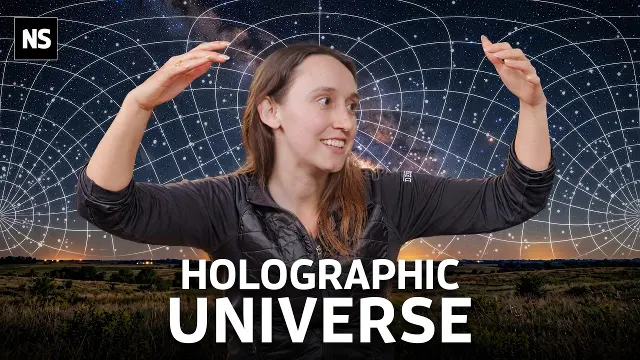
 Sabrina Pasterski on Celestial Holography and Unifying Physics
#Celestial Holography
1 ideas
Sabrina Pasterski on Celestial Holography and Unifying Physics
Get new #Celestial Holography ideas by email
Every Thursday: the week's best ideas, with the newest from #Celestial Holography.
Related tags
Celestial Holography: Flat Space as a Hologram
Celestial holography is a research programme in theoretical physics that proposes a surprising equivalence: the physics of particles flying through empty, flat space can be rewritten as a theory living on the sphere of directions around an observer. Every direction you could look in becomes a point on that sphere, and every scattering event becomes a correlation between points. The ambition is a dictionary, one entry at a time, between ordinary particle physics and a two-dimensional conformal field theory on the celestial sphere.
Where the idea comes from
The idea grows out of the holographic principle, the insight that the contents of a region of space can sometimes be encoded on its boundary rather than in its bulk. That principle found its sharpest form in Anti-de Sitter space, where a gravitational theory in the interior is conjectured to match a conformal field theory on the boundary. Flat space, however, has no such convenient wall. What it does have is null infinity: the far-away surface that light rays eventually reach. Celestial holography treats that surface, and the sphere of directions it carries, as the boundary where the dual theory lives.
The main tools
Read more
The translation between the two descriptions is a change of basis. A particle's momentum is replaced by a point on the celestial sphere together with a scaling weight, a transformation known in the subject as a Mellin transform. States labelled this way are called conformal primary states.
A second thread is symmetry. Flat space at infinity admits an infinite family of asymptotic symmetries, larger than the ordinary Poincaré group — the BMS group, named for the researchers who first described it. Its generators include supertranslations and superrotations, and they act on the celestial sphere much as conformal transformations do. Many familiar results in scattering theory, the soft theorems that describe what happens when a particle carries almost no energy, turn out to be the shadow of these symmetries rather than accidents of calculation. The same reasoning connects to gravitational memory, the permanent displacement left in a detector after a wave passes.
What to keep in mind
Celestial holography is not a settled theory but a set of interlocking conjectures, some proven in simple settings and others open. If you approach it, the prerequisites are real: quantum field theory, general relativity, and enough conformal field theory to be comfortable with weights, operator products and the meaning of a two-dimensional symmetry algebra. The spin-weighted spherical harmonics used to expand fields of nonzero spin are worth learning early, because they appear everywhere.
Read the introductory reviews before the technical papers, and expect the notation to differ between schools. Ask of any statement which symmetry is doing the work, and whether it holds for gravity, for gauge theory, or only for the simplest toy models. Progress in this field has come from small, careful dictionaries, so patience with conventions pays off more than speed.
Videos come from YouTube and posts from Instagram; titles and summaries are our own. All rights belong to their creators.