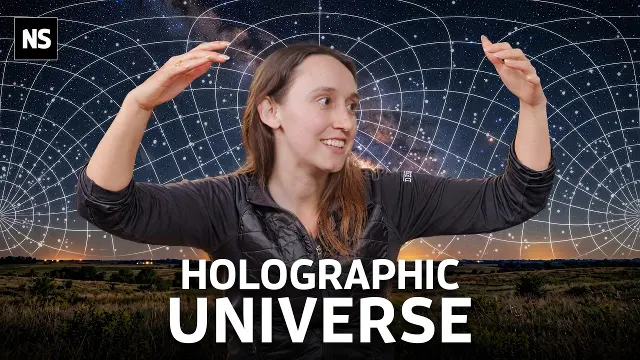
 Sabrina Pasterski on Celestial Holography and Unifying Physics
#Quantum Gravity
1 ideas
Sabrina Pasterski on Celestial Holography and Unifying Physics
Get new #Quantum Gravity ideas by email
Every Thursday: the week's best ideas, with the newest from #Quantum Gravity.
Related tags
Quantum Gravity: Where Physics Meets the Very Small
Quantum gravity is the name for the attempt to describe gravity using the same rules that govern everything else in physics. It is one of the most stubborn open problems in science, and also one of the most inviting: you need very little mathematics to understand what the question actually is, only patience.
Two theories that each work
Modern physics rests on two extraordinarily successful frameworks. General relativity describes gravity as the shape of space and time, curved by energy and matter. Quantum mechanics, and the quantum field theories built on it, describe the other forces and the behaviour of particles with remarkable precision. Each is tested constantly, and each keeps passing.
The trouble is that they are built on incompatible assumptions. In quantum theory, quantities are uncertain and outcomes are probabilities; in general relativity, spacetime is smooth and definite. When you try to apply quantum rules to gravity itself, the calculations stop making sense and the answers come out infinite. That failure is not a minor technical nuisance — it tells you something in the picture is missing.
Read more
Why it matters
Most of the time the mismatch is invisible, because gravity is fantastically weak and quantum effects stay confined to tiny scales. But there are places where both are unavoidable: the interior of a black hole, and the earliest moments of the universe. A theory of quantum gravity is what you would need in order to say anything sensible about them. It might also explain why gravity is so much weaker than the other forces, and whether space is genuinely continuous or built from something smaller.
The main approaches
- String theory replaces point particles with extended objects, and asks for extra dimensions of space to stay consistent.
- Loop quantum gravity keeps the framework of relativity but quantises space itself, arriving at a discrete, grainy geometry.
- Holography suggests that everything inside a region of space can be described by information on its boundary.
- Causal set theory treats spacetime as a network of events linked by cause and effect.
- Asymptotic safety asks whether gravity simply becomes well-behaved at very short distances, without any new ingredients at all.
These programmes differ in temperament and ambition, and none has been confirmed by experiment.
What beginners should know
Start with the question rather than the formalism. A solid grasp of general relativity and quantum mechanics at undergraduate level will do more for you than skimming popular accounts of five rival theories. Read critically: the field holds many promising ideas and no settled answer, so treat confident claims with polite scepticism.
- Learn what a quantum field is before asking what quantising gravity means.
- Expect mathematics: differential geometry and group theory appear everywhere.
- Follow the arguments rather than the personalities.
A final word
Quantum gravity rewards curiosity more than speed. You are joining a conversation that has run for generations, and the honest position — that nobody yet knows the answer — is shared by everyone taking part in it.
#Quantum Gravity: frequently asked questions
How should a complete beginner start learning quantum gravity?
Begin with the question itself rather than with any theory's machinery: what happens when you try to apply quantum rules to the geometry of spacetime? Once that puzzle is clear in your head, the technical apparatus has somewhere to attach. Patience matters far more than early speed here.
What background do I actually need before tackling quantum gravity?
A working undergraduate grasp of general relativity and quantum mechanics will carry you much further than a shelf of popular science books. Before asking what it means to quantise gravity, make sure you genuinely understand what a quantum field is. Expect to meet differential geometry and group theory along the way, since they show up in essentially every approach.
Which approach to quantum gravity is the right one to study?
There is no right one yet — string theory, loop quantum gravity, holography, causal set theory and asymptotic safety all remain unconfirmed by experiment, so the choice is largely about temperament and ambition. A reasonable strategy is to learn the shared problem thoroughly first, then explore the programmes whose methods suit how you like to think. Many researchers work across more than one.
Do I have to commit to a single theory of quantum gravity?
No, and committing too early tends to narrow your thinking rather than sharpen it. The field holds many promising ideas and no settled answer, so the more useful skill is being able to follow an argument on its own merits. Treat confident claims from any camp with polite scepticism.
What mistakes do people new to quantum gravity commonly make?
The most frequent is skimming popular accounts of several rival theories and mistaking familiarity with their names for understanding the problem. Another is following personalities rather than arguments, which makes it hard to notice when a claim is unsupported. It also helps to stop expecting a quick resolution — the honest position that nobody yet knows the answer is shared by everyone working on it.
Why can't gravity simply be quantised the way the other forces were?
General relativity treats spacetime as smooth and definite, while quantum theory deals in uncertainty and probabilities, and the two assumptions do not fit together. When quantum rules are applied to gravity itself, the calculations stop producing sensible answers and return infinities instead. That breakdown is a signal that something in the picture is missing, not a technicality to be patched over.
Videos come from YouTube and posts from Instagram; titles and summaries are our own. All rights belong to their creators.