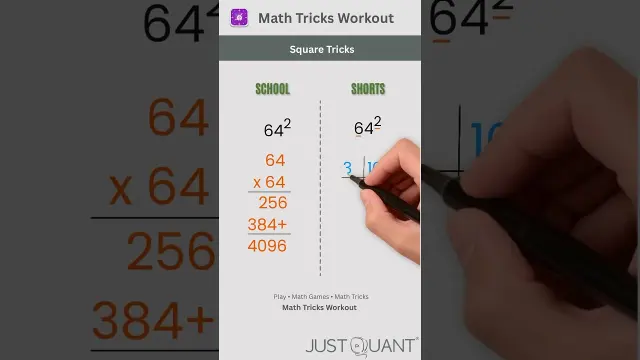
 Fast Mental Math Trick for Squaring Two Digit Numbers
#Squaring Numbers
1 ideas
Fast Mental Math Trick for Squaring Two Digit Numbers
Get new #Squaring Numbers ideas by email
Every Thursday: the week's best ideas, with the newest from #Squaring Numbers.
Related tags
Squaring Numbers: A Simple Guide
Squaring a number means multiplying it by itself. In other words, the square of 7 is 7 × 7, and the square of 12 is 12 × 12. It is one of the most basic ideas in arithmetic, and it appears often in algebra, geometry, measurement, and everyday problem-solving. Squares help you understand area, patterns, and how numbers grow.
What squaring means
When you square a number, you are finding the area of a square whose side length is that number. That is why squaring is closely connected to geometry. The idea works with whole numbers, fractions, decimals, and even negative numbers. For example, the square of a negative number is positive, because a negative times a negative gives a positive.
You may also see squares written with a small 2, as in 5². This means 5 multiplied by itself. The result is called a perfect square when it comes from squaring a whole number.
Read more
Why it is useful
Squaring numbers helps in many places:
- Finding the area of squares and other shapes
- Working with formulas in algebra
- Comparing how values change when they are multiplied by themselves
- Recognizing number patterns and relationships
It is also useful for mental math. If you can square small numbers quickly, it becomes easier to estimate, check answers, and work with larger calculations.
Simple ways to square numbers
For small numbers, direct multiplication is often easiest. For example, 6² is 6 × 6 = 36. With practice, many squares become familiar and easy to remember.
For numbers near a round number, you can use nearby values to help:
- 11² = 121
- 12² = 144
- 15² = 225
You can also use the idea of expanding a number around a familiar base. For example, 13² can be thought of as (10 + 3)², which helps break the calculation into smaller parts. This kind of approach is especially useful when you want to do the work in your head.
Things to remember
A few habits make squaring easier and less confusing:
- Check whether you are multiplying the number by itself, not by two
- Remember that a negative number squared becomes positive
- Keep your place value careful when working with larger numbers
- Learn the squares of numbers from 1 to 20 if you can, since they come up often
A good way to practice
The best way to get comfortable with squaring numbers is steady practice. Start with small whole numbers, then move on to two-digit numbers, decimals, and fractions. Try to notice patterns, such as how the square of a number changes when the number increases by 1. With time, squaring becomes less of a separate calculation and more of a familiar mental skill.
Videos come from YouTube and posts from Instagram; titles and summaries are our own. All rights belong to their creators.