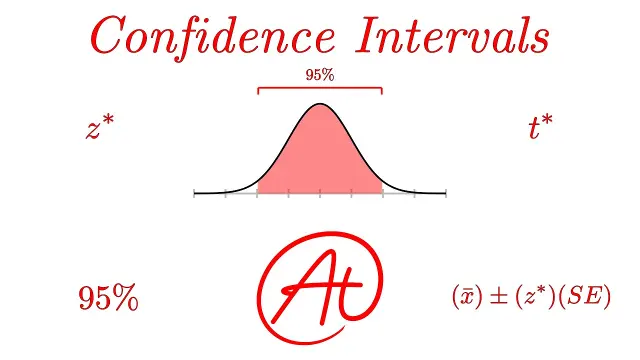
 Confidence Intervals Explained: The General Formula
#Standard Error
3 ideas
Confidence Intervals Explained: The General Formula
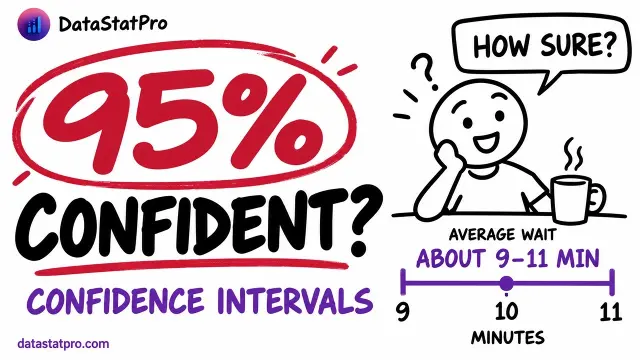 Confidence Intervals Explained With a Cafe Waiting-Time Example
 Statistical Inference Standard Error Problems
Get new #Standard Error ideas by email
Every Thursday: the week's best ideas, with the newest from #Standard Error.
Related tags
Standard Error Explained
Standard error is a way of describing how much a sample statistic is likely to vary from sample to sample. You will most often meet it in statistics, where it helps you understand how precise an estimate is. If you take many samples from the same population, the results will not be exactly the same each time. The standard error gives you a sense of that natural variation.
What standard error means
In simple terms, standard error measures the uncertainty around an estimate such as a mean, proportion, or regression coefficient. A small standard error suggests that the estimate is fairly stable across repeated samples. A larger standard error suggests more variation and less precision.
It is important to know that standard error is not the same as standard deviation. Standard deviation describes how spread out individual data points are within a sample or population. Standard error describes how spread out sample statistics are likely to be across repeated samples.
Read more
Why it matters
Standard error is used to judge how reliable a sample result may be. It appears in confidence intervals, hypothesis tests, and many forms of statistical reporting. When you see a mean with a small standard error, you can usually be more confident that the sample mean is close to the true population mean, although it still does not guarantee it.
In practical work, standard error helps you compare groups, assess estimates, and understand whether an observed difference may be meaningful or simply due to sampling variation.
Common kinds of standard error
You may see different forms depending on what is being measured:
- Standard error of the mean, for sample averages
- Standard error of a proportion, for percentage-based estimates
- Standard error of a regression coefficient, for values in a model
Each one follows the same basic idea: it describes the uncertainty in a sample-based estimate.
A simple way to think about it
Imagine repeatedly taking samples from a large group and calculating the average each time. Those averages will not match perfectly. The standard error describes how much those averages tend to differ from one another. The larger the sample, the less these averages usually vary, so the standard error tends to become smaller.
What to keep in mind
If you are new to statistics, it helps to remember a few basics:
- Standard error is about estimates, not individual observations
- Smaller standard error usually means greater precision
- It depends on sample size and data variability
- It should be interpreted together with the context of the data
Practical use
When reading statistical results, look at standard error alongside the estimate itself. A number on its own can be misleading, but an estimate with its standard error gives a clearer picture of how much trust to place in the result. If you are working with data, learning to read standard error will help you understand uncertainty more carefully and avoid over-interpreting small differences.
#Standard Error: frequently asked questions
What is standard error used for in statistics?
Standard error helps you understand how much a sample estimate may change if you repeated the study with new samples. It is useful for judging how precise an estimate is and how much confidence you should place in it.
How do I know which standard error to use?
Choose the version that matches the estimate you are working with, such as a mean, a proportion, or a regression coefficient. The goal is the same in each case: to describe the uncertainty around that specific sample-based result.
How is standard error different from standard deviation?
Standard deviation describes how spread out individual data points are within a dataset. Standard error describes how much a sample statistic, like an average, is likely to vary from one sample to another.
What affects standard error the most?
Standard error is influenced by how much variation is in the data and how large the sample is. In general, more data tends to give a more stable estimate and a smaller standard error.
How should I interpret a small standard error?
A small standard error usually means the estimate is fairly consistent across repeated samples. That suggests greater precision, though it still does not prove the estimate is exactly correct.
What are common mistakes people make with standard error?
One common mistake is treating standard error as if it were the same as standard deviation. Another is reading it in isolation instead of alongside the estimate and the context of the data.
Videos come from YouTube and posts from Instagram; titles and summaries are our own. All rights belong to their creators.