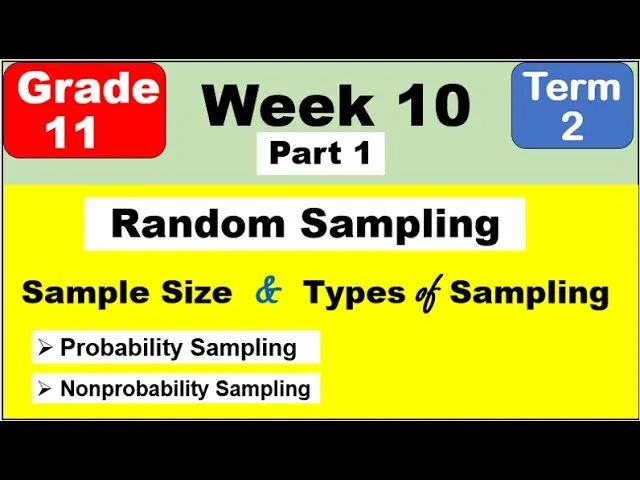
 Grade 11 General Math Lesson on Random Sampling and Sample Size
#Sample Size
4 ideas
Grade 11 General Math Lesson on Random Sampling and Sample Size
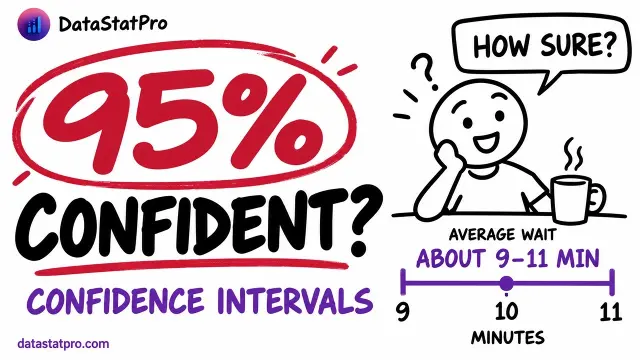 Confidence Intervals Explained With a Cafe Waiting-Time Example
 How Confidence Intervals Express Uncertainty in Business Data
 How to Determine Sample Size in Research
Get new #Sample Size ideas by email
Every Thursday: the week's best ideas, with the newest from #Sample Size.
Related tags
Sample Size: How Much Data Do You Really Need?
Sample size is simply the number of observations, people, transactions or measurements a study actually collects. It is the "n" in a research report, and it sits underneath everything else: the precision of an estimate, the credibility of a comparison, the cost and feasibility of the whole project. Choosing it deliberately is one of the first decisions in any investigation, whether the field is market research, product analytics, medicine, education or social science.
Why the number matters
A sample is a stand-in for a larger population you cannot fully measure. Because you only see part of that population, your result will differ somewhat from the truth, and the size of the sample governs how much of that difference you should expect. Larger samples generally produce estimates that vary less from one study to the next, which makes narrow conclusions possible. Small samples are not automatically wrong, but they leave more room for chance: a striking result drawn from a handful of cases may simply be noise.
The practical problem is that sample size trades off against everything else. Every additional participant or record costs time, money and effort, and some populations are genuinely hard to reach. The skill lies in finding the point where extra data stops buying meaningfully more certainty.
Read more
The main approaches
The formal route is a power analysis, usually done before data collection. You state the smallest effect you would care about detecting, the level of confidence you want, and the probability of detecting a real effect if it exists; the calculation then returns the sample size implied by those choices. Decisions made this way are defensible because the assumptions are visible.
The informal route relies on rules of thumb passed down within a discipline, or on the size of comparable published studies. These are convenient starting points but carry hidden assumptions, and they rarely explain what precision they buy.
Qualitative work uses a different logic entirely. Instead of estimating a quantity, researchers sample until new interviews or observations stop producing new themes, a point usually called saturation. It is judged rather than calculated.
What beginners should know
- Decide on the question first. Sample size cannot be chosen in isolation from what you are trying to estimate or compare.
- Be honest about how you will recruit. A plan that cannot be executed is not a plan; account for non-response and incomplete records.
- Keep sampling separate from sample size. A large sample collected in a biased way is still a biased sample; how you choose units matters as much as how many.
- Do not add data after the fact to chase a desired answer. Decide the stopping point in advance and record it.
- Report what you did. Readers can judge a study only if they know how many units were included, how they were selected, and what was missing.
Treat sample size as a design decision rather than an afterthought, and your conclusions will hold up far better when someone else looks closely at them.
#Sample Size: frequently asked questions
How do I decide on the right sample size for my study?
Start with the question you want to answer, then think about how precise you need the result to be and how much uncertainty you can tolerate. A good sample size balances those goals with the time and effort you can realistically spend collecting data.
What do I need to figure out before choosing a sample size?
You need a clear research question, a plan for how you will collect the data, and an idea of what kind of difference or pattern would actually matter to you. It also helps to think ahead about missing responses or incomplete records so your final sample does not end up smaller than planned.
Should I use a formula or a rule of thumb to choose sample size?
A formula-based approach is usually better when you want a defensible choice, because it ties the sample size to your goal and expected uncertainty. Rules of thumb can be useful as a starting point, but they may hide assumptions that do not fit your study.
How does sample size affect the quality of my results?
In general, a larger sample gives you results that are less likely to swing wildly from one study to the next. A smaller sample can still be useful, but it leaves more room for chance to influence what you see.
What are the most common mistakes people make with sample size?
One common mistake is picking a number before defining the question, which makes the study harder to interpret. Another is collecting data in a biased way or changing the stopping point after looking at results, which can weaken the credibility of the findings.
Videos come from YouTube and posts from Instagram; titles and summaries are our own. All rights belong to their creators.