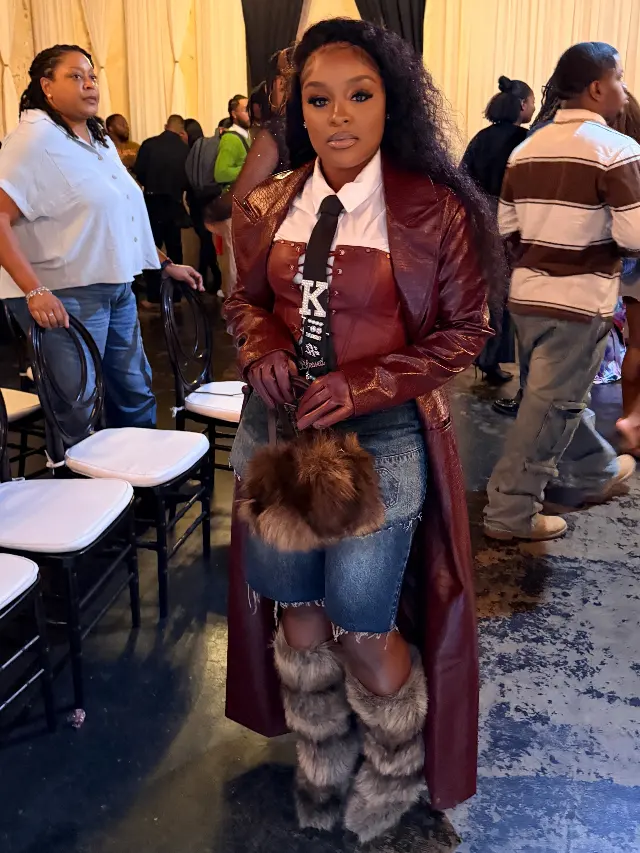
 Fashion Show Look Styled for an Event Appearance
#Statement Outfit
1 ideas
Fashion Show Look Styled for an Event Appearance
Get new #Statement Outfit ideas by email
Every Thursday: the week's best ideas, with the newest from #Statement Outfit.
Related tags
Statement Outfit: How to Wear One Bold Look Well
A statement outfit is a look built around a single piece that does the talking. It might be a coat in a colour you would not normally reach for, a jacket with an exaggerated shoulder, a dress in a loud print, or an accessory large enough to be noticed from across a room. The rest of the outfit steps back so that the one element can be seen properly. What separates a statement outfit from simply wearing something unusual is intention: the bold piece is chosen, and everything else is arranged around it.
The idea has a long history in dress. Court dress, ceremonial uniforms and theatrical costume have always used scale, colour and ornament to make a wearer visible. In everyday clothing the same principle appears whenever someone chooses one striking garment and keeps the rest quiet, and it has been revived repeatedly by designers interested in silhouette and colour rather than decoration for its own sake.
Kinds of statement pieces
Almost any category can carry the role. Colour statements rely on a single saturated hue against neutrals. Shape statements use volume, an unusual cut or a strong shoulder. Print statements let pattern do the work. Material statements depend on texture that catches light or moves in a particular way, such as heavy satin, crisp taffeta or dense knitwear. Accessory statements work through scale, finish or an unexpected detail. The common thread is that one element is clearly the loudest, and the wearer knows it.
Read more
Building the rest of the look
The supporting pieces should be simple, well fitting and calm in colour. Neutral trousers, a plain knit, a straightforward shoe. This is not a rule about being boring; it is about giving the eye somewhere to rest. Repetition helps too: echoing one colour from the statement piece in a small detail ties the outfit together without competing with it.
Proportion matters more than people expect. A voluminous top usually wants a slimmer lower half, and the reverse. A very long coat reads differently with a cropped trouser than with a full skirt. Trying the combination in a mirror, sitting down in it, and walking a few steps will tell you more than looking at it on a hanger.
Practical advice for beginners
Start with one piece you already love and build around it rather than buying a whole new outfit. Wear it somewhere low-stakes first, such as a weekend lunch, so you get used to how it feels before an important occasion. Check the practicalities: can you sit, drive, climb stairs and carry a bag comfortably. Consider the setting, since a statement outfit at a formal event and one at a casual gathering read very differently.
Fit is what makes bold clothing look deliberate rather than accidental, so budget for alterations if a piece is close but not quite right. And keep the finishing simple: a single strong element plus good grooming often looks more considered than several competing ones. Above all, wear the piece rather than letting it wear you; confidence comes from familiarity, which is why the outfits that work best are usually the ones worn more than once.
#Statement Outfit: frequently asked questions
How do I start building a statement outfit if I don't want to buy a whole new wardrobe?
Begin with a single piece you already own and genuinely love, then arrange calm, well-fitting basics around it. Wear the look somewhere low-pressure first so you get used to how it feels before a big occasion. Starting from something familiar keeps the outfit grounded and saves you from a rushed, costly shopping spree.
What actually makes an outfit a statement outfit rather than just something unusual?
It comes down to intention: one piece is deliberately chosen to carry the attention, and everything else is quieted so that piece can be seen. Without that arrangement, bold items compete and the effect turns muddled. The wearer should know exactly which element is the loudest before leaving the house.
Which kind of statement piece should I choose — colour, shape, print, material or accessory?
Pick the category that suits what you naturally reach for and where you are going: a saturated colour against neutrals, a strong shoulder or volume, a bold pattern, a texture like satin or taffeta, or an oversized accessory. Consider how the piece behaves when you sit, walk and move, since that matters more than how it looks on a hanger. One clear loud element is enough; several competing ones tend to cancel each other out.
How do I keep the rest of the outfit from fighting with the statement piece?
Keep the supporting pieces simple, quietly coloured and properly fitted, such as neutral trousers, a plain knit and a straightforward shoe. Echoing a small detail of the statement piece, like a single colour, ties the look together without competing for attention. Letting the eye rest is what makes the bold element read as deliberate.
How should I care for and get the most out of a statement piece?
Treat it as a piece you will wear repeatedly rather than once, so follow the care label and store it in a way that protects its shape, especially for structured or textured fabrics. If the fit is close but not quite right, allowances for alterations make bold clothing look intentional. Familiarity built through repeat wear is also what gives the confidence the outfit needs.
What are the most common mistakes people make with statement outfits?
The usual slips are wearing several loud elements at once, ignoring proportion so volume sits where it flattens the silhouette, and forgetting practicalities like sitting, stairs or carrying a bag. Another is choosing a piece for a setting it does not suit, since the same outfit reads very differently at a formal event and a casual gathering. Trying the full look in a mirror and moving around in it catches most of these before anyone else does.
Videos come from YouTube and posts from Instagram; titles and summaries are our own. All rights belong to their creators.