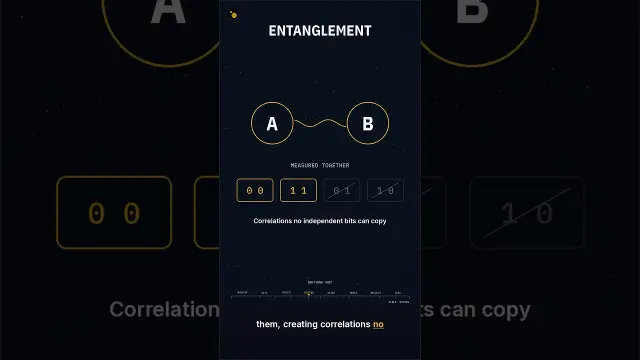
 How Quantum Computers Use Interference to Cancel Wrong Answers
#Superposition
2 ideas
How Quantum Computers Use Interference to Cancel Wrong Answers
 Hadamard and CNOT Gates Explained by IBM's Olivia Lanes
Get new #Superposition ideas by email
Every Thursday: the week's best ideas, with the newest from #Superposition.
Related tags
Superposition: What It Means for a Quantum System
Superposition is one of the foundational ideas of quantum physics, and one of the easiest to misread. At its simplest, it says that a quantum system does not have to settle on a single definite state before you look at it. It can exist in a combination of possibilities, each with its own weight, and those possibilities behave like waves that can reinforce or cancel one another.
Where the idea comes from
The concept grows out of the wave nature of matter. When a particle travels, it is described not by a single position but by a wave that spreads through space, and where that wave is large the particle is likely to be found, where it is small, unlikely. Because waves add together, two possible paths can overlap and produce a pattern of high and low probability. This is the everyday sense in which a quantum object is "in superposition": its state is a sum of alternatives, not a choice between them.
What measurement does
Read more
The superposition does not usually survive being observed. Interact with the system in a way that reveals which alternative it took, and you get one definite outcome, with probabilities set by the weights in the original combination. The interference pattern disappears. Physicists describe this as the state collapsing onto a single result. It is not magic and it is not about a conscious observer; it is about the system becoming entangled with its surroundings, which leaks away the delicate phase relationship between the alternatives.
That leaking is called decoherence, and it is why superpositions are so hard to keep. Any stray vibration, heat, or electromagnetic noise can destroy them. Laboratories therefore work at very low temperatures and with heavy shielding.
Superposition in quantum computing
A classical bit is either zero or one. A quantum bit, or qubit, can be in a superposition of both, described by two amplitudes. A common first step in a quantum circuit is a gate that puts a qubit resting in one state into an equal blend of both, which is the starting point for most quantum algorithms. Two qubits in superposition together can hold four weighted combinations, and the count grows quickly with each added qubit.
The power does not come from trying every answer at once, which is a popular but misleading shortcut. It comes from arranging the amplitudes so that wrong answers cancel out through interference while the right one adds up, then measuring. Designing that arrangement is the hard part, and it is why only a handful of problems have clear quantum advantage.
If you are just starting out
- Treat the amplitudes as weights, not as "the particle is secretly in one place".
- Remember that superposition is always relative to a chosen measurement; a state definite in one basis is a blend in another.
- Keep the wave picture in mind: adding and cancelling is the whole story.
- Expect decoherence to be the practical enemy in any real experiment.
Superposition rewards patience. Once the wave intuition settles in, much of quantum mechanics stops looking strange and starts looking like ordinary arithmetic with unfamiliar rules.
#Superposition: frequently asked questions
What does superposition actually mean, in plain terms?
It means a quantum system does not have to pick one definite state before it is examined; it can sit in a blend of several possibilities, each carrying a different weight. Those possibilities behave like waves, so they can reinforce or cancel each other rather than simply adding up. The blend is always relative to how you choose to measure, so a state that looks definite one way can look mixed another way.
Do I need a laboratory to start learning about superposition?
No. The fastest way in is to get comfortable with the wave picture, treating the amplitudes as weights rather than imagining a particle secretly hiding in one spot. From there, work through how waves add and cancel, since that single idea explains almost everything else. Real experiments do require extreme cold and heavy shielding, but understanding the concept does not.
Why does the superposition vanish as soon as it is measured?
Once the system interacts with anything that could reveal which alternative it took, you get one outcome, chosen with odds set by the original weights, and the interference pattern is gone. The usual description is that the state collapses onto that result. The underlying cause is entanglement with the surroundings, which destroys the fragile phase relationship between the alternatives.
What makes superpositions so difficult to preserve?
Any stray vibration, warmth, or electromagnetic noise leaks the delicate phase relationship away, a process called decoherence. That is why careful setups rely on very low temperatures and extensive shielding. In practice, decoherence is the enemy to plan around in any real attempt to keep a quantum state intact.
Does a quantum computer really test every possible answer at once?
That is a popular shorthand, but it misleads. The advantage comes from arranging the amplitudes so wrong answers cancel through interference while the correct one builds up, and only then measuring. Getting that arrangement right is the genuinely difficult part, which is why clear quantum advantage remains limited to a small set of problems.
What are the most common beginner mistakes with superposition?
The biggest one is treating amplitudes as if the particle were secretly in one definite place all along. Another is forgetting that superposition depends on the chosen measurement basis. Keeping the wave picture in view and expecting decoherence to interfere with real experiments will save a lot of confusion.
Videos come from YouTube and posts from Instagram; titles and summaries are our own. All rights belong to their creators.