 Thermal Energy Notes: Conduction, Convection and Radiation
#Thermal Energy
1 ideas
Thermal Energy Notes: Conduction, Convection and Radiation
Get new #Thermal Energy ideas by email
Every Thursday: the week's best ideas, with the newest from #Thermal Energy.
Related tags
Thermal Energy: Heat, Temperature and How It Moves
What thermal energy is
Everything around you is made of particles that are never still. They vibrate, spin and collide, and that restless motion is what we call thermal energy: the total movement energy stored inside a substance. Warm something up and its particles move faster; cool it down and they slow.
Two things decide how much thermal energy an object holds: how fast its particles are moving, and how many particles there are. That second half is easy to forget. A whole bathtub of lukewarm water holds far more thermal energy than a single drop of boiling water, simply because it contains vastly more particles.
Temperature and heat are not the same word
Read more
Temperature is an average. It tells you how fast the particles in a substance are moving on average, not how much energy is stored there. Two objects at the same temperature can hold very different amounts of thermal energy depending on their size and what they are made of.
Heat is different again: it is energy on the move. Heat is what flows from a warmer object to a cooler one whenever the two are in contact. It always travels in that direction, from hot towards cold, and it keeps going until both reach the same temperature.
The three routes heat takes
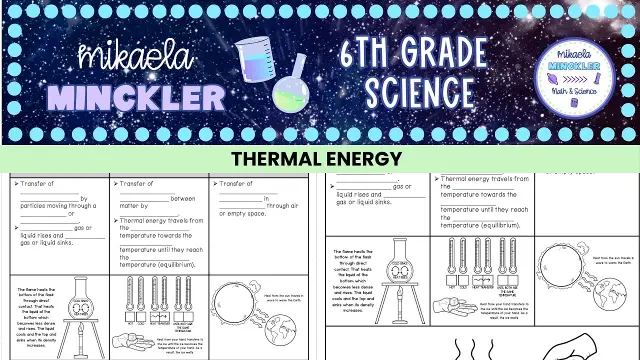
- Conduction happens through direct contact. Fast-moving particles jostle their slower neighbours and pass the motion along. Metals carry heat this way very well, which is why a metal spoon left in a hot pan becomes uncomfortably warm.
- Convection happens in liquids and gases. Warm fluid expands, becomes less dense and rises, while cooler fluid sinks to take its place. These looping currents are what heat a room from a radiator or stir a pot of soup.
- Radiation needs no material at all. Warm objects give off infrared radiation, which travels through empty space. This is how the sun's warmth reaches us across the vacuum.
Most real situations use more than one. A campfire warms your face by radiation, the air above it by convection, and the ground beneath it by conduction.
Useful things to know
Insulation works by slowing all three routes: trapping air to limit convection, using poor conductors to limit conduction, and adding reflective surfaces to limit radiation. A vacuum flask is the classic example, tackling each one in turn.
Melting and boiling are worth understanding too. While ice is turning to water, or water to steam, the temperature stays put even though energy keeps going in. That energy is being spent on loosening the bonds between particles rather than speeding them up.
Two common misunderstandings are easy to clear up. First, cold does not flow into things; heat flows out of them, and we simply describe the result as feeling cold. Second, metal and wood at the same temperature feel different because metal draws heat away from your skin faster, not because it is colder.
Once you notice conduction, convection and radiation in your kitchen, your home and the weather outside, thermal energy stops being an abstract idea and becomes something you can see working everywhere.
#Thermal Energy: frequently asked questions
What is the difference between heat and temperature?
Temperature is an average: it tells you how fast the particles in something are moving on average, not how much energy is stored there. Heat is energy on the move, flowing from a warmer object to a cooler one on contact until both settle at the same temperature. Two things at the same temperature can hold very different amounts of thermal energy depending on their size and what they are made of.
Why does a metal spoon feel colder than a wooden one when both are at room temperature?
They are actually at the same temperature — the difference is how quickly each one draws heat out of your skin. Metal carries heat away by conduction far faster, so your fingers register that loss as cold, while wood barely pulls heat at all.
How does insulation actually keep things warm?
Insulation slows all the routes heat uses to escape: it traps air to hold back convection, uses poor conductors to restrict conduction, and adds reflective surfaces to cut down radiation. A vacuum flask is the classic case, tackling each route in turn. The same thinking works for keeping a casserole warm or draughts out of a room.
Why does the temperature stay the same while ice melts?
Energy is still going in, but it is being spent loosening the bonds between particles rather than speeding them up. Since temperature only measures how fast particles move on average, it holds steady through the change. The same thing happens while water turns to steam.
Does cold flow into things, or does heat flow out?
Heat flows out — cold is not a substance that seeps in, it is simply what we call the result when warmth leaves. Your drink cools because its thermal energy moves into the surrounding air and the glass, not because cold enters it. Once you notice conduction, convection and radiation working around your kitchen and home, this becomes much easier to picture.
Videos come from YouTube and posts from Instagram; titles and summaries are our own. All rights belong to their creators.